
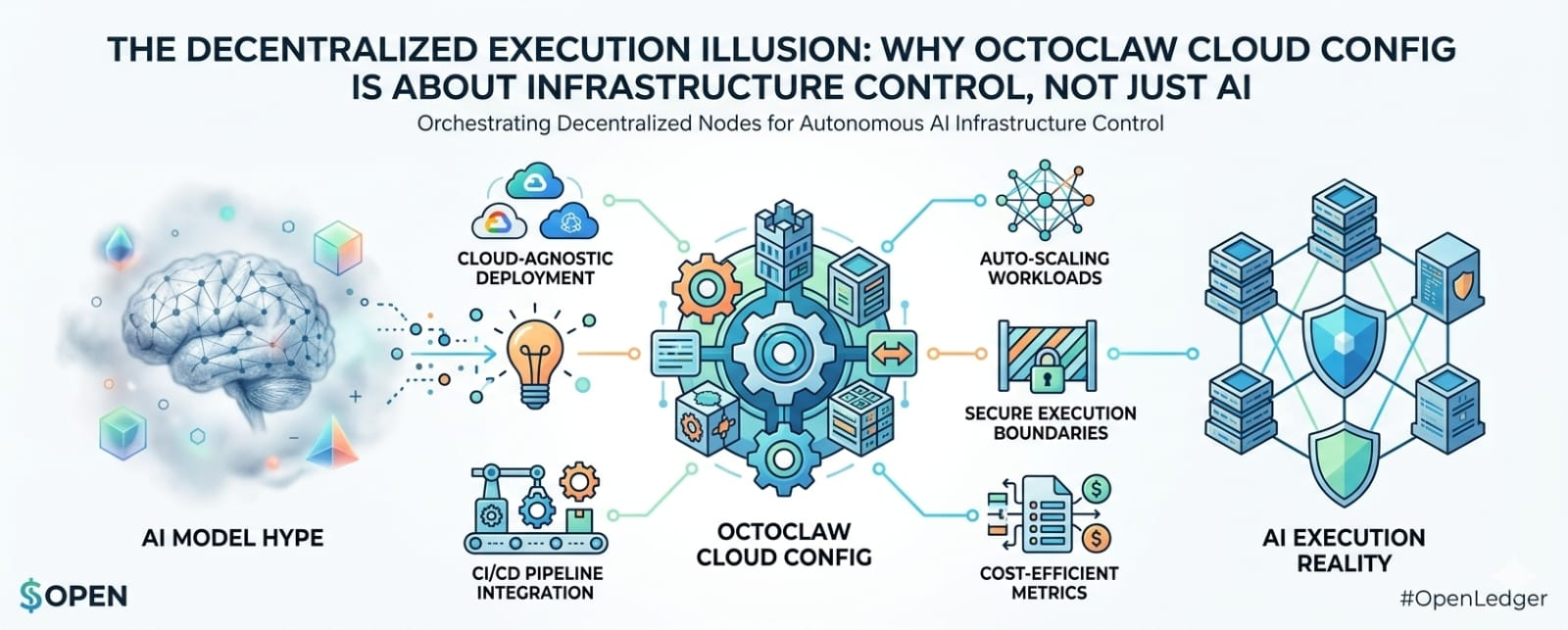
Sometimes I think most people still don’t understand how important “execution data” is going to be in the world of autonomous AI.
If I had to say it from the bottom of my heart, it’s because the whole discussion is still stuck on the model. Which model has a faster response rate, which agent makes better semantic connections, which company has raised more venture capital. But underneath, something much deeper is happening…. and that’s probably architectural attribution. Who actually controls the telemetry and the active conduits when an AI agent interfaces with the real world? And honestly, the more I look at the OpenLedger Trading Agent architecture, the more it seems like they’re not just creating another automated script. They’re actually trying to redefine the relationship between machine labor and data infrastructure.
It sounds big. Maybe even extra big I mean something absolutely massive. And it might take a few more cycles for people to understand whether this decentralized system will actually work at scale under heavy network stress. Yet…. there’s something different here at the structural level. Because traditionally, AI agents absorb vast streams of real-time telemetry, market feeds, and human adjustments but once the execution becomes highly valuable, the underlying data pipelines are completely obscured from the engineers who rely on them.
The machine executes tasks.
The infrastructure hides value.
This imbalance has been there for many years.
And to be honest, this is where OpenLedger's focus on the Machine Economy starts to sound interesting to me. Not for branding. Honestly, crypto projects launch new autonomous bots almost every week. But since the technical frameworks moved into live execution, the discussion has shifted from predictive theory to economic reality. Now the Trading Agent layer is no longer just a conceptual drawing. Developers can deploy specialized agents, integrate them directly through standard API pathways, and watch them interact across ecosystems while smart contracts manage execution metrics on-chain. It changes the psychological structure of development.
Suddenly, an API integration is no longer just a passive pipe.
It becomes traceable digital labor.
And I think this distinction is more important than people think. Especially after looking closely at how these agents handle multi-layered data feeds. The architecture relies on feeding real-time telemetry directly into a distributed decision engine. If a specific API source or data feed goes dark, or if a minor node intentionally provides skewed metrics, the performance drops instantly. By tracking these performance shifts at the granular level, the framework attempts to mathematically attribute which data streams actually drove a successful execution. Because mapping collective output to an opaque web of external APIs is an uncomfortable engineering hurdle.
Outputs are collective.
Telemetry is blurred.
Almost anonymous.
So trying to isolate the exact value contribution of a single API trigger within a massive multi-agent loop… is actually a hugely ambitious infrastructure problem. And maybe imperfect. I don’t think machine coordination will ever be completely mathematically pure. Still, trying to at least create a transparent execution layer seems like a different shift from where the industry was going. Most platforms optimize simple extraction. OpenLedger is at least trying to optimize execution accountability. Or at least going in that direction.
And here's another thing I keep thinking about... the user experience for the people actually building this stuff. When you look at a futuristic UI mockup showing real-time telemetry, data feeds, and execution pathways glowing on a screen, it looks incredibly polished. But in the practical world, enterprises and developers aren't looking at pretty graphics. They are asking hard questions:
Can this telemetry be verified ?
Is the API pipeline secure ?
How does the agent handle execution friction ?
Will the system remain stable under stress ?
And this could change the entire dynamics of the automated machine ecosystem. Looking at OpenLedger's approach to domain-specific agent clusters, they seem aware of this reality. They aren't trying to build a generic assistant that answers everything. They are focusing on specialized, high-fidelity data environments. Honestly, it seems refreshing in a market where many projects are still trying to be AI infrastructure for everything. But at the same time..... I don't think the journey will be easy from here. Because where real economic value moves, unpredictable behavior will come.
API timeouts.
Data poisoning.
Feed manipulation.
Attribution disputes.
So the real test probably starts now as more builders plug their custom models into the stack. Will the validation process remain strong even when scaling across thousands of parallel integrations? Will the telemetry be trusted across millions of autonomous interactions?
Honestly.......
I really don't know. But maybe this uncertainty is what makes this phase important. Because after a long time, a project is emerging that isn't just talking about abstract intelligence or speculative narratives. They're trying to answer a much more uncomfortable question:
“If autonomous agents create real economic value.… will the infrastructure actually remember where that value came from ?”
And honestly, I think the industry will have to face this question sooner or later. OpenLedger may not have all the answers yet. Still, it seems like this is one of the very few architectures that is not avoiding the messy reality of live data routing, but rather trying to build a permanent foundation around it anyway.
If you are currently building or experimenting with automated agent pipelines, how are you handling telemetry validation at scale right now?