

 One of the recurring contradictions I keep encountering in crypto is that we often talk about ownership at the edges while value continues to accumulate at the center.
For years, blockchains promised a world where users could own their assets, creators could control their work, and networks could coordinate without relying on a single institution. Yet as artificial intelligence has become the dominant technological narrative, many of the same questions have quietly returned. Who owns the data that trains models? Who gets compensated when those models generate value? And perhaps most importantly, who benefits from the infrastructure that makes AI possible?
The strange reality is that AI appears decentralized at the point of consumption but highly concentrated beneath the surface. Millions of people interact with AI systems every day, yet the datasets, training pipelines, computational resources, and distribution channels often remain controlled by a relatively small number of organizations. This concentration is not necessarily the result of bad intentions. Building large-scale AI systems is expensive, technically demanding, and operationally complex. Centralization emerged because it solved practical problems.
Still, the tension remains unresolved.
Crypto has spent years attempting to address similar forms of concentration. Distributed storage networks sought to decentralize cloud infrastructure. Decentralized compute projects attempted to create alternative markets for computational power. Data marketplaces emerged with the promise of allowing individuals to monetize information directly. Yet many of these efforts struggled to achieve lasting adoption.
The reason was rarely ideological failure. More often, the challenge was coordination.
Data is difficult to verify. Contributors want compensation. Consumers want quality guarantees. Developers need predictable infrastructure. Networks need incentives that align all participants without creating unnecessary friction. Solving one side of the equation often made another side more complicated.
As a result, many blockchain-based data economies remained fragmented experiments rather than fully functioning ecosystems.
This is the context in which OpenLedger emerges.
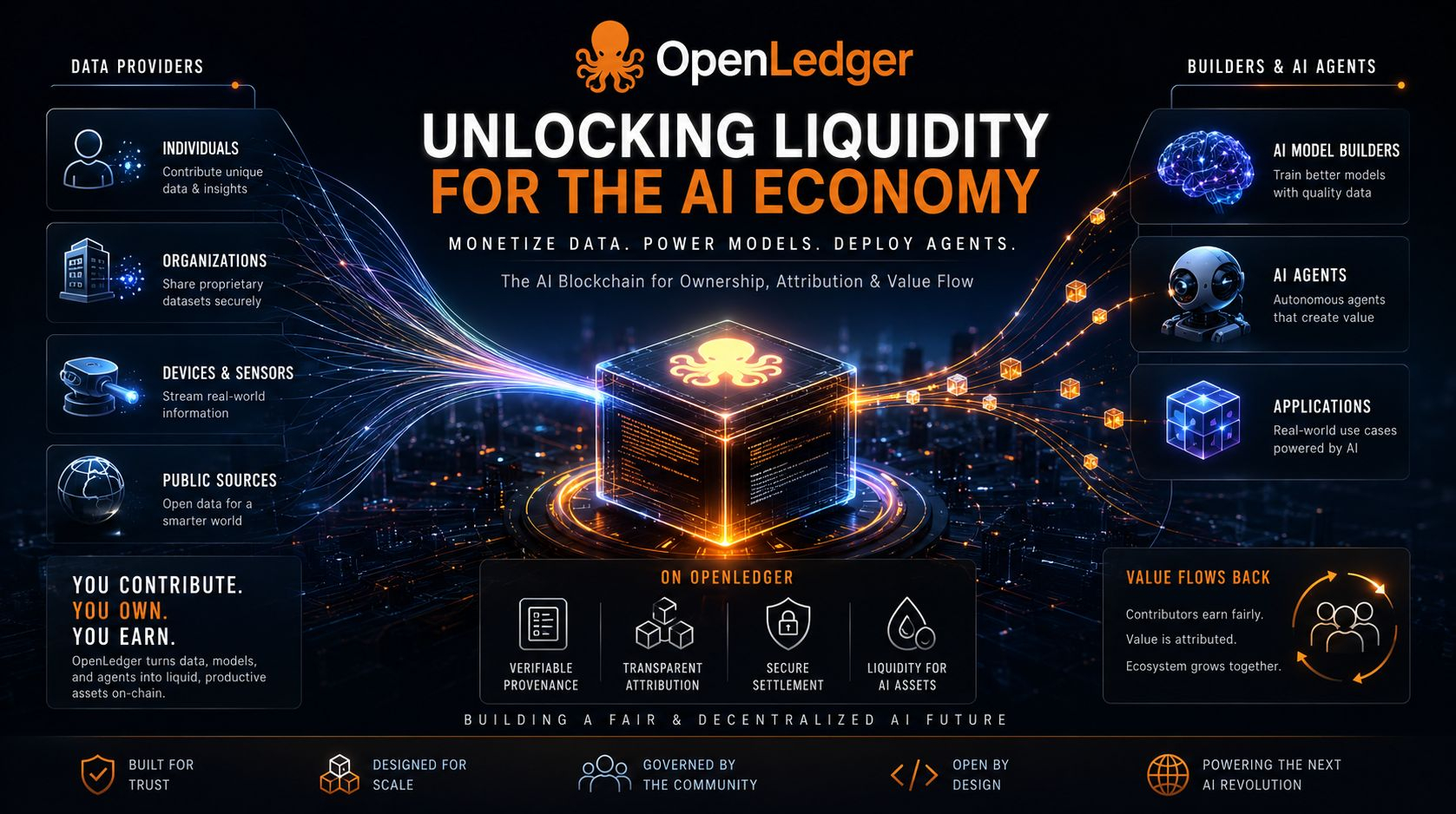
Rather than positioning itself as another general-purpose blockchain competing for transaction volume or ecosystem mindshare, OpenLedger presents itself as an AI-focused blockchain designed around a more specific question: can data, models, and AI agents become productive on-chain assets with measurable ownership and economic attribution?
The idea sounds straightforward on paper, but it touches one of the most persistent challenges in both crypto and artificial intelligence.
Today, data creates enormous value, yet the relationship between contributors and outcomes is often indirect. A dataset may improve a model. That model may power applications. Those applications may generate revenue. Yet tracing value back to the original contributors remains difficult.
OpenLedger attempts to create infrastructure where this attribution process becomes more visible and programmable.
At the center of the design is the concept of liquidity for AI resources.
Traditionally, liquidity refers to financial assets. OpenLedger extends the idea toward data, models, and agents. Instead of treating these resources as static inputs, the network aims to transform them into assets that can participate in an economic system where contributions are recorded, utilized, and potentially rewarded according to their role within the ecosystem.
What makes this approach interesting is not the promise itself. Similar ambitions have existed for years. The notable difference is the effort to integrate attribution directly into the network's architecture rather than treating it as an application-layer feature added afterward.
The logic appears simple.
If developers can contribute models, data providers can contribute datasets, and AI agents can operate within a shared environment, then a blockchain can potentially act as a ledger that records how these components interact over time. In theory, such a system creates a transparent framework for tracking participation.
Whether transparency automatically leads to fairness is another question entirely.
OpenLedger introduces mechanisms intended to support this vision. The network seeks to create infrastructure where datasets can be registered, models can be built upon those datasets, and downstream applications can interact with both while preserving a record of relationships between contributors and outputs.
The broader ambition is not merely decentralization for its own sake. It is attribution.
This distinction matters.
Many blockchain projects frame decentralization as the primary objective. OpenLedger appears more focused on accountability and traceability within AI ecosystems. Decentralization functions as a means toward that goal rather than the final destination.
From a design perspective, this reflects an important shift.
The AI industry increasingly faces questions around provenance. Where did training data originate? How should contributors be recognized? How can developers evaluate the quality of datasets? How can organizations trust externally sourced models?
These questions become more significant as AI systems move beyond experimentation and into production environments.
OpenLedger's architecture attempts to create a framework where provenance becomes observable rather than assumed.
Yet this is also where complexity begins.
Recording contributions is easier than measuring their importance.
A dataset may contribute to a model's performance, but determining precisely how much value that contribution created is extraordinarily difficult. Modern AI systems are highly interconnected. Improvements often emerge from combinations of data sources, model architectures, optimization techniques, and engineering decisions.
Attribution in such environments can quickly become subjective.
This creates one of the fundamental challenges facing OpenLedger.
The network may be able to track participation, but translating participation into meaningful value distribution requires measurement systems that remain credible under scrutiny.
If contributors perceive attribution mechanisms as inaccurate, incentives weaken.
If attribution becomes too complex, usability declines.
If governance must constantly intervene to resolve disputes, decentralization risks giving way to administrative oversight.
None of these challenges are unique to OpenLedger. They represent broader problems within AI economics itself.
Another interesting component of the project is its emphasis on AI agents.
The concept of autonomous agents has become increasingly popular across both AI and crypto communities. These agents can perform tasks, interact with applications, process information, and potentially coordinate with other systems.
OpenLedger treats agents not merely as software tools but as economic participants within the network.
In theory, this creates an environment where agents, models, and data providers interact within a shared framework of incentives and attribution.
The appeal is understandable.
As AI systems become more capable, the distinction between infrastructure and participants begins to blur. Agents consume resources, generate outputs, and influence network activity. Recording those interactions within a blockchain environment creates opportunities for transparency that traditional systems may struggle to provide.
However, the practical adoption of agent-based ecosystems remains uncertain.
Many organizations continue to prioritize reliability over experimentation. Enterprises often prefer centralized services because accountability is straightforward. When something fails, responsibility is clear.
Decentralized networks introduce resilience and openness, but they can also introduce operational complexity.
OpenLedger must therefore solve two problems simultaneously.
It must convince crypto-native users that its infrastructure provides genuine utility rather than another abstract framework. At the same time, it must persuade AI developers that blockchain-based attribution offers enough practical value to justify integration costs.
Neither task should be underestimated.
The history of crypto is filled with technically impressive systems that struggled to attract sustained usage because the user experience remained more difficult than centralized alternatives.
Network effects present another challenge.
Data marketplaces become valuable when contributors participate.
Contributors participate when consumers exist.
Consumers arrive when useful resources are available.
This circular dependency has complicated nearly every decentralized data initiative over the past decade.
OpenLedger's success may depend less on technical architecture and more on whether it can generate sufficient activity to escape this coordination trap.
Governance introduces additional questions.
Whenever a system seeks to determine attribution, ownership, or rewards, governance inevitably becomes important. Rules must evolve. Disputes must be resolved. Parameters require adjustment.
The challenge is maintaining legitimacy while adapting to changing circumstances.
If governance becomes concentrated, the project's decentralization narrative weakens.
If governance becomes fragmented, decision-making slows.
Finding a sustainable balance is easier in theory than in practice.
Despite these concerns, I find OpenLedger notable because it addresses a problem that continues to reappear across technological cycles.
The problem is not simply AI.
The problem is contribution.
Modern digital systems depend on countless contributors whose participation often becomes invisible once products reach scale. Data creators, model builders, infrastructure providers, and application developers all participate in value creation, yet the mechanisms connecting contribution to recognition remain imperfect.
OpenLedger can be viewed as an attempt to make those connections more explicit.
Whether the attempt succeeds is still unknown.
What I find most interesting is that the project does not seem to assume that ownership alone solves coordination problems. Instead, it experiments with the idea that transparent attribution might become a foundation for new forms of collaboration between data providers, model developers, and autonomous systems.
If the framework works, researchers, developers, specialized data providers, and AI-native businesses could benefit from clearer participation models and more visible contribution pathways.
If it fails, the reasons may teach us something equally valuable about the limits of programmable incentives in complex AI ecosystems.
Either outcome would provide useful information.
For now, OpenLedger feels less like a finished answer and more like a live experiment operating at the intersection of two industries that share many of the same unresolved questions.
Crypto has long searched for mechanisms that distribute ownership more fairly.
AI is increasingly searching for mechanisms that distribute attribution more accurately.
OpenLedger sits directly between those ambitions.
The question that remains unanswered is whether a ledger can truly capture the full complexity of human, machine, and data contributions—or whether some forms of value creation will always resist being measured, recorded, and assigned to an owner.