
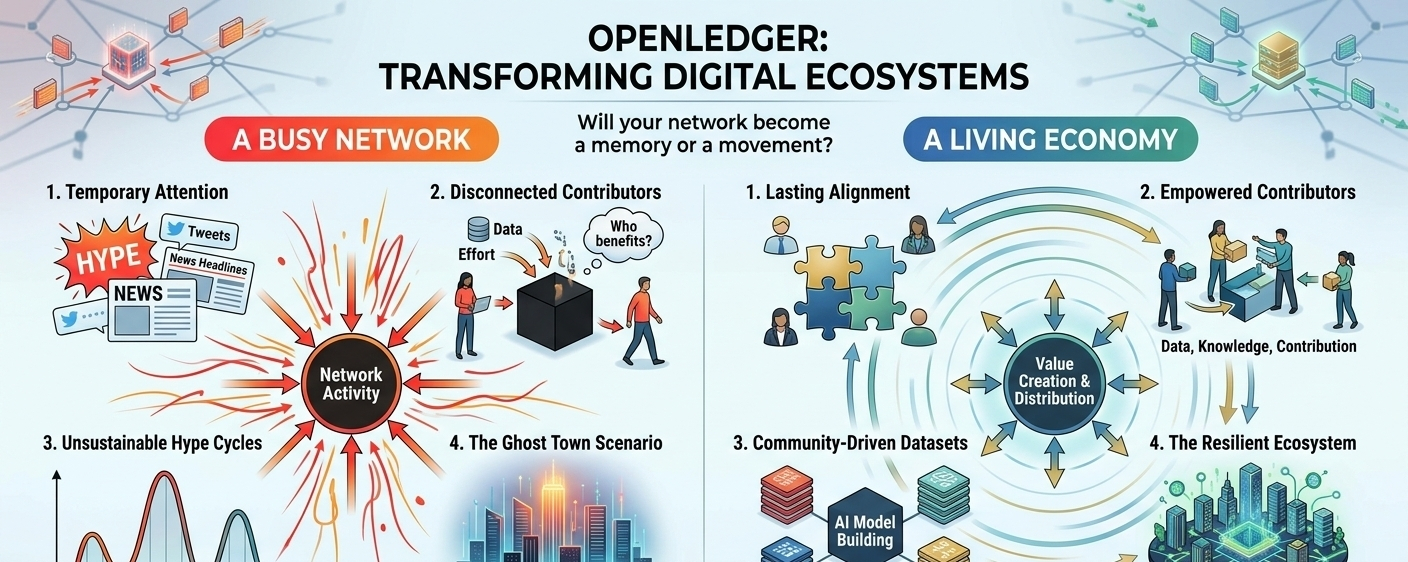

OpenLedger is building something that feels surprisingly rare in today's digital world.
Most people have seen pictures of abandoned cities. Streets that once carried thousands of people now sit empty. Buildings that once housed businesses, families, and dreams remain standing, but the energy that gave them purpose is gone. The walls still exist. The roads still exist. Yet something essential disappeared.
The reason is simple.
Activity left.
History is full of places that looked unstoppable during their peak years. Mining towns flourished when resources were abundant. Manufacturing cities expanded when factories created jobs and opportunity. Trade hubs attracted merchants from every direction. Money flowed, people arrived, and growth seemed endless.
Then conditions changed.
The mines ran dry. Industries moved elsewhere. New opportunities emerged in different places.
What remained was a reminder that activity and lasting value are not the same thing.
A city can continue existing long after the reason for staying has vanished.
That same pattern appears in digital ecosystems more often than many people realize.
A project can generate headlines, attract users, produce impressive numbers, and create enormous excitement. From the outside, everything can look successful. Yet beneath the surface, an important question remains unanswered.
Why would people still participate years later?
That question sits at the heart of what makes OpenLedger interesting.
While many projects focus primarily on creating activity, OpenLedger spends time thinking about something deeper. Instead of asking only how to attract participants, it also asks how contributors can remain connected to the value they help create.
It is a subtle difference, but it changes everything.
OpenLedger is an AI and blockchain infrastructure designed around the idea that data, knowledge, and contribution should not simply disappear into a system where only a small group benefits. The project introduces a model where communities can contribute datasets, participate in building specialized AI models, and become part of an ecosystem that recognizes the value they create.
The vision feels larger than technology alone.
At its core, OpenLedger is exploring ownership.
Every day, people generate information, insights, expertise, and data. These contributions help power modern AI systems, yet the individuals behind that value are often invisible once the process is complete.
OpenLedger attempts to rethink that relationship.
Rather than treating contributors as temporary participants, the project seeks to build an environment where contributions remain meaningful over time. Users can create and contribute to what OpenLedger calls Datanets, community-driven datasets that serve as foundations for specialized AI models. Those models can then be trained, deployed, and utilized within an ecosystem designed around transparency and participation.
The concept is simple enough for anyone to understand.
If people help create value, should they remain connected to that value?
It is a question that many industries are beginning to ask.
For OpenLedger, the answer appears to be yes.
That answer becomes even more important when viewed through the lens of long-term sustainability.
The early stages of a project are often exciting. New announcements arrive constantly. Communities grow quickly. Attention increases. Conversations spread across the internet. Momentum feels unstoppable.
But every ecosystem eventually faces a different challenge.
Retention.
Can people find reasons to stay after the excitement fades?
Can contributors still feel connected when the headlines become quieter?
Can value continue circulating through the system instead of concentrating in only a few places?
These questions often determine whether a project becomes a lasting economy or simply a temporary trend.
This is where the role of OPEN becomes especially interesting.
Every successful economy requires mechanisms that connect participation with value creation. Growth attracts people. Retention keeps them there. The strongest systems create relationships that continue functioning long after the initial wave of attention has passed.
The OPEN ecosystem appears to be built with that reality in mind.
Instead of focusing exclusively on short-term engagement, the project explores ways to create ongoing relationships between contributors, datasets, models, and the broader network. The goal is not merely to generate activity but to establish foundations that can support participation over longer periods of time.
That distinction may sound small.
History suggests it is not.
The world remembers countless places that experienced moments of rapid growth. Far fewer managed to build economies capable of surviving changing conditions, shifting incentives, and evolving markets.
The same principle applies to digital networks.
Temporary attention can create impressive numbers.
Lasting alignment creates resilience.
Whether OpenLedger ultimately succeeds in achieving its vision remains a question that only time can answer. Every ambitious project faces challenges, competition, and uncertainty. No roadmap comes with guarantees.
Yet some ideas deserve attention because of the problems they are trying to solve.
OpenLedger stands out because it focuses on a challenge that many people overlook.
How do you create an ecosystem where contributors feel valued not only during periods of growth but also during periods of maturity?
How do you prevent participants from becoming replaceable pieces in a machine that no longer remembers who helped build it?
How do you create an economy that remains alive rather than becoming another digital ghost town?
Those questions matter.
Perhaps more than ever.
As AI continues expanding into every corner of the digital world, conversations about ownership, participation, and value distribution will only become more important. The future will not belong solely to the systems that generate the most activity. It will belong to the systems that create reasons for people to remain engaged long after the excitement fades.
OpenLedger is positioning itself around that belief.
Not simply building technology.
Not simply chasing attention.
But exploring how digital economies can remain alive, connected, and meaningful for the people who help create them.
And in a world filled with projects competing for temporary attention, that may be one of the most valuable ideas of all.