
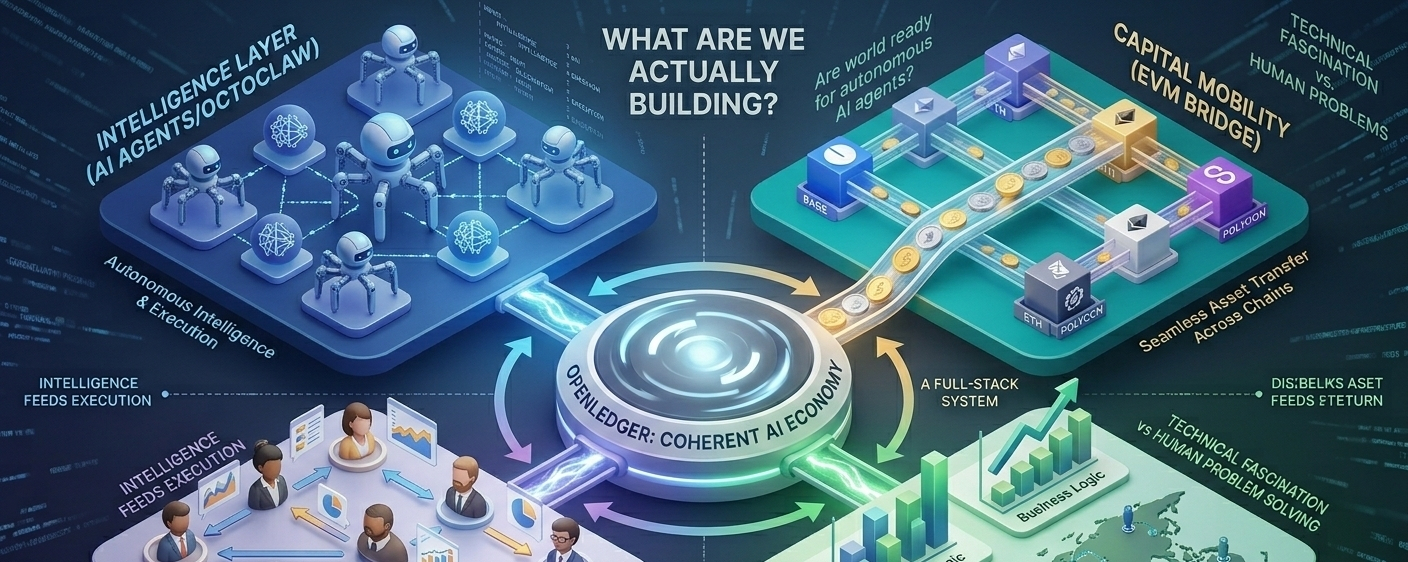

OpenLedger is often introduced as an AI project.
At first glance, that description seems reasonable. The project talks about data, models, agents, attribution, and the future of intelligent systems. Like many others in the industry, it is operating in a world where artificial intelligence dominates headlines and attracts enormous attention.
But the more time I spend studying OpenLedger, the more I feel that calling it an AI project only tells a small part of the story.
What if the real story is much bigger?
What if OpenLedger is not trying to participate in the AI race the way most people think?
What if it is trying to build the foundation for an entirely new economy?
That question stayed in my mind long after I finished reading about the project.
The first thing that caught my attention was not the technology.
It was the ambition.
OpenLedger secured $8 million in funding from respected investors and builders who have spent years identifying emerging opportunities before they become obvious to everyone else. That alone is significant, but what happened next is what made me pause.
The project committed $25 million to OpenCircle.
That decision reveals something important.
Most projects raise capital to build products.
OpenLedger appears to be thinking beyond products.
It appears to be thinking about ecosystems.
That difference matters more than many people realize.
Products solve individual problems.
Ecosystems create entire environments where thousands of people can participate, build, contribute, and benefit together.
History shows that the largest opportunities are rarely created by a single application. They emerge when a complete network forms around a new idea.
The internet became powerful because it connected people, businesses, services, and information.
Mobile technology became transformative because entire economies formed around smartphones.
The same pattern may eventually emerge with artificial intelligence.
And that is where OpenLedger becomes interesting.
Today, most discussions about AI focus on intelligence.
People want smarter models.
Faster answers.
More capable agents.
More powerful systems.
Every major player is pushing toward the same destination: making AI better at thinking.
But intelligence alone does not create an economy.
An economy requires something deeper.
Value must be created.
Ownership must be recognized.
Contributors must be rewarded.
Transactions must be settled.
Trust must exist between participants.
Without those things, intelligence remains impressive but isolated.
The more I examined OpenLedger, the more it seemed focused on these missing pieces.
Instead of concentrating on only one layer, the project appears to be building across multiple parts of the future AI value chain.
Data must come from somewhere.
Models must be trained.
Agents must operate.
Contributions must be tracked.
Rewards must be distributed.
Value must move from one participant to another.
Trust must be maintained throughout the process.
These are not glamorous problems.
They rarely generate the same excitement as a breakthrough model release.
Yet history suggests that infrastructure often becomes more valuable than the applications built on top of it.
Roads are not as exciting as the businesses that use them.
Banks are not as visible as the companies they finance.
Payment networks rarely receive the same attention as the stores that depend on them.
But none of those businesses function without underlying infrastructure.
That comparison kept returning to my mind while studying OpenLedger.
The project's different components begin to make more sense when viewed together rather than separately.
OctoClaw, Datanets, Model Factory, OpenLoRA, Proof of Attribution, EVM connectivity, and payment systems start looking less like individual products and more like pieces of a larger puzzle.
Each component appears to address a different challenge that could emerge if AI becomes deeply integrated into everyday economic activity.
Imagine a future where intelligent agents perform meaningful work.
Imagine businesses relying on specialized AI systems.
Imagine creators contributing valuable datasets.
Imagine models generating revenue.
Imagine millions of interactions occurring every day between people, data providers, applications, and autonomous agents.
The moment that future becomes reality, difficult questions appear.
Who deserves credit?
Who owns the underlying contribution?
Who receives compensation?
How is value distributed fairly?
How can participants trust the system?
These questions are easy to ignore today because the AI economy is still young.
But they become impossible to ignore once real value begins moving through these networks.
That is why attribution may become one of the most important ideas in the entire AI industry.
For years, the internet struggled with similar issues.
Content creators wanted recognition.
Developers wanted compensation.
Contributors wanted proof that their work mattered.
The systems were often imperfect.
Artificial intelligence introduces those same challenges at a much larger scale.
OpenLedger seems to recognize that.
Rather than focusing solely on creating smarter systems, it appears focused on ensuring that value can be tracked, recognized, and distributed.
That is a very different mission.
It is also a much harder one.
Building infrastructure is rarely easy.
The rewards often arrive later.
The market frequently overlooks it in the early stages because infrastructure is not always visible.
People notice the skyscraper.
Few notice the foundation underneath.
Yet the foundation determines whether the skyscraper remains standing.
That thought makes OpenLedger fascinating to watch.
The project feels less like a competitor in the intelligence race and more like an attempt to build the environment where future intelligence can operate.
And if that interpretation is correct, the long-term implications could be enormous.
The world may eventually reach a point where AI systems are not simply tools.
They may become participants in economic activity.
They may create value.
Exchange value.
Move value.
And settle value.
If that happens, entirely new forms of infrastructure will be required.
The future will need mechanisms for ownership.
It will need attribution.
It will need payment rails.
It will need trust frameworks.
It will need systems that connect all these moving parts together.
OpenLedger appears to be positioning itself around those needs long before they become obvious.
That does not guarantee success.
Every ambitious vision carries risk.
Execution remains the ultimate test.
Building technology is difficult.
Building ecosystems is even harder.
Many promising ideas fail because adoption never arrives.
Others struggle because reality moves more slowly than expected.
Those risks are real.
They should not be ignored.
Yet sometimes the most interesting opportunities emerge from projects willing to think several steps ahead of the market.
And that is what keeps bringing me back to OpenLedger.
The project seems to be asking a different question than most of the industry.
Instead of asking how intelligent AI can become, it appears to be asking what happens after intelligence creates value.
That question may prove far more important than people realize.
Because eventually intelligence alone may no longer be enough.
The systems that organize ownership, incentives, trust, attribution, and settlement could become just as valuable as the intelligence itself.
And if that future arrives, OpenLedger's story may not be remembered as the story of an AI project.
It may be remembered as the story of a team that looked beyond the intelligence race and started building the economic foundations of a world where AI creates, owns, moves, and settles value on its own.
That possibility is what makes OpenLedger worth watching.
Not because of what it is today.
But because of what it might be quietly preparing for tomorrow.