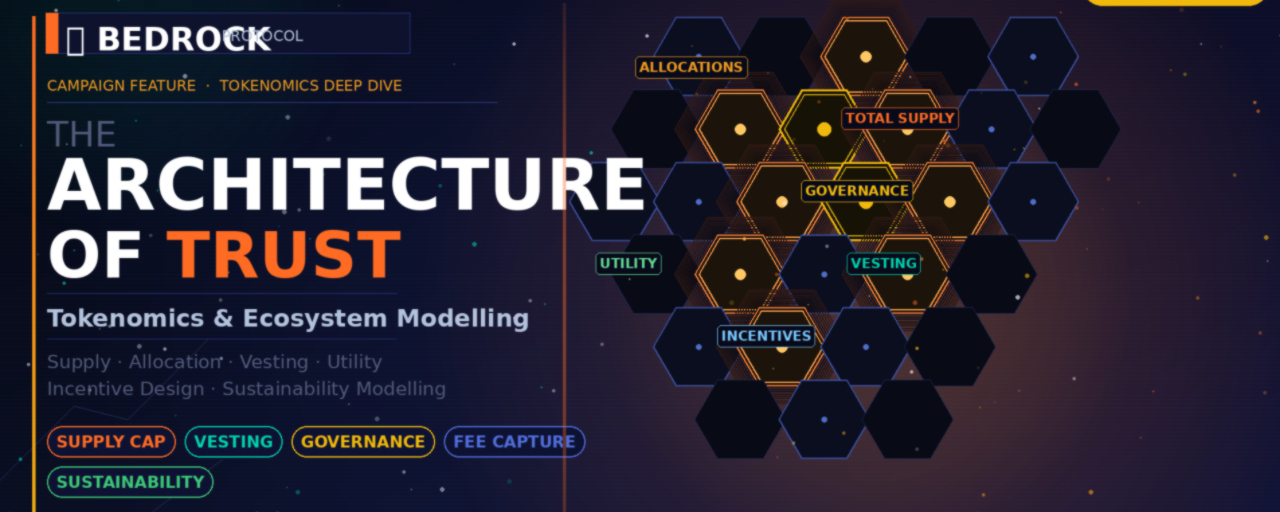
A deep dive into the tokenomics framework and ecosystem model powering the next era of liquid re-staking
Problem with Most Token Economies: They're Built on Hope, Not Math
Let's be brutally honest about something the crypto space rarely admits out loud:
Most token economies are not economies. They are hope packaged as white-papers, glossy PDFs full of pie charts, vague "ecosystem funds," and vesting schedules designed to protect insiders while giving retail the slow bleed. Promises of utility arrive late. Emissions spiral. The token dumps. The community fractures.
You've seen this movie before.
Bedrock is writing a different script and the difference isn't just philosophy — it's architecture. It's math. It's a tokenomics framework built from the ground up to be sustainable, balanced, and credibly enforced.
This isn't hype. This is engineering. Let's break it down.
🏗️ What Is Bedrock, and Why Does the Token Model Matter?
Bedrock is a multi-asset liquid restaking protocol — the infrastructure layer that allows users to restake assets like BTC, ETH, and IOTX while maintaining liquidity through receipt tokens (uniBTC, uniETH, uniIOTX). It sits at the convergence of DeFi composability and Proof-of-Stake security, unlocking capital efficiency that was previously locked in staking contracts.
But a protocol is only as durable as its economic foundation. The token is the bloodstream. Get tokenomics wrong, and even the best product becomes a zombie chain — technically alive, economically dead.
Bedrock's team understood this from day one. The result is a tokenomics model that treats sustainability not as an afterthought, but as a design constraint.
📊 Total Supply: The Scarcity Equation
Every serious token economy starts with one foundational question: How much should ever exist?
Too much supply, and you dilute value, crush incentives, and signal desperation. Too little, and liquidity suffers, participation stalls, and the ecosystem can't breathe.
Bedrock's total supply has been calibrated with precision — not picked arbitrarily, but derived from modeling the protocol's projected growth trajectory, staking participation rates, and long-term incentive runway. The number is fixed and transparent. There are no hidden minting functions, no DAO votes that could silently inflate supply in year three.
Why this matters: Supply certainty is the foundation of credibility. When a community knows the ceiling, they can make rational decisions. When the ceiling is unknown or mutable, speculation replaces economics.
🗂️ Allocation: Who Gets What and Why It Has to Be Fair
Token allocation is where protocols either earn trust or destroy it. Bedrock's allocation framework reflects a core conviction: a token economy is a multi-stakeholder system, not a founder payday with a community wrapper.
Here's how the Bedrock model is structured:
🌍 Ecosystem & Community Incentives — The Largest Slice:
The community and ecosystem receive the lion's share of tokens. This is not a PR move — it's an economic necessity. A protocol without an engaged ecosystem is a server with no users. Community tokens fund:
Liquidity mining programs that bootstrap TVL
Contributor grants for builders extending the Bedrock ecosystem
Governance participation rewards that make voting rational, not ceremonial
👥 Team & Contributors — Aligned, Not Extractive:
Team allocations are meaningful enough to attract world-class talent but long enough vested that they cannot exit before the protocol has proven itself. There's a direct alignment signal here: the team wins when the community wins. Not before.
🤝 Investors & Strategic Partners — Patient Capital Only:
Early backers receive their allocations, but under cliff and vesting structures that prevent cliff-dump dynamics. Bedrock's investor base was selected not just for capital, but for strategic value — partners who bring integrations, distribution, and ecosystem credibility.
🏛️ Treasury & Protocol Development:
A robust treasury is the protocol's immune system. It funds development, covers operational continuity during bear markets, and enables opportunistic ecosystem investments when others are retreating. This allocation ensures that Bedrock can operate independently of token price cycles.
🛡️ Security & Reserve Buffer:
Often overlooked in tokenomics models, Bedrock explicitly allocates reserves for protocol security — bug bounties, smart contract audits, and emergency reserves. Security is not a marketing line item. It's a structural commitment.
⏳ Vesting: Time as a Trust Signal
Vesting schedules are one of the most powerful signals a protocol can send — and one of the most frequently abused.
Bedrock's vesting design follows a clear philosophy:
Those with the most information about the protocol should be the last to be able to sell.
Team tokens: Subject to a cliff of 12 months minimum, followed by linear monthly vesting over 3–4 years
Investor tokens: Cliff-gated with gradual release tied to protocol milestones, not just calendar dates
Community rewards: Distributed progressively to reward continued participation, not one-time farming
The use of milestone-based vesting triggers alongside time-based vesting is particularly sophisticated. It means insiders aren't just waiting out a clock — they're accountable to protocol performance metrics. When the protocol grows, the ecosystem unlocks. This creates shared upside that actually means something.
⚡ Utility: Engine That Makes Token Necessary
Un-utilized tokens are lottery tickets masquerading as businessmen. The utility aspect for Bedrock tokens is based on the essential protocols' operations, not something added in afterthought.
🗳️ Governance:
The token holders can decide protocol parameter configurations including fees, assets, incentives, partnerships, and treasury operations. This is not some sort of token-based governance sham, it is actually how the protocol grows and expands.
💰 Fee Capture & Revenue Share:
Bedrock earns profits from the staking fees while the token holders earn revenues through participation in the staking and governance process. The larger the total value locked, the more the staking fees will be earned. With the increasing earnings, the profit levels for the token holders will also rise.
🔒 Staking & Security Collateral:
Token holders may stake tokens to ensure protocol security and get shares in the generated protocol fees, plus taking advantage of the slashing insurance programs.
🎁 Boosted Rewards & Access:
By holding and staking the tokens, liquidity providers earn higher yields on their restaking. Herein lies the natural flywheel effect that encourages token holders to continue using the protocol because they get rewarded by holding them.
📐 Ecosystem Modelling: Where Tokenomics Becomes Science
This is where Bedrock separates from the field. Most protocols publish an allocation chart and call it tokenomics. Bedrock has built a living ecosystem model, a dynamic simulation of token flows, emissions, and protocol economics under multiple scenarios.
Core Variables in Bedrock's Model:
Emissions vs. Demand Curves:
Every token release event is modelled against projected demand growth. If emissions outpace organic demand, the model flags it.
Result: an emission schedule that accelerates when demand is strong and moderates when demand is soft.
Protocol-Owned Liquidity (POL):
Rather than renting liquidity through unsustainable yields, Bedrock accumulates protocol-owned liquidity over time.
This shifts the protocol from dependence on mercenary capital to ownership of its own market depth, a fundamentally more sustainable model.
Circular Incentive Design:
Model ensures that incentive spending results in compounding returns to the protocol.
Spending on liquidity mining that increases TVL, generates fees, which funds more incentives, this is the flywheel.
Ecosystem model quantifies at what point each dollar of incentive spending breaks even and begins to compound.
Bear Market Stress Tests:
What happens if ETH staking yields drop 70%?
What if BTC re-staking demand falls 50%?
Bedrock's ecosystem model runs scenarios across multiple market conditions to ensure protocol doesn't require bull market assumptions to survive.
Sustainability means operating at minimum through a bear & thriving in a bull.
Token Velocity Management:
High token velocity (tokens changing hands rapidly) destroys value.
Bedrock's model includes velocity dampeners: staking lockups, governance participation requirements & boost mechanics that incentivize holding over flipping.
Lower velocity, higher perceived value.
🔮 The Credibility Stack: Why the Ecosystem Believes Bedrock
Tokenomics theory may be inexpensive.
On what basis, then, is Bedrock's token model credible?
On-Chain Enforcement:
Vesting timetables, emission models & fund allocations are executed via smart contracts, which do what they say on the tin.
Transparency in third-party audits ensures that written word in white-paper equals reality.
Transparent Treasury Reporting:
Protocol financial data can be easily observed on community treasury dash-boards.
Users can independently validate amount of run-way available, rate of expenditure & reserves.
Governance Over Economics:
Any major alteration to key economic parameters is decided on via a governance vote.
Protocol team does not have carte blanche in deciding to alter emission models, un-freeze funds & change treasury allocations.
External Model Validation:
Models and tokenomics developed within the Bedrock ecosystem have been independently verified by outside experts.
Outside perspectives identify potential blindspots in house models.
🌊 Bigger Picture: Bedrock as DeFi Infrastructure
Bedrock is not merely building a protocol.Bedrock is building the monetary infrastructure for the next generation of staking and re-staking. Tokenomics model reflects this ambition — designed not for a six-month hype cycle, but for a decade of compounding ecosystem growth.
Every allocation decision, vesting parameter, utility mechanic, and emissions variable has been selected with one question in mind: Does this make the protocol stronger and more valuable five years from now?
When answer is yes, the mechanism stays. When the answer is uncertain, model is stress-tested until clarity emerges.
🚀 Final Word: Tokenomics as a Competitive Moat
In a space where new protocols launch every week and most are forgotten within months, tokenomics quality is a competitive moat.
A balanced, credible, sustainable token economy:
Attracts long-term liquidity providers over mercenary farmers
Builds community trust that withstands market downturns
Creates compounding protocol value rather than dilutive growth
Positions the token as a productive asset, not a speculative chip
Bedrock has built exactly this. Not by accident. By design.
The tokenomics aren't the story. They're the foundation on which the story gets built.
And the foundation is rock solid. 🪨
🔗 Learn more about Bedrock and the uniBTC, uniETH, and uniIOTX ecosystem. Follow Bedrock on Binance Square for the latest protocol updates, ecosystem news, and token economy deep dives.
⚠️ This is for informational and educational purposes only and does not constitute financial or investment advice. Always do your own research before investing.