
Introduction
In June 2026, the Bank of Japan raised its policy rate to 1%, marking the first time since 1995 that Japan’s benchmark rate had reached this level. In absolute terms, a 1% policy rate is hardly remarkable among major economies. The U.S. federal funds rate remains above 4%, and policy rates across much of Europe are still meaningfully higher than Japan’s. Viewed purely as a number, Japan’s rate hike does not appear significant enough to attract such widespread global attention. Yet financial markets rarely focus only on the level of interest rates; they focus on what those rates signal about policy direction and the broader economic cycle. For an economy that has spent decades in a zero-rate and even negative-rate environment, the move from negative rates to 1% represents a profound shift in the monetary framework that has supported Japan’s economy for nearly thirty years.
The reason this rate hike has drawn so much attention from global markets is not that Japan has suddenly become a new engine of global growth. Rather, it is because Japan has long played a highly unusual and often underappreciated role in the global financial system: it has served as one of the world’s lowest-cost funding centers. Over the past two decades, large amounts of international capital have borrowed cheaply in yen and used those funds to buy higher-yielding assets around the world, from U.S. technology stocks and emerging-market bonds to commodities and real estate. In that sense, Japan has not only exported cars, electronics, and industrial equipment; it has also exported low-cost liquidity to the rest of the world. That liquidity has been one of the important foundations behind the rise in global asset prices over the past twenty years.
Therefore, when Japan enters a rate-hiking cycle, the real question for markets is not simply whether the Bank of Japan will raise rates from 1% to 1.25%. The deeper question is whether the gradual withdrawal of one of the world’s largest sources of cheap funding will force a rethink of the global capital-allocation model that has been built on low-cost money.
I.Why Japan Kept Interest Rates So Low for So Long
To understand the impact of Japan’s current rate hikes, it is necessary to go back to the 1990s and understand why Japan became such an exceptional case among major economies.
In the late 1980s, Japan experienced one of the most famous asset bubbles in modern economic history. Supported by easy monetary conditions and extremely optimistic expectations, Japanese real estate and equity prices surged. Land prices in central Tokyo reached extraordinary levels, while the Nikkei 225 climbed to an all-time high of 38,915 at the end of 1989. But the bubble eventually burst. During the 1990s, property prices fell sharply, the Nikkei lost more than 70% over the following years, and both corporate and household balance sheets came under severe pressure.
Unlike an ordinary recession, the collapse of an asset bubble does not merely slow economic growth; it changes the risk appetite of an entire society. Companies prioritize debt repayment over investment, households increase savings instead of consumption, and banks spend years dealing with bad loans. Under such conditions, even sharply lower borrowing costs may fail to revive economic activity.
Faced with persistent weakness, the Bank of Japan steadily lowered interest rates. According to historical BOJ data, Japan’s policy rate was often between 6% and 9% in the 1970s, but after the bubble burst it declined steadily, falling below 1% by 1995. In 1999, Japan formally entered the zero-interest-rate era. In 2001, the BOJ launched quantitative easing, becoming the first major central bank to conduct large-scale QE. In 2016, it went further and introduced negative interest rates, lowering the policy rate to -0.1%.
Japan’s monetary policy over the past thirty years was therefore not a normal cyclical adjustment. It was a long period of structural easing. Unlike the United States, where interest rates have moved up and down across economic cycles, Japanese rates effectively followed a one-way path downward and remained near zero for decades.
Behind this low-rate environment were three structural constraints.
The first was demographics. According to Japan’s Ministry of Internal Affairs and Communications, Japan’s population peaked in 2008 and has been declining since then, while the share of the working-age population has continued to shrink. Aging reduces consumption growth, raises the propensity to save, and lowers potential economic growth. When an economy lacks new demand generated by population growth, investment returns naturally decline, making it difficult for interest rates to remain high.
The second constraint was long-term low inflation, and in many periods outright deflation. Between 1998 and 2020, Japan’s core CPI rose by less than 1% on average, far below inflation rates in most Western economies. In many years, Japanese companies were more worried about selling fewer goods than about rising input costs. This weakened their ability to raise prices and reduced their incentive to expand investment.
The third constraint was government debt. According to IMF data, Japan’s gross government debt now exceeds 250% of GDP, one of the highest levels among developed economies. If Japan had to finance this debt at interest rates similar to those in the United States, where rates are above 4%, the fiscal burden would become extremely heavy. As a result, ultra-low interest rates have not only been a tool to stimulate the economy; they have also become an important condition for maintaining fiscal stability.
In other words, Japan’s long period of low rates was not simply the result of a deliberate policy preference. It was an equilibrium produced by low growth, aging demographics, and high public debt. Over the past three decades, Japan’s economy has effectively relied on ultra-low funding costs to keep the broader system functioning, while markets gradually formed a consensus that Japan would remain in the zero-rate world indefinitely.
That consensus began to weaken after 2022.
II. Why Japan Has Re-entered a Rate-Hiking Cycle
For many years, markets widely believed that Japan was the least likely major economy to enter a genuine rate-hiking cycle. Even as the Federal Reserve moved through multiple tightening and easing cycles over the past decade, Japan remained close to zero rates. When the BOJ ended its negative-rate policy in 2024 and began raising rates gradually, many investors initially viewed the move as symbolic rather than as a genuine monetary-policy turning point.
Over time, however, markets began to recognize that Japan’s rate hikes were supported by deeper economic changes.
The first change was inflation.
For more than two decades, Japan’s biggest macroeconomic problem was deflation. Companies worried about falling prices, consumers became used to waiting for cheaper goods, and the broader economy lacked sustained inflation expectations. After the pandemic, however, supply-chain restructuring, higher energy prices, and changes in global trade conditions pushed the world into a higher-inflation environment. Japan was no exception.
According to Japan’s Statistics Bureau, core consumer prices remained above the BOJ’s 2% target for several quarters. Compared with inflation in the United States or Europe, Japan’s inflation was not especially high, but for an economy long trapped in low inflation, it marked a meaningful shift.
Even so, the BOJ has not focused only on inflation itself. What matters more is whether wages can rise alongside prices.
Historical experience shows that if inflation is driven only by imported energy and food costs while household incomes fail to improve, inflation eventually suppresses consumption and hurts growth. This is why the BOJ has repeatedly emphasized the importance of a “virtuous cycle” between wages and prices.
That cycle has begun to appear in recent years.
Japan’s annual spring wage negotiations, known as shunto, delivered wage increases of 5.1% in 2024, 5.2% in 2025, and around 5.26% in 2026. This marked three consecutive years of wage growth above 5%, the strongest run in decades. At the same time, data from Japan’s Ministry of Health, Labour and Welfare showed that nominal wages rose 3.5% year-on-year in April 2026, while real wages also continued to improve.
These numbers matter more than they may appear at first glance.
For three decades, Japan struggled to create a positive loop between wage growth, consumption, and corporate profits. Companies hesitated to raise wages because demand was weak; households hesitated to spend because income growth was weak; and the economy remained stagnant as a result. The recent improvement in wage growth suggests that Japan may finally be moving away from its deeply entrenched deflationary mindset.
Exchange rates have also become an important factor behind Japan’s rate hikes.
Between 2022 and 2025, the Federal Reserve maintained high interest rates, while the interest-rate gap between the United States and Japan widened sharply. The dollar-yen exchange rate rose from around 110 to nearly 160. A weaker yen benefits Japanese exporters, but it also raises the cost of imported energy and food. For a country heavily dependent on imported resources, sustained currency weakness is not an unqualified positive.
Japan’s government intervened several times in the foreign-exchange market in 2024 to stabilize the yen, with total intervention exceeding 11 trillion yen. Even so, the yen remained weak, suggesting that intervention alone could not fundamentally change market views on the currency.
Therefore, Japan’s move from negative rates into a rate-hiking cycle since 2024 has not been driven solely by inflation. It has reflected a combination of stronger wage growth, structural economic shifts, and pressure from the exchange rate.
More importantly, this change is not only affecting Japan’s domestic economy. It is also beginning to affect one of the most important funding chains in global markets: the yen carry trade.
III. The Yen Carry Trade: The Hidden Engine of Global Liquidity
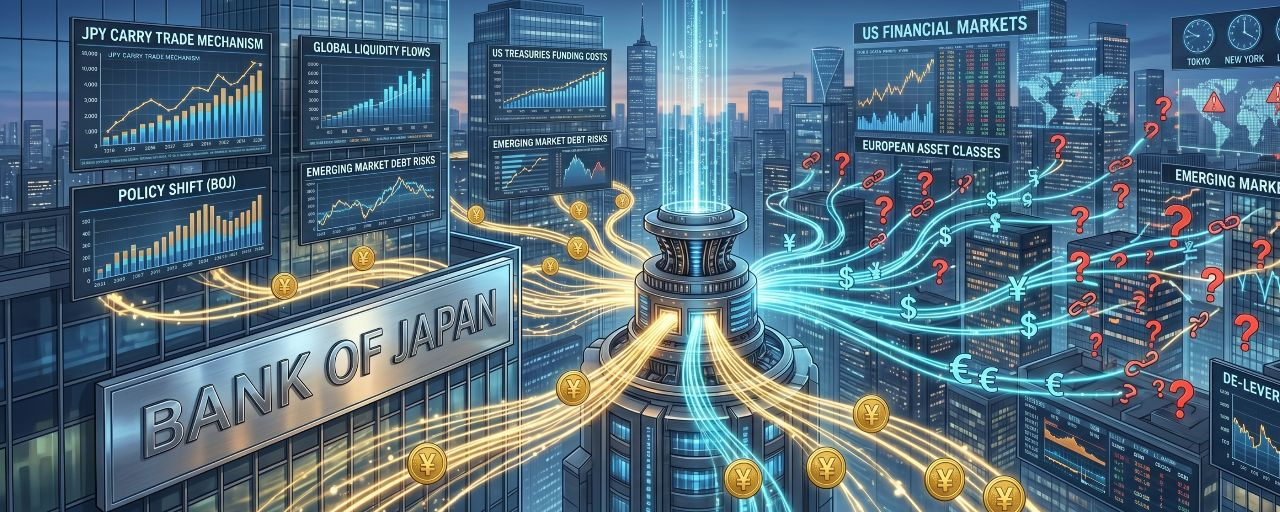
If we look only at Japan’s domestic economy, raising rates from negative territory to 1% may not seem large enough to attract such global attention. But once we shift the perspective from Japan’s local economy to global capital flows, it becomes clear that Japan has played a critical role over the past two decades: it has been one of the world’s lowest-cost funding centers. The key to understanding this role is the yen carry trade.
The basic principle of a carry trade is simple: investors borrow in a low-interest-rate currency and invest in higher-yielding assets elsewhere. When the funding cost in one country is significantly lower than returns available in another, capital naturally flows from the low-cost market to the higher-yielding market. Over the past two decades, Japan maintained near-zero or negative rates, while the United States, Australia, New Zealand, and many emerging markets offered much higher returns. This interest-rate gap created a large and persistent arbitrage opportunity.
For example, an international hedge fund could borrow 10 billion yen at near-zero cost, convert the funds into dollars, and buy U.S. Treasuries yielding 4% to 5%. Ignoring exchange-rate movements, the interest-rate spread alone could generate a stable return. If leverage was added, the return could be magnified further. For large global institutions, Japan’s ultra-low-rate environment was therefore not merely a domestic monetary-policy condition; it was a funding advantage.
From the early 2000s onward, as Japan’s zero-rate policy became normalized, global capital increasingly used the yen as a funding currency. According to the Bank for International Settlements, the yen has long ranked among the world’s three most actively traded currencies in foreign-exchange markets. A meaningful share of that activity has not been tied to Japan’s real economy, but to global portfolio allocation. For many international institutions, borrowing yen, selling yen, and buying dollar assets became a highly standardized strategy.
The yen carry trade survived for so long because markets had a stable expectation: Japan would not raise rates meaningfully. In financial markets, an interest-rate spread alone is not enough to guarantee success; exchange-rate stability is also essential. If the funding currency appreciates sharply, investors may suffer losses when converting back to repay their loans. Investors were willing to keep borrowing yen because they believed the BOJ would not quickly abandon its ultra-loose policy and that the yen would not experience a sustained surge.
This expectation gradually turned the yen into one of the world’s most important funding currencies. In a sense, Japan was exporting not only goods and capital, but also liquidity. When international investors used cheap yen funding to buy U.S. technology stocks, European bonds, emerging-market equities, and global real estate, Japan effectively became a foundational funding source for the global leverage system.
Looking back at the rise in global asset prices over the past twenty years, it is difficult to separate that rise from the ultra-low-cost funding environment. After the 2008 global financial crisis, the Federal Reserve released dollar liquidity through quantitative easing, while Japan continued to provide near-zero funding costs to global markets. In the models used by many investment banks and macro funds, Japanese funding costs were almost treated as a permanent market condition.
Yet any trading system built on a stable long-term assumption shares one common vulnerability: once that assumption changes, the adjustment can be more violent than the original build-up.
Markets once believed Japan would never enter a rate-hiking cycle, and that belief encouraged investors to expand carry-trade positions. Now that Japan has begun to raise rates, the entire carry-trade system must reassess its risk-return profile. This is why every BOJ policy meeting has started to attract global investor attention.
IV.Why Japan’s Rate Hikes Matter for Global Markets
For many ordinary investors, Japan’s share of global GDP is much smaller than it was in the 1980s, and Japan’s stock market is far less influential than the U.S. market. It is therefore natural to ask: why should Japan’s rate hikes matter so much to global markets?
The answer lies not in Japan’s domestic economy, but in Japan’s special role in the global liquidity system.
At its core, capital markets are about the movement of money across assets. One of the key factors determining those flows is the cost of funding. When funding costs are extremely low, investors are more willing to take risks and use leverage. When funding costs rise, investors tend to reduce risk exposure and cut leverage.
For the past two decades, Japan’s ultra-low rates meant global investors could obtain funding at extremely low cost. Those funds then flowed into U.S. technology stocks, emerging-market assets, commodities, and real estate, helping push asset prices higher. Once Japan begins raising rates, that funding mechanism starts to change.
Consider a global macro fund that has long borrowed yen at a cost of 0.25% and invested the proceeds in U.S. technology stocks. If Japan’s policy rate rises to 1%, the funding cost has effectively quadrupled. If it rises further to 1.5%, the funding cost becomes six times higher than before. In absolute terms, 1% or 1.5% may still look low, but for leveraged institutional investors, it requires a recalculation of the entire investment model.
Even if U.S. technology stocks continue rising, fund managers must reassess their holdings because higher funding costs reduce expected returns. When more institutions reach similar conclusions, the market may see a common response: deleveraging.
Deleveraging is not simply the selling of one asset. It is the contraction of the entire funding chain. Investors sell stocks, bonds, commodities, and other risk assets, convert the proceeds back into yen, and repay their yen loans. For a single institution, this is ordinary risk management. But when many institutions do it at the same time, global markets can experience a liquidity squeeze.
There are historical precedents. During the later stages of the 1998 Asian financial crisis and again during the 2008 global financial crisis, the yen carry trade experienced large-scale unwinds. The yen strengthened rapidly, investors were forced to cover funding positions, and global market volatility rose sharply. The current environment is different in many respects, but the basic capital-flow mechanism remains similar.
Japan’s rate hikes therefore affect global markets not mainly through trade or domestic growth, but through capital flows and funding costs. When one of the world’s largest sources of cheap funding begins to shrink, the entire risk-asset complex has to adjust to a new funding environment.
V.What Markets Fear Is Not 1%, but a Change in Direction
Japan’s 1% policy rate is still far below rates in the United States and Europe. From that perspective, the market reaction to Japan’s rate hikes might seem excessive. But financial markets are rarely driven by the current level alone; they are driven by the expected path ahead.
According to Reuters surveys of economists, many institutions expect Japan’s policy rate to reach around 1.25% by the end of 2026 and move closer to 1.5% in 2027. These levels are still low by global standards, but what matters is what they represent.
For the past twenty years, global investors held a deeply embedded belief: Japan would not enter a sustained rate-hiking cycle. This belief shaped not only market sentiment, but also investment models, risk pricing, and asset allocation. Many carry-trade strategies worked precisely because that assumption seemed stable.
Today, Japan is gradually changing that expectation.
In the past, markets viewed 0% as the ceiling for Japanese interest rates. That ceiling has now been broken. The question is no longer whether Japan will raise rates, but how far it will ultimately go.
For markets, this uncertainty matters more than the rate level itself. Asset prices are based on expectations of the future, not just current facts. Once investors begin to believe that Japan may continue raising rates, they will adjust portfolios in advance, often before policy moves are fully implemented.
It is also worth noting that Japan’s economy is showing changes that have been rare over the past three decades. Wage growth has improved, inflation has stayed above target, and corporate profitability has strengthened. If these conditions continue, further policy normalization by the BOJ cannot be ruled out.
For global markets, the key issue is not the next 25-basis-point move. The real question is whether the low-rate era that defined Japan for three decades is coming to an end. Once markets begin to accept that possibility, global capital-flow logic may shift over the longer term.
VI. The Federal Reserve Still Determines the Final Direction
Although Japan is gradually exiting ultra-loose monetary policy, the key variable determining the final direction of global capital flows remains the United States, not Japan.
The reason is simple: international capital does not look only at the absolute interest rate in one country. It compares relative returns across markets. For global investors, Japan’s move from 0% to 1% matters, but if the United States is still offering rates above 4%, the U.S.-Japan rate gap remains wider than three percentage points. In other words, even after Japan begins raising rates, U.S. assets can still remain highly attractive.
This helps explain why the yen has not appreciated as much as some expected, even after Japan ended negative rates and began raising rates. From 2024 to 2026, the dollar-yen exchange rate spent much of its time in the 150 to 160 range. For a country that has exited negative rates and entered a hiking cycle, this may appear unusual. But viewed through the lens of the U.S.-Japan rate differential, the logic becomes clear.
Over the past twenty years, the dollar-yen exchange rate has been driven largely by the U.S.-Japan interest-rate spread. When the Federal Reserve hikes and Japan keeps rates low, capital tends to flow into dollar assets, and the yen weakens. When the Fed cuts rates while Japan remains stable, the yen tends to receive support. Exchange rates therefore reflect not only a country’s economic strength, but also how global capital compares returns across markets.
The BOJ understands this well. In recent years, it has repeatedly emphasized that its policy goal is not to engineer a stronger yen, but to maintain economic and price stability. In practical terms, even if Japan hopes that rate hikes will support the yen, it cannot determine the exchange-rate direction alone. As long as U.S. yields remain meaningfully higher than Japanese yields, global capital will still have an incentive to hold dollar assets.
Therefore, the key question for the next few years is not simply whether Japan’s rate will reach 1.25% or 1.5%. The more important question is whether Japan’s rate hikes will coincide with U.S. rate cuts.
If the Federal Reserve enters a new easing cycle while Japan continues normalizing policy, the U.S.-Japan rate differential could narrow significantly. That change may have a much greater impact on global capital flows than Japan’s rate hikes alone.
Historically, whenever major central banks shift policy direction, international capital reassesses its allocation framework. In the mid-2000s, Fed tightening supported a stronger dollar. After the 2008 financial crisis, the Fed’s ultra-loose policy pushed global capital into risk assets. Today, Japan is raising rates while the United States is gradually moving toward rate-cut discussions. This combination has been rare over the past two decades, and markets may need to search for a new pricing anchor.
For global investors, the most important variable in the years ahead may not be Japan’s interest-rate level itself, but the speed at which the monetary-policy gap between the United States and Japan changes. As one of the world’s largest sources of low-cost funding begins to tighten, while the issuer of the world’s reserve currency potentially moves toward easing, international capital markets may enter a new phase of adjustment.
VII.Conclusion
Looking back over the past thirty years, Japan’s zero-rate environment was not merely a domestic monetary-policy arrangement. It gradually became an important piece of infrastructure for global capital flows. While the United States supplied dollar liquidity to the world, Japan supplied an almost unlimited source of low-cost funding. Large amounts of cross-border capital used yen financing to invest in global assets, making Japan a key funding base for the global leverage system. In that sense, Japan’s rate hikes do not simply represent a change in one country’s monetary policy; they signal a shift in one of the variables that has helped support global asset pricing.
Even if Japan’s policy rate rises to 1% or eventually 1.5%, it will still remain low compared with rates in the United States and Europe. Markets are therefore not necessarily worried about Japan entering an aggressive tightening cycle in the near term. What matters more is that the market consensus built over three decades — that Japan would always provide cheap money — is gradually being challenged. As one of the world’s largest sources of low-cost funding moves toward normalization, the carry-trade system, cross-border capital flows, and risk-asset pricing models built on ultra-cheap funding may all need to adjust. That may be the most important long-term implication behind Japan’s rate hikes.