
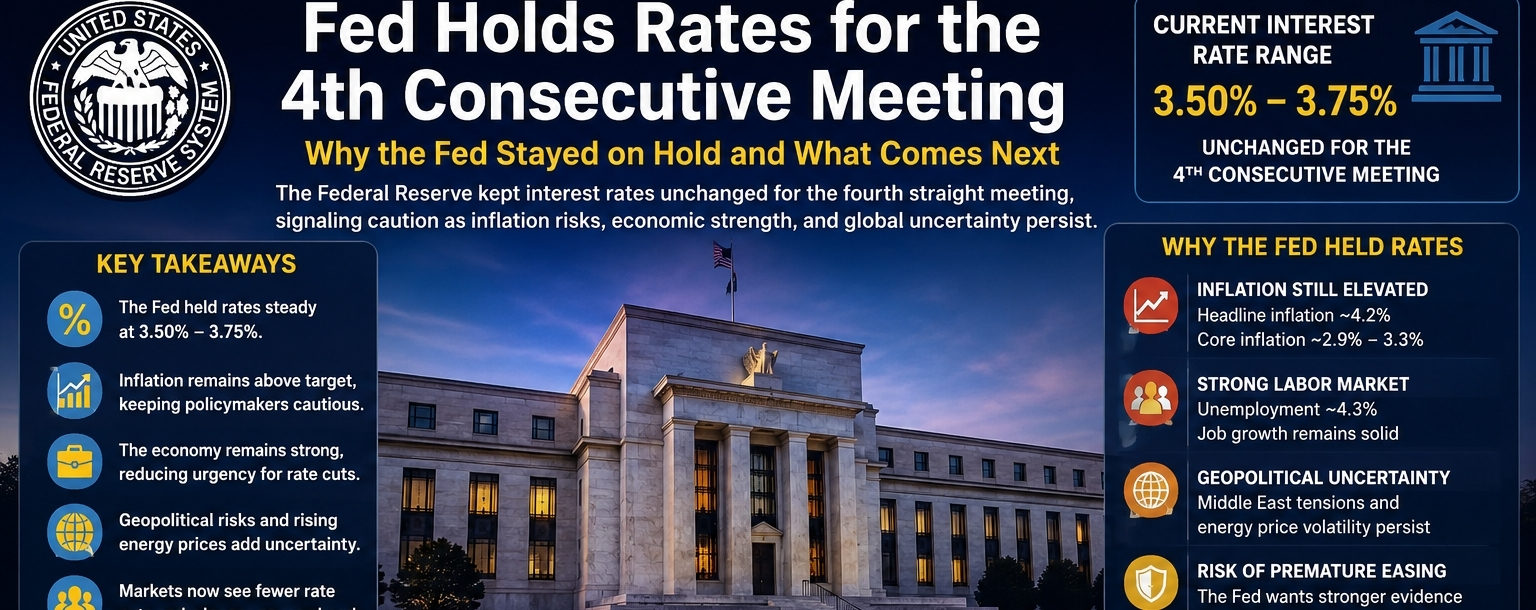
The Federal Reserve Chooses Patience Over Action as Inflation Risks Continue to Cloud the Economic Outlook
The U.S. Federal Reserve has once again captured the attention of global financial markets after deciding to keep interest rates unchanged for the fourth consecutive policy meeting. While the decision itself was largely anticipated by economists and investors, the broader implications extend far beyond a simple rate announcement. The latest move highlights a central bank that remains deeply focused on controlling inflation while navigating a complex economic environment marked by resilient consumer demand, geopolitical uncertainty, and shifting expectations across financial markets.
For months, investors had been searching for clues regarding the timing of the next monetary policy adjustment. Many entered 2026 believing the discussion would revolve around how quickly rates could be lowered. Instead, the conversation has evolved into whether the Federal Reserve may need to keep borrowing costs elevated for a significantly longer period than markets initially expected.
The fourth consecutive rate hold serves as a reminder that the battle against inflation remains unfinished and that policymakers are unwilling to risk undoing years of progress by easing financial conditions prematurely.
---
Understanding the Significance of the Fourth Consecutive Rate Hold
Interest rates influence nearly every aspect of the economy, from mortgage payments and credit card balances to corporate borrowing costs and investment activity. Because of this, every Federal Reserve decision has consequences that ripple through stocks, bonds, commodities, currencies, and increasingly, digital assets.
By maintaining the federal funds rate at its current level, policymakers signaled that they remain concerned about inflationary pressures despite substantial progress made over the past several years. Although inflation has declined significantly from the highs that followed the post-pandemic economic recovery, recent data suggests that price pressures are proving more persistent than many officials had hoped.
Rather than rushing toward rate cuts, Federal Reserve officials have chosen to wait for additional evidence that inflation is moving sustainably toward their long-term target of 2 percent. This approach reflects a growing belief that patience may ultimately prove less costly than acting too soon and risking another inflationary cycle.
The decision also underscores the confidence policymakers have in the broader economy. If economic conditions were deteriorating rapidly, pressure for immediate rate reductions would likely be much stronger. Instead, economic growth continues, employment remains relatively healthy, and consumer spending has demonstrated remarkable resilience despite elevated borrowing costs.
---
Why Inflation Continues to Be the Federal Reserve's Primary Concern
Although inflation is no longer dominating headlines at the same intensity seen during previous years, it remains the most important variable influencing monetary policy decisions.
The challenge facing policymakers is that inflation has become increasingly difficult to predict. Earlier phases of inflation were largely driven by supply chain disruptions, labor shortages, and extraordinary fiscal stimulus. Today's inflation environment is more complicated because multiple factors are contributing simultaneously.
Housing costs continue to remain elevated across many regions of the United States, while service-sector inflation has proven particularly resistant to decline. At the same time, rising energy prices resulting from geopolitical tensions have introduced additional uncertainty into future inflation forecasts.
Federal Reserve officials understand that inflation expectations play a critical role in economic behavior. If consumers and businesses begin expecting higher inflation to persist indefinitely, those expectations can become self-reinforcing through wage negotiations, pricing decisions, and spending patterns.
For this reason, policymakers remain committed to maintaining a restrictive stance until they gain greater confidence that inflation is firmly under control.
---
A Surprisingly Strong Economy Has Reduced Pressure for Rate Cuts
One of the most notable developments throughout the current economic cycle has been the resilience of the U.S. economy despite the most aggressive tightening campaign in decades.
Historically, sharp increases in interest rates have often resulted in significant economic slowdowns or recessions. Yet the U.S. economy has repeatedly exceeded expectations.
The labor market continues to generate jobs, unemployment remains relatively low by historical standards, and household spending has remained stronger than many forecasters predicted. Corporate balance sheets have also demonstrated resilience, helping businesses navigate a higher-rate environment more effectively than anticipated.
This strength creates an unusual challenge for policymakers.
While strong economic activity is generally positive, it also reduces the urgency for monetary easing. A healthy labor market and stable consumer demand can sustain economic growth, but they can also contribute to inflationary pressures if demand continues to outpace supply.
As a result, the Federal Reserve finds itself in a position where patience appears both possible and necessary.
---
Financial Markets Are Beginning to Adjust to a New Reality
Perhaps the most important takeaway from the latest Federal Reserve meeting is the growing realization that rates may remain elevated for longer than investors previously expected.
Throughout much of the previous year, financial markets priced in multiple rate cuts based on assumptions that inflation would continue falling steadily. However, recent economic data has forced investors to reassess those expectations.
Bond yields have fluctuated as traders adjust their outlook for future monetary policy, while equity markets have become increasingly sensitive to inflation reports, employment data, and Federal Reserve commentary.
The shift in expectations is significant because financial markets often move not on current conditions but on anticipated future developments. If investors begin believing that interest rates will remain higher for an extended period, valuations across numerous asset classes may need to adjust accordingly.
This dynamic explains why even a widely expected rate hold can trigger substantial market reactions when accompanied by a more cautious policy outlook.
---
What the Decision Means for Cryptocurrency Markets
Although Federal Reserve policy primarily targets the broader economy, its influence extends deeply into the cryptocurrency ecosystem.
Digital assets have become increasingly interconnected with global liquidity conditions over the past several years. When monetary policy becomes more accommodative and borrowing costs decline, investors generally become more willing to allocate capital toward higher-risk assets, including cryptocurrencies, technology stocks, and emerging growth sectors.
Conversely, when interest rates remain elevated, liquidity becomes more selective. Investors demand stronger fundamentals, greater profitability, and clearer growth prospects before committing capital.
This relationship explains why Bitcoin, Ethereum, AI-focused tokens, infrastructure projects, and emerging blockchain ecosystems closely monitor every Federal Reserve meeting. The availability and cost of capital often play a major role in determining the strength and sustainability of market trends.
While the latest rate hold does not necessarily signal bearish conditions for digital assets, it does suggest that future rallies may require stronger fundamental catalysts rather than relying solely on expectations of monetary easing.
---
The Three Economic Indicators That Could Determine the Fed's Next Move
As markets look ahead, several critical indicators will shape future Federal Reserve decisions.
Inflation Trends
Inflation remains the most important variable. Consistent declines toward the Fed's target would increase the likelihood of future rate cuts, while persistent price pressures could force policymakers to maintain their restrictive stance.
Labor Market Conditions
Employment data will continue serving as a key measure of economic strength. A weakening labor market could create pressure for monetary easing, while continued resilience may reinforce the case for patience.
Energy and Geopolitical Developments
Global conflicts and energy market disruptions remain major sources of uncertainty. Significant increases in oil and energy prices could reignite inflation concerns and complicate the path toward policy normalization.
---
A Defining Moment for Global Markets
The Federal Reserve's fourth consecutive rate hold is not simply another routine policy decision. It represents a critical moment in the ongoing effort to balance inflation control with economic stability.
Policymakers have made it clear that they are unwilling to declare victory prematurely. Inflation has moderated, but it has not disappeared. Economic growth remains positive, but risks continue to emerge from both domestic and international developments. Financial markets remain optimistic, yet central bankers remain cautious.
As the second half of 2026 unfolds, every inflation report, employment release, consumer spending update, and geopolitical development will carry heightened significance. Investors across traditional markets and the digital asset ecosystem will be watching closely for any signal regarding the Federal Reserve's next move.
For now, the message from policymakers is unmistakable: maintaining stability remains the priority, and until inflation shows more convincing signs of returning to target, interest rates are likely to remain at the center of every major market conversation.