
The cryptocurrency market is famous for its life-changing rallies, but it is equally notorious for its brutal corrections. In an environment driven by high volatility and 24/7 trading, the difference between a successful trader and a bankrupt one rarely comes down to who finds the best token—it comes down to who manages their risk effectively.
The 5 Pillars of Crypto Risk Management
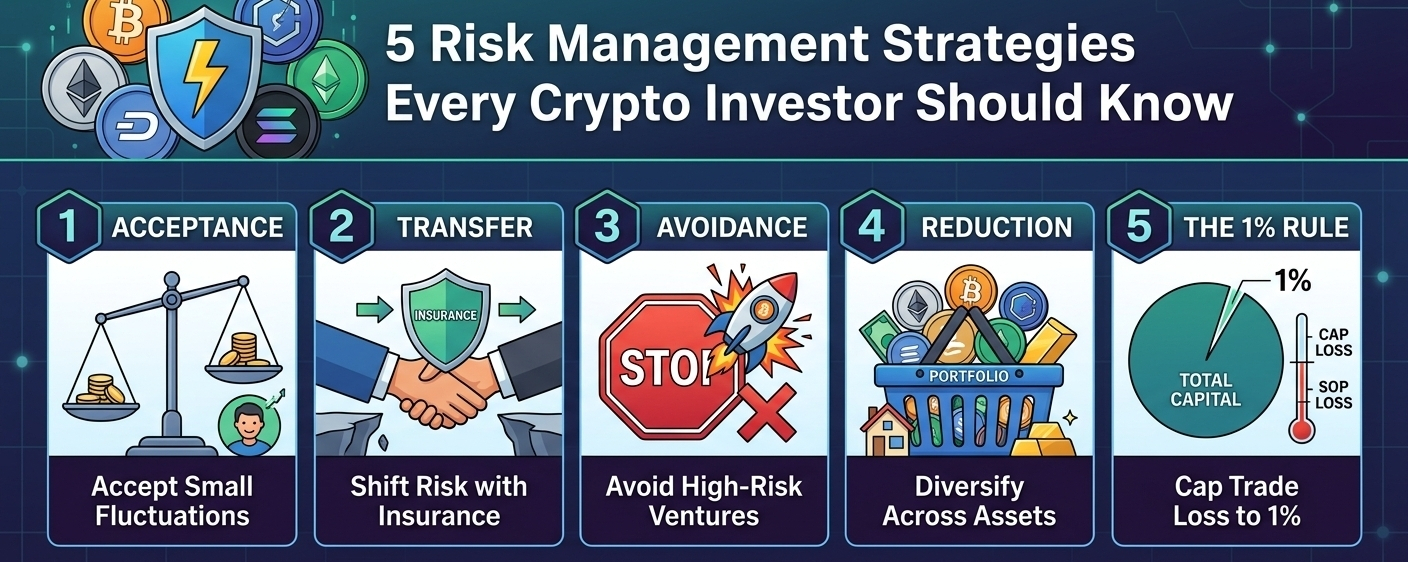
An infographic showing 5 Risk Management Strategies Every Crypto Investor Should Know, including Acceptance, Transfer, Avoidance, Reduction, and The 1% Rule. Look at the image watermarked_img_11621319690546079966.png.
1️⃣ Acceptance: Embracing Necessary Volatility
Every investment carries an inherent baseline risk. Risk acceptance means recognizing that certain small-scale fluctuations or minor losses are simply the "cost of doing business" in crypto. If the potential downside of a specific micro-cap asset or experimental protocol is small enough that it won’t impact your financial well-being, it makes sense to simply accept the risk. In these cases, spending extra capital on complex hedging strategies or insurance outweighs the benefit of the position itself.
2️⃣ Transfer: Shifting the Burden
When a risk is too large to absorb comfortably but you still want exposure to the market, you can choose to transfer it. In traditional finance, this is usually done via insurance. In crypto, risk transfer is achieved through decentralized coverage protocols (like Nexus Mutual) or by utilizing derivatives. By paying a premium for protective put options or hedging your spot holdings with short futures positions, you effectively shift the downside risk to a third party.
3️⃣ Avoidance: Knowing When to Walk Away
The simplest way to eliminate a risk is to stay completely out of its path. If a project feels overly hyped, lacks transparent documentation, or exhibits "rug pull" red flags, practicing risk avoidance is your best weapon. No matter how high the potential returns look on paper, if an asset exceeds your personal comfort level and risk tolerance, walking away is a sign of discipline, not missed opportunity. Capital preserved is capital available for safer trades.
4️⃣ Reduction: The Power of Diversification
You should never put all your digital eggs in one basket. Risk reduction relies heavily on diversification across different assets, sectors, and layers of the blockchain ecosystem. Instead of allocating your entire portfolio to a single meme coin or a single Layer-1 network, spread your capital across established giants (like Bitcoin and Ethereum), stablecoins, decentralized finance (DeFi), and infrastructure tokens. This minimizes the structural damage to your portfolio if a single asset goes to zero.
5️⃣ The 1% Rule: Hardcoding Your Downside
The 1% Rule is a gold standard among institutional and retail traders alike. It dictates that you should never risk more than 1% of your total trading capital on a single trade.
How it works: If you have a $10,000 portfolio, you should design your trade so that you only lose $100 if the market moves against you. You achieve this by pairing the rule with strict stop-loss orders, which automatically liquidate your position at a predetermined price point before a small loss spirals into a catastrophic portfolio wipeout.
💡 Operational Security (OpSec) Bonus Tips
Managing trade risk on a chart is useless if you leave your assets vulnerable to hackers and exploiters. Enhance your portfolio protection by adopting these four security habits:
Use Hardware Wallets for Long-Term Holdings: Keep your "cold storage" assets entirely offline using a hardware wallet (like a Ledger or Trezor). This ensures your private keys never touch an internet-connected device.
Enable App-Based 2FA: Never rely on SMS-based two-factor authentication, as hackers can easily bypass it via SIM-swapping attacks. Always use authenticator apps like Google Authenticator or YubiKeys.
Use Burner Wallets for DeFi: When interacting with new, unaudited DeFi protocols or minting NFTs, use a temporary "burner" wallet containing only the exact amount of funds required. Never connect your primary savings wallet to unverified smart contracts.
Always DYOR (Do Your Own Research): Never buy an asset based solely on influencer hype or social media trends. Read the whitepaper, analyze the tokenomics, audit the team's background, and verify contract addresses yourself#Read2Learn $BTC