
America isn’t collapsing because it lacks resources. It’s struggling because it can no longer produce leaders willing to confront concentrated wealth.
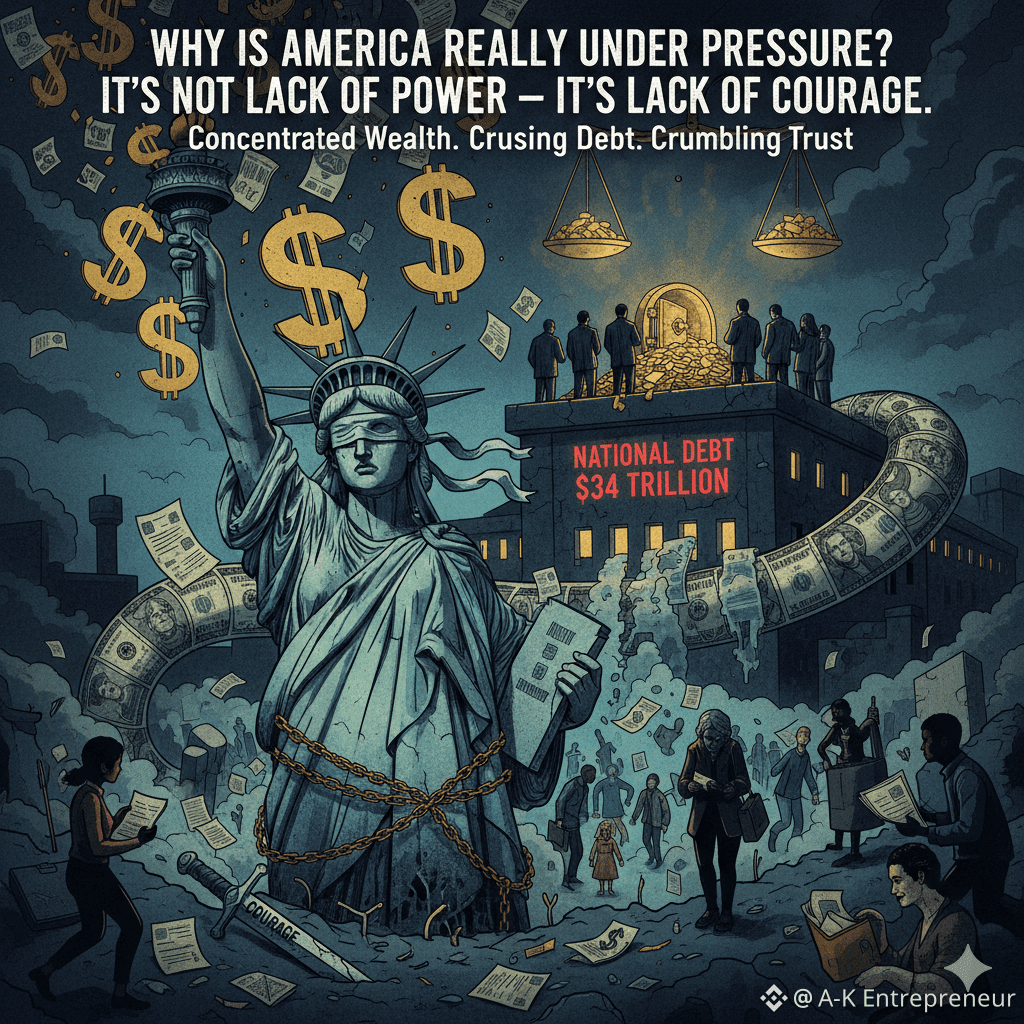
The U.S. government is spending far more than it earns. National debt has crossed $34 trillion, and interest payments are now the largest single expense, even bigger than military spending. That alone should alarm anyone watching macro trends.
Meanwhile, major financial institutions and ultra-wealthy groups on Wall Street sit on capital that rivals the GDP of nations. Money clearly exists in the system. The issue is where it’s locked and who controls it.
With limited options, the government keeps borrowing or expanding the money supply. The result is predictable: persistent inflation and declining purchasing power for ordinary people. Savings lose value while asset owners benefit.
In theory, during times like this, those with the most should help stabilize the system. If the country sinks, no one truly wins. In reality, that burden never reaches the top.
Why? Because political power and capital are deeply intertwined. U.S. elections require massive funding, much of which comes from financial giants. Any serious attempt to tax extreme wealth or tighten regulations faces intense lobbying and usually dies before becoming law.
This creates a distorted outcome: social programs are cut, public services weaken, student debt explodes, and homelessness rises — all while touching elite wealth remains politically untouchable.
History tells a different story. During the Great Depression, America recovered because leaders like Franklin D. Roosevelt confronted monopolistic capital directly. The New Deal, higher taxes on the wealthy, social security, and strong regulation rebuilt the middle class and restored confidence.
Today, that kind of leadership is missing. Modern politics revolves around reelection cycles and donor approval. Structural reform becomes a talking point, not action.
If this continues, debt will keep rising and confidence in U.S. fiscal discipline will erode. The dollar’s global dominance depends on trust in America’s ability to manage its finances. Once that trust weakens, volatility follows.
Even more dangerous is social fracture. When wealth concentrates at the top while living costs crush the majority, history shows instability becomes unavoidable. Markets can ignore inequality for a while, but societies can’t.
America still has the tools to fix this. What it lacks is a leader willing to challenge entrenched capital and rebalance responsibility.
Until that happens, the system remains stuck:
• The rich protect their wealth
• The poor absorb the pressure
• The government watches debt climb
That is the real risk facing America today.
#BTC90kChristmas #StrategyBTCPurchase #CPIWatch #USJobsData #USBitcoinReserveDiscussion
