
Most blockchain conversations revolve around speed, fees, or speculation. Very few pause to ask a quieter but more important question: where does all the data actually live? As decentralized applications mature, data is no longer lightweight metadata. It is media, history, identity, AI inputs, and long-term records. This is the problem space where Walrus Protocol operates, not by chasing attention, but by building infrastructure that data-heavy systems can rely on.
Blockchains were never designed to store large volumes of data efficiently. Storing everything on-chain is expensive, slow, and unsustainable at scale. Centralized cloud services filled this gap, but at the cost of control, censorship resistance, and long-term sovereignty. Walrus approaches this challenge from first principles, treating storage as a core layer of Web3 rather than an afterthought bolted on later.
At the heart of Walrus is a decentralized storage architecture built for efficiency. Instead of copying entire files across multiple nodes, the protocol uses erasure coding to split data into fragments. These fragments are distributed across independent storage providers, allowing files to be reconstructed even if parts of the network go offline. This dramatically reduces storage overhead while preserving durability and availability, two properties essential for real-world use.
This design choice matters because cost determines adoption. Storage that is theoretically decentralized but economically impractical will never power real applications. By lowering redundancy costs without sacrificing reliability, Walrus creates a model where decentralized storage can compete with traditional cloud services on efficiency while outperforming them on trust and censorship resistance.
Walrus operates on the Sui blockchain, leveraging its performance and scalability while keeping data storage logically separate from execution. This separation allows blockchains to focus on consensus and security, while Walrus handles the heavy lifting of data availability. The result is a cleaner architecture where applications can scale in complexity without overloading the base layer.
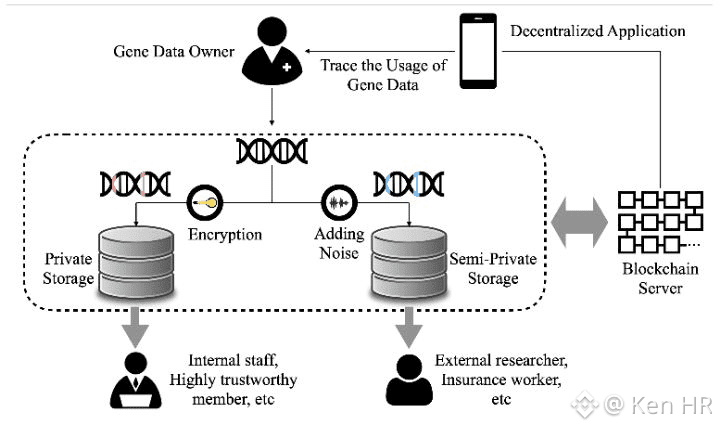
Privacy is another dimension where Walrus avoids shortcuts. Rather than exposing raw data paths or relying on trusted intermediaries, the protocol is designed to support privacy-preserving storage by default. This makes it suitable for enterprise use cases, regulated environments, and applications where sensitive data must remain protected without sacrificing decentralization.
The WAL token plays a functional role in this ecosystem. It aligns incentives between users, storage providers, and governance participants. Storage providers are rewarded for reliability and availability, while users pay for verifiable storage guarantees rather than vague promises. Governance mechanisms allow the network to evolve as storage demands change, keeping the protocol adaptable over time.
What sets Walrus apart is not a single feature, but coherence. Every design decision points toward long-term usability rather than short-term excitement. It is built for applications that expect to exist for years, not cycles. Social platforms, NFT media hosting, AI-driven systems, and enterprise data pipelines all require storage that does not disappear when market narratives shift.
In a space crowded with experimental ideas, Walrus feels closer to infrastructure than speculation. It addresses a problem most blockchains quietly depend on but rarely solve directly. As Web3 grows more data-intensive, protocols like Walrus will determine whether decentralization can scale beyond theory into everyday use.
If blockchains are the logic layer of Web3, then Walrus is helping define its memory. And memory, once lost, is something systems rarely recover.

