
In the current Web3 landscape, we’ve often been forced to make a "Devil’s Bargain": if you want your data private, prepare for it to be slow. If you want it fast, prepare for it to be public. This friction has kept sensitive enterprise data and personal medical records locked away in the "walled gardens" of Big Tech.
Walrus changes this narrative. By reimagining how data is "sharded" and "sealed," it offers a decentralized storage layer where privacy isn't a bolt-on feature—it’s the architecture itself.
1. The Secret Sauce: Red Stuff and Erasure Coding
To understand how Walrus maintains lightning speed, we have to look at Red Stuff. Traditional blockchains often try to achieve reliability by making 100 copies of a file. That’s slow, expensive, and a nightmare for privacy.
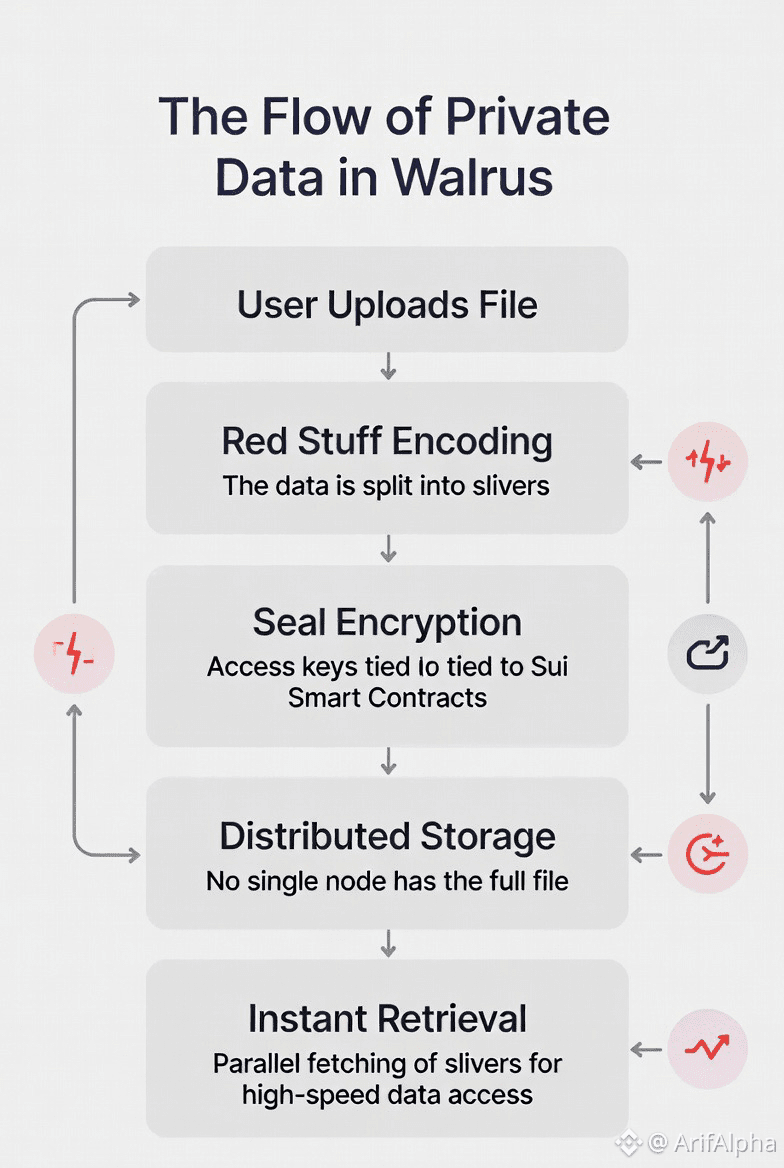
Walrus uses a two-dimensional erasure coding protocol. Instead of full replication, it breaks data into tiny fragments called "slivers."
• The Speed Factor: You don’t need to download the whole file from one slow node. You pull slivers from dozens of nodes simultaneously. It’s like streaming a movie where every pixel comes from a different source at the same time.
• The Privacy Factor: No single storage provider ever holds your entire file. To a node operator, your data looks like digital white noise. Even if a node is compromised, the attacker gains nothing but a useless fragment.
2. "Seal": The Programmable Privacy Guard
Walrus introduces a specialized layer called Seal. This isn't just basic encryption; it’s On-Chain Access Control.
Imagine a decentralized version of Spotify. In the old model, if an artist wanted to keep a track private for "Premium" fans, they’d have to trust a central server to guard the gate. With Walrus and Seal:
1. Encryption at Rest: The audio file is encrypted before it ever touches the network.
2. Smart Contract Gates: The "key" to decrypt that file is managed by a Sui smart contract.
3. Instant Decryption: Only when the fan proves they own the required NFT (the "Premium Pass") does the contract release the access key.
This happens in milliseconds, meaning the user experience is as smooth as any Web2 app, but with 100% data sovereignty.
Real-Life Scenario: The Patient-Centric Health App
Consider Clara, a developer building a Web3 healthcare platform. She needs to store sensitive MRI scans.
• The Problem: Traditional clouds can be subpoenaed or hacked. Public blockchains would expose patient data.
• The Walrus Solution: Clara’s app encrypts the MRI scan locally. It’s shattered into slivers via Red Stuff and scattered across the Walrus network.
• The Result: When the doctor needs to see the scan, the app fetches the fragments, reassembles them instantly, and decrypts them—all while Clara remains the only person who truly "owns" the data. No "middleman" ever saw the image.
The Flow of Private Data in Walrus
Why This Matters for the "Mindshare"
Walrus isn't just "another Dropbox." It is the first protocol to treat Data Availability (DA) as a financial asset. Because it lives on the Sui blockchain, storage is programmable. You can trade storage space, collateralize it, or even set files to "self-destruct" after a certain date.
By solving the privacy-speed trade-off, Walrus is moving Web3 from a niche playground for degens into a robust infrastructure capable of hosting the world's most sensitive information. It builds trust not through promises, but through the cold, hard logic of mathematics and decentralized consensus.
Join the Conversation
As we move toward a future where our digital identities are our most valuable assets, would you trust a decentralized network more than a centralized giant like Google or Amazon to hold your private documents? Share your thoughts below!
@Walrus 🦭/acc #Walrus #walrus $WAL

