

The first time I really felt Ethereum’s wait times wasn’t during some chaotic meme-coin launch. It was during a normal day when I just wanted a transaction to go through, and it didn’t. You sit there watching a wallet spinner like it’s 2009 buffering a YouTube video. Then you realize something important: in markets, speed isn’t a luxury feature. It’s part of the risk.
That’s the angle traders sometimes miss when they talk about “fast chains.” Speed isn’t about bragging rights. Speed is about how quickly you can react, how efficiently capital moves, and how much execution uncertainty you’re forced to accept. And that’s where Dusk’s positioning becomes interesting, especially when you compare it to Ethereum not as a technology fanboy, but as someone who cares about settlement times, fees, and predictable execution.
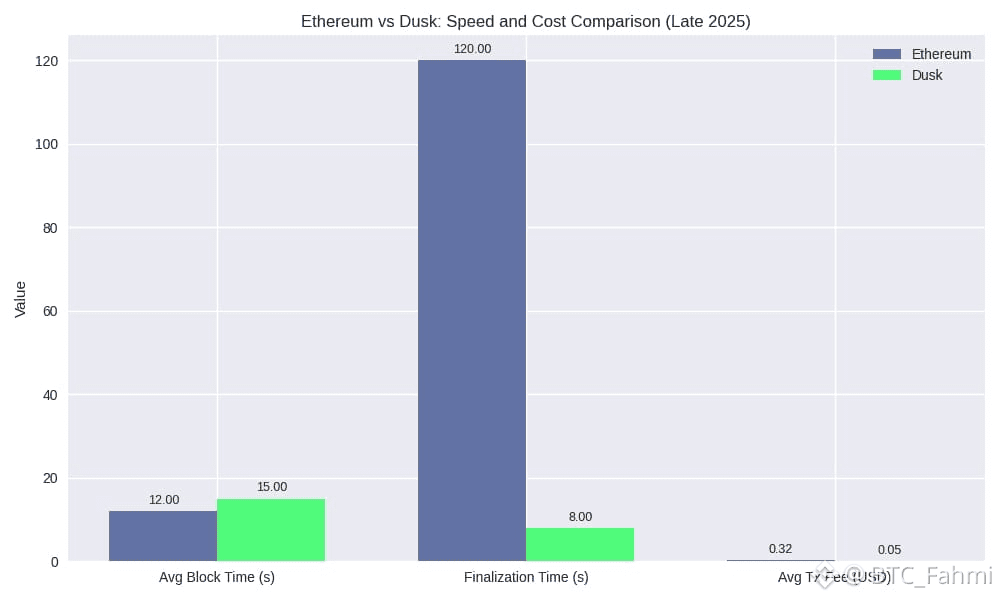
Ethereum has become a global settlement layer, but it’s not designed to feel instant. The network’s average block time sits around ~12 seconds. That sounds fast until you remember how the real user experience works. Most applications don’t treat “one block” as final. They wait for multiple confirmations, especially when the value is meaningful or when there’s a risk of reorgs, MEV interference, or competing transactions. In practice, that can stretch a basic action into minutes during normal periods, and longer during high-demand spikes. When activity surges, the mempool becomes a bidding war. If you underpay gas, you wait. If you overpay, you feel like you got taxed for existing.
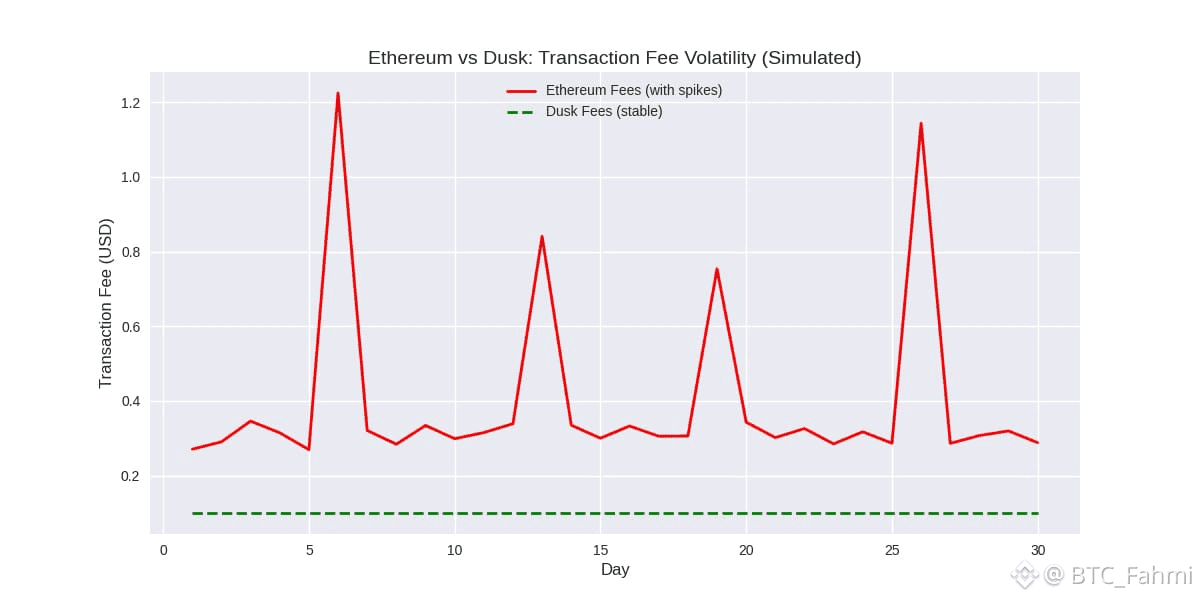
Fees are the second half of this picture. Ethereum fees are a moving target. In late 2025, the average transaction fee floated around roughly $0.30–$0.33 per transaction on some datasets. That’s not catastrophic, and it’s way better than Ethereum’s worst historical moments. But averages hide the lived reality traders care about: volatility. During sudden market events, onchain demand jumps and fees can snap upward quickly, especially when people rush to swap, bridge, liquidate, or exit. Some sources also point out how extreme Ethereum fees have been historically at peak congestion.
So what exactly is Dusk doing differently?
Dusk was built with a narrower mission than Ethereum: regulated finance infrastructure where privacy and compliance need to coexist. Instead of pushing everything into a completely public, transparent mempool by default, Dusk leans into privacy-preserving design and institutional workflows. The key point for traders is that Dusk’s architecture is aiming for faster and more predictable finality under its own consensus model, rather than trying to be the world computer for every use case.
According to Dusk’s own economic model documentation, block finalization in an ideal scenario is set to a minimum of 8 seconds, with a target block time of 15 seconds. That doesn’t automatically mean it’s “faster than Ethereum” in a simple way, because Ethereum’s base block time is slightly shorter on average. The real difference is not raw block time. It’s what that block time means.
Ethereum is optimized for decentralization and security at massive scale, but it’s also burdened by global demand. You’re competing with everyone: DeFi whales, NFT mints, bridges, liquidations, arbitrage bots, and whatever the market is obsessed with that week. That demand pressure is what creates the “wait time” feeling, even when the chain itself is technically producing blocks consistently.
Dusk’s bet is that if you focus on a specific lane (tokenized assets, institutional settlement, compliant DeFi, privacy-aware operations), you can design for smoother throughput and cleaner execution. Its consensus is described as having phases, including leader selection via Proof-of-Blind Bid and additional agreement stages designed to finalize blocks. In plain English: the system is engineered so blocks don’t just get produced, they get agreed upon and finalized through a structured process.
This matters because, from a trader’s perspective, the pain isn’t “Ethereum is slow.” The pain is “Ethereum is unpredictable.” When networks are unpredictable, you can’t confidently size positions, time entries, or manage exits with precision. You start padding for slippage, padding for delays, padding for worst-case gas spikes. That turns execution into a probability game.
Now zoom out to the trend that’s quietly reshaping everything: tokenization and regulated onchain finance. This isn’t the loud retail DeFi cycle where people chase yield. This is the world of tokenized securities, funds, real-world assets, and institutions that care about audit trails, controllable privacy, and compliance. Dusk is explicitly designed around that category of requirements, which is why the network’s tradeoff is worth understanding: it’s not trying to host everything. It’s trying to be good at one thing that traditional finance actually needs.
And this is where the “affordable” part comes in.
Ethereum can be affordable when demand is low, but it can become expensive when demand is high. Dusk’s long-term appeal is that a purpose-built chain for regulated finance should avoid the global bidding-war dynamic that dominates Ethereum mainnet usage. That doesn’t guarantee low fees forever, but it changes the fee psychology. If the chain is built to support financial products where costs must be predictable—think settlement rails, issuance systems, compliant exchanges—then “spiky fees” become a design failure, not a temporary inconvenience.
If you’re evaluating Dusk as a trader or investor, the cleanest way to think about it is not “Ethereum killer.” That’s not realistic. Ethereum is too embedded, too liquid, too socially and financially anchored. The better framing is this: Ethereum is a general-purpose settlement layer where you rent blockspace in a global market. Dusk is trying to offer a more specialized highway where the traffic rules are built for regulated assets, privacy-preserving transactions, and institutional behavior.
And personally, I think that distinction matters more than the usual speed arguments. Because speed is only useful if it’s paired with reliability. The kind of reliability where you don’t have to wonder whether your transaction will settle quickly, or whether you’ll be forced to pay 5x the normal fee because everyone panicked at once.
That’s the real meaning of “outpacing Ethereum’s wait times.” Not beating 12 seconds with 11 seconds. But building an environment where execution is smoother, confirmation is more predictable, and costs don’t feel like a surprise tax. For traders, that’s not just a nicer experience. That’s risk reduced. That’s strategy improved. That’s capital moving like it’s supposed to.