

The first time I started taking Dusk seriously wasn’t because of a loud announcement or a sudden candle on the chart. It was because I kept running into the same quiet problem in crypto trading: the real cost of moving money isn’t always the obvious trading fee. It’s the hidden friction slow confirmations, unpredictable network fees, failed transactions, and the way all of that turns a clean trading plan into a messy execution. If you’ve ever tried to rotate capital quickly during volatility, you know how it feels. You’re not “investing” in that moment you’re racing. And in a race, the smallest delays can become expensive.
That’s the lens traders should use for Dusk’s low-fee advantage. Low fees aren’t just a marketing bullet. They are a behavioral shift. When fees are consistently small, people stop hesitating. They rebalance more often. They split orders. They move liquidity between venues without overthinking it. In traditional markets, that sort of smooth capital flow is normal. In crypto, it still isn’t especially when you compare it to congested chains where the cost of a single action can spike unpredictably.
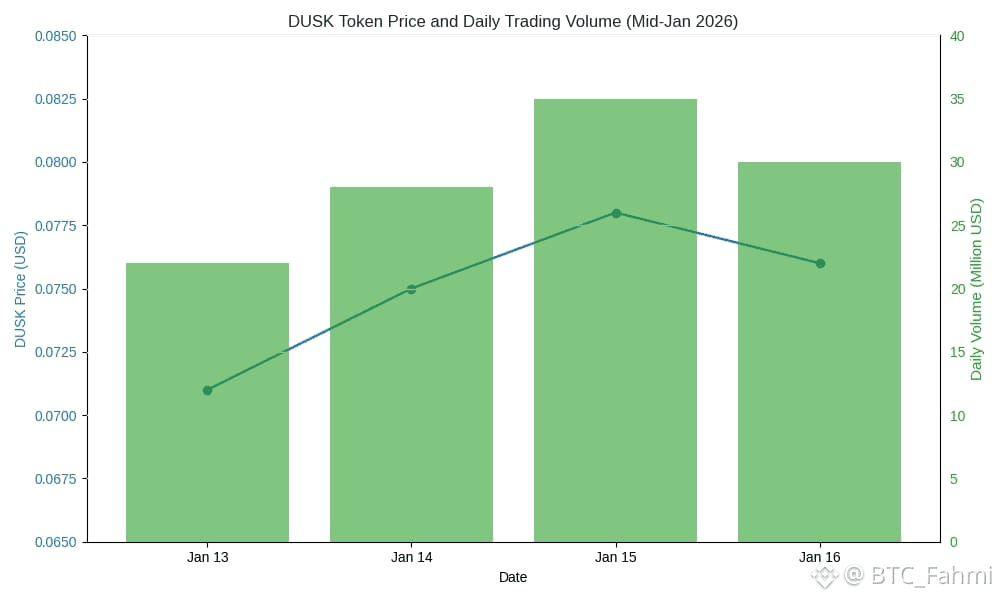
To stay grounded in real-world numbers, let’s start with what traders actually see today: token price and market activity. As of mid-January 2026, DUSK is trading around the $0.07–$0.08 zone across major trackers, with daily trading volume in the tens of millions of dollars and circulating supply near ~487M DUSK (varies slightly by data provider). That matters because lower unit price often psychologically encourages more on-chain usage people feel less “punished” when experimenting with transfers, staking, and interaction costs. But the bigger point isn’t the price; it’s what the network is designed to optimize.
Dusk’s core mission has always pointed toward regulated finance infrastructure settlement, compliant tokenization, privacy with auditability. Even years back, Dusk’s own writing emphasized faster block confirmation targets and practical settlement finality in the seconds range, framing it as closer to real-time settlement than typical probabilistic chains. In 2026, the same idea is repeatedly highlighted in newer ecosystem explanations: this chain is being positioned as a settlement layer with strong finality properties rather than a “wait and hope nothing reorgs” experience.
Now let’s connect that to the title: “Faster closes, smoother transactions.” Traders are used to the word “close” meaning the end of a position. But in practice, closing isn’t only pressing sell. It is the entire operational chain: moving collateral, bridging, settling, moving proceeds, reallocating, sometimes doing it again. Friction at any step is risk. If you can’t reliably and cheaply move funds when you need to, you start trading smaller than you want to—not because you’re conservative, but because the rails are unreliable.
Here’s a simple real-life example that will feel familiar if you trade actively. Imagine you catch a move and take profit, but your next best setup is elsewhere, and timing matters. On high fee chains, you hesitate. You think: “Is it worth transferring now? What if fees jump? What if the transaction gets stuck?” That hesitation is a cost. Sometimes it’s the difference between getting the next entry or watching it run without you. Low-fee chains don’t automatically make you richer, but they reduce the number of small decision frictions that grind performance down over a month.
This is why Dusk’s low fee narrative isn’t just about saving cents. It’s about making micro actions economical. When actions are cheap, you can behave like a professional operator: split funds, manage risk actively, move frequently, adjust positions without feeling like the network is charging you a penalty for being disciplined.
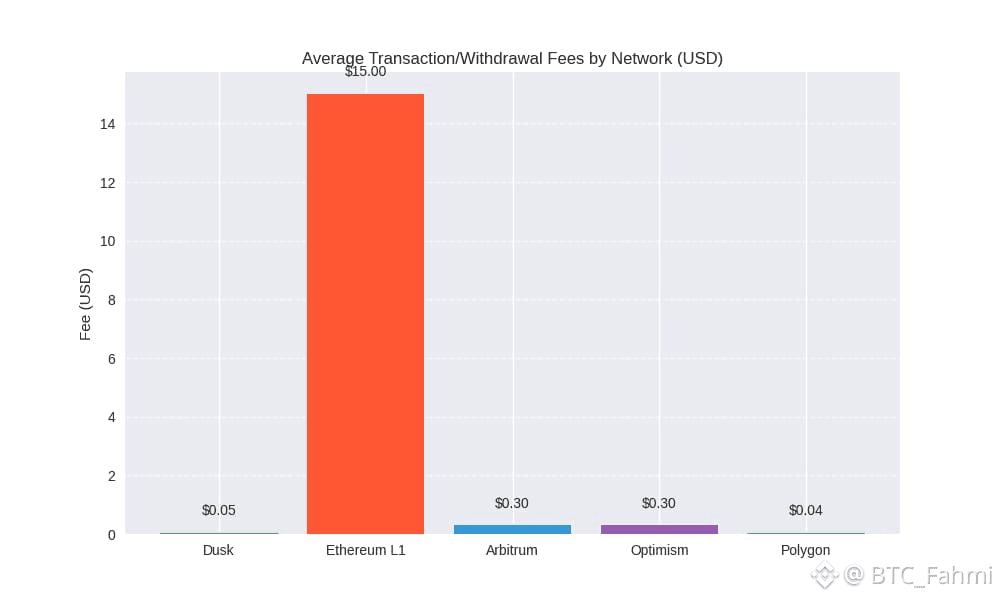
Even in something as basic as exchange withdrawals something most traders do weekly fees matter. For instance, tracking sites show that DUSK withdrawal fees on exchanges can be very low (examples include sub-$0.05 equivalents depending on platform and fee schedule). That’s not “on-chain fee,” but it reflects the broader truth: the asset and its transaction economics are generally not viewed as “expensive to move,” and that has real behavioral consequences for liquidity.
The other angle traders often miss is that low fees reduce execution stress. People underestimate how much stress affects decision making. When every transaction feels costly, you start second-guessing normal risk control behaviors. You delay moving to cold storage. You avoid small rebalances. You postpone exits. Over time, that changes your whole style into something less precise and more emotional. Low-fee environments support discipline—because discipline becomes affordable.
Of course, there’s a serious investor question underneath all this: do low fees come at the expense of security or decentralization? Sometimes, yes on some networks. But Dusk’s positioning leans toward using purpose-built consensus ideas and a settlement-first model, aiming for fast finality and a predictable operational environment. That doesn’t mean risk disappears. It means the chain is trying to optimize the exact thing finance demands: finality and cost predictability.
One more important nuance: not all of Dusk’s ecosystem has identical settlement characteristics. DuskEVM documentation, for example, notes that DuskEVM inherits a 7-day finalization period from the OP Stack as a temporary limitation, with upgrades intended to reduce that. Traders and investors should pay attention to these distinctions, because “fast finality” on one layer does not always translate equally across every compatibility layer or execution environment.
So what’s the unique takeaway here? Dusk’s low-fee advantage, if it persists, won’t just be about being cheaper than competitors. It will be about enabling a “cleaner” trading workflow where execution feels closer to traditional market plumbing: quick settlement, predictable cost, less friction. That’s the kind of advantage that doesn’t always show up in hype cycles, but it shows up in behavior. And behavior is what creates durable network usage.
If I had to summarize the investor lens in one line: low fees won’t guarantee price appreciation, but they can increase the odds that the chain becomes a place where serious activity can happen repeatedly without the network fighting its own users. That’s when “faster closes” stops being a catchy phrase and starts being a measurable edge.

