
Within the frame of modern blockchain rhetoric, a fascinating paradox currently afflicting the industry of 2026 is a state of plenty of throughput potential as opposed to a lack of deliberative intelligence. Many Layer-One and Layer-Two networks are claiming 100,000 transactions per second (TPS) but in effect they are inertified databases whose relational understanding is recognisably that of the ice age. They are correct in their transactional ledger records yet they are not doing the inference of context required to engage in the actual semantic processing.
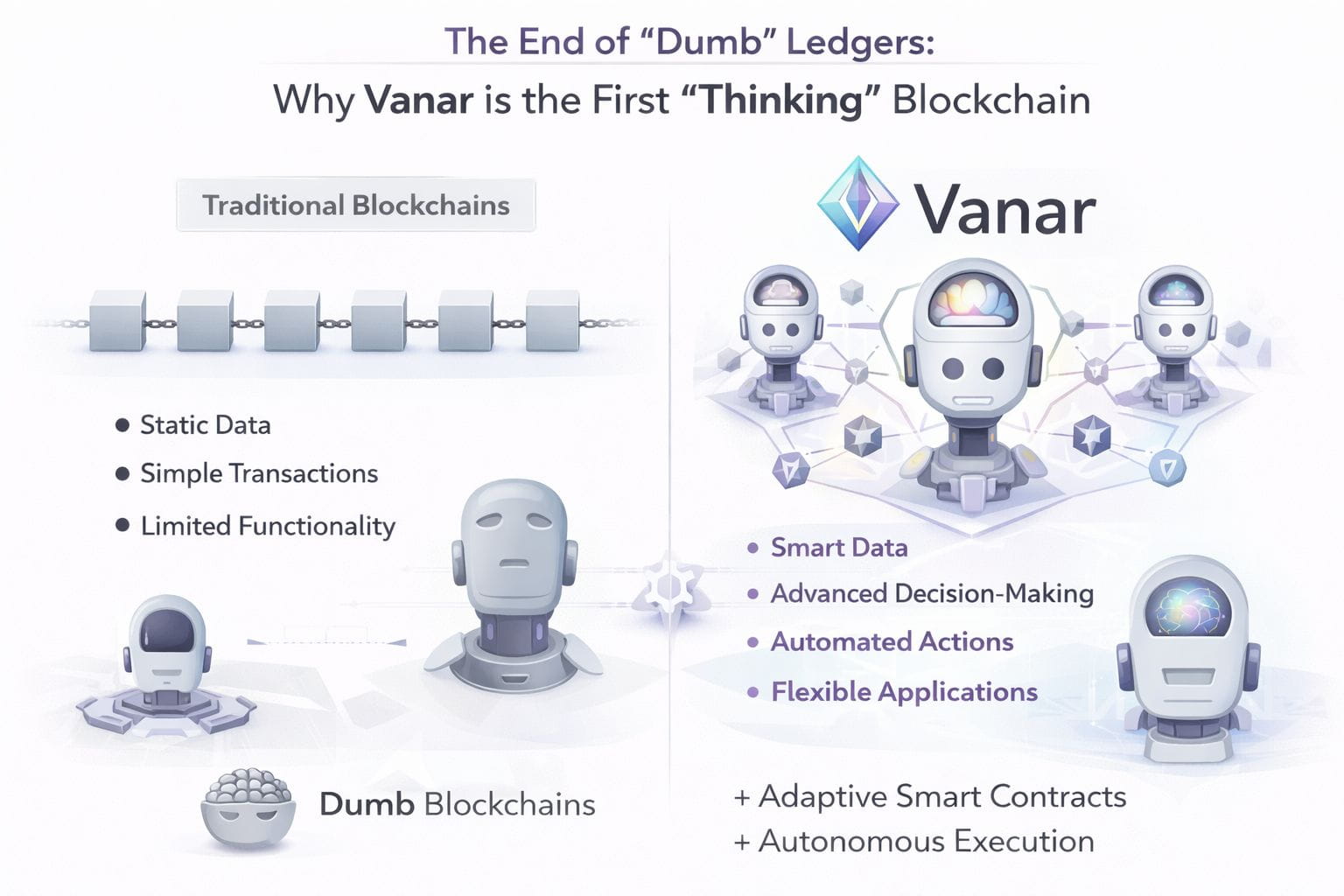
This lack represents what can be known as the missing link of the cryptocurrency economy. Having spent the past decade of its life in the democratization of programmable monetary instruments, humanity has now heard the voice of creating instrument like these into discriminating creatures. Vanar Chain has set itself apart in the larger group by not focusing on the short-lived speed wars and becoming the first of its kind to represent what can be called an Intelligence Layer.
What Fallen Away: The Context Vacuum
In the midst of the rise of heterogeneous chains in 2024 and 2025, there was one major blemish. In the event that an Ethereum smart contract is asked the question of Why did you execute this trade?, the smart contract, by design, will give no explanatory answer. The contract does not have any temporal memory, relation to exterior data, or semantic awareness but instead only codified logic (IF X, THEN Y). This theoretical nullification barred the realization of what amounts to actual artificial intelligence; an off-chain AI could indeed work well, but when it interacts with the blockchain it had to be reduced to primitive inputs and outputs. Vanar recognized that the industry needed not faster blockchains but some that could represent a meaning.
AI-Era differentiation The 5-Layer Stack.
Competitive advantage criteria in the AI epoch are radically different to those of the DeFi. The former focused on low fees and high throughput capabilities but the latter focused on memory and reasoning capabilities. The advantageous positioning of Vanar in 2026 is that it has left an all-encompassing architecture in favor of a narrowed down five-layer stack particular to AI workloads:
Neutron (Semantic Memory)- An antidote to AI amnesia. Neutron allows knowledge objects to persist whereas the other chains store raw hex. As a result, an AI agent on Vanar may store the behavioral logs of the user or brand-specific compliance requirements without re-processing a complete data provenance every time.
Kayon (Reasoning Engine) – This is an entire paradigmatic change. Kayon supports AI-based logic verification on-chain. Finally, instead of a black-box decision process, Kayon provides a transparent audit trail that goes on to explain the basis of each result, with the probabilistic aspects of AI thus being balanced in the deterministic verifiability of blockchain technology.
The Brand “Eco‑System”
The technical background is advanced but the interface is purposely easy to use. Vanar has not stopped being an entertainment-focused brand integrator. Rather, the Intelligence Layer has made the “Brand Blockchain viable. Companies were reluctant to use public chains before because of the negative constraints on user-experience. The Pilot Agent integration created by Vanar eliminates such friction instead users can ask things written in their own language, like, Send 50 VANRY to my savings instead of using the clandestine wallet hash language. This is not a Clojure UI decoration but inherent in the logic of the chain.
Additionally, the investment in renewable-energy projects by Vanar tackles environmental, social and governance (ESG) issues which have in the past discouraged the Fortune 500 participants. Customers are no longer just putting money into a blockchain, they are putting it in a smart infrastructure that is Ecofriendly and which is carbon-neutral.
Inference: Intelligence Blockwise.
The TPS will cease to be the metric of success in 2026, instead, Intelligence Per Block (IPB) will take its place, which is the quantity of work the network completes, context-aware. Whereas other chains are competing against each other to achieve liquidity in a zero-sum game, Vanar is building the nervous system upon which an autonomous economy rests. It is the only network, in which an AI agent can be implemented, trained, remembered and traded fully within a detached, controlled setting. The artificial intelligence is gradually taking over business activity, and in times like these, Vanar is not just another agent; it is the first smart highway.
