If you’ve been in crypto long enough, you’ve seen the same trade-off over and over: public chains are transparent (good for verification) but terrible for confidentiality, while private systems hide data (good for institutions) but often lose the open, composable power that makes crypto useful. Dusk is trying to solve that exact problem by building a privacy-first Layer-1 that is specifically designed for regulated financial markets—so institutions can follow rules, and users don’t have to expose everything to the world. �
DOCUMENTATION +2
At the core, Dusk positions itself as “privacy infrastructure” for real-world assets and institutional finance workflows (issuance, settlement, compliance, and reporting) without forcing everything to be fully public. The vision is simple: bring the benefits of public blockchains (programmability, shared liquidity, automation) to finance, while keeping sensitive data confidential and still supporting compliance needs. �
Dusk Network +2
A big reason this matters is because finance is not just “sending tokens.” Real markets have counterparties, regulated disclosures, KYC/AML requirements, and private positions that shouldn’t be broadcast on-chain. If every balance, order, or smart contract state is visible, institutions either won’t come—or they’ll build closed systems again. Dusk aims to be the middle path: confidential by design, but still programmable and open enough to build real markets. �
DOCUMENTATION +1
How Dusk works (in plain English) is easier to understand if you see it as a modular stack. In Dusk’s documentation, the network separates the base settlement layer from execution environments. The settlement layer (often described as DuskDS in docs) handles consensus, data availability, and final settlement, while an Ethereum-compatible environment (DuskEVM) provides familiar tooling so developers can deploy contracts with EVM workflows—while DUSK remains the native gas token in that environment. That modular design is meant to make Dusk “EVM-friendly” without sacrificing its privacy/compliance primitives. �
DOCUMENTATION +2
On consensus, Dusk has historically described a privacy-oriented PoS design (SBA / variations), and newer documentation describes Succinct Attestation, a committee-based proof-of-stake approach designed for fast, deterministic finality (meaning once blocks are ratified, they are final in normal operation). The “why” behind this is important: financial settlement needs predictable finality and low-latency confirmation, not probabilistic “maybe it reorgs.” Dusk’s docs emphasize deterministic finality and a consensus approach designed for markets. �
DOCUMENTATION +2
Another part that often gets overlooked: identity and access control. Dusk includes work like Citadel, described as a zero-knowledge based self-sovereign identity system, aimed at letting compliance checks exist without exposing identity data publicly. In regulated markets, identity and permissions are unavoidable—so Dusk’s approach is basically: don’t pretend KYC/AML doesn’t exist; instead, give developers tools to enforce rules while keeping user privacy intact. �
DOCUMENTATION +1
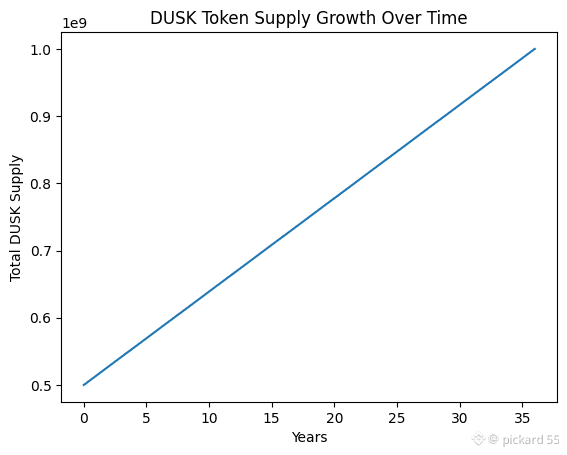
Now tokenomics—because on Binance Square people always ask “what does the token do?” and “how does supply work?” The official docs lay this out clearly: DUSK is used for staking, rewards to consensus participants, paying network fees, deploying dApps, and paying for services on the network. The docs also state an initial supply of 500,000,000 DUSK, plus 500,000,000 DUSK emitted over 36 years for staking rewards, giving a maximum supply of 1,000,000,000 DUSK. Emissions follow a long schedule with reductions over time (geometric decay style), designed to bootstrap security early but control long-term inflation pressure. �
DOCUMENTATION
Token distribution (from the same tokenomics documentation) includes categories like token sale, team, advisors, development, exchange, and marketing, with vesting historically running May 2019 to April 2022 per the docs. For staking details, the docs list a minimum staking amount (1,000 DUSK) and describe maturity/epoch mechanics. The key takeaway: DUSK isn’t “just a ticker”; it’s the security and fee asset that keeps the chain running. �
DOCUMENTATION
Ecosystem-wise, Dusk’s official messaging focuses on regulated digital securities, institutional DeFi, payment/settlement rails (including delivery-versus-payment), and identity-driven access control. In other words, it’s not competing head-on with meme chains or pure retail DeFi networks; it’s trying to become infrastructure where regulated markets can exist on-chain without leaking sensitive information. That’s why you see repeated emphasis on RWAs, compliance, and institutional-grade settlement. �
DOCUMENTATION +2
On roadmap and progress: Dusk has published roadmap-related updates (including “path to mainnet” and later updates), and it has also posted “Mainnet is Live” messaging around early 2025. The official narrative is that mainnet is a starting point, with continuing milestones afterward aimed at expanding capabilities and building toward broader financial use cases. �
Dusk Network +1
Of course, no deep dive is honest without the challenges. Dusk is operating in one of the most competitive and difficult segments in crypto: privacy + finance + compliance. The hard parts are not only technical (zero-knowledge systems are complex; building fast finality + privacy together is difficult), but also go-to-market: institutions move slowly, regulations evolve, and there are many competing L1/L2 ecosystems chasing RWAs. Dusk’s bet is that “privacy with compliance” will be a long-term necessity, not a marketing slogan—but adoption has to prove that. �
DOCUMENTATION +2
So how should someone think about Dusk today? If you believe the next major wave in crypto adoption is real financial activity on-chain—tokenized securities, regulated markets, private settlement, and compliant DeFi—then Dusk’s design choices make sense. If you think everything will remain fully transparent and retail-only, then Dusk’s privacy-first architecture might feel like overkill. But the problem it targets is real: markets need confidentiality, and regulation isn’t going away.