
By early 2026, we will have a different opinion on artificial intelligence. We no longer wonders about AI poems, we are horrified by the amount of data it consumes. Large language models have now become the era of continuous learning agents, and the transition has compromised the traditional decentralized storage.
The other type of internet was designed to support protocols like Filecoin and Arweave. Filecoin is a type of digital vault, useful in preserving history, slow and cumbersome to recover data. Arweave resembles a digital stone tablet - it is constant and irremovable, but it is too costly to store short-term data. Walrus is a novel project and AI agents do not require a patella or a stone butt; they require a scratchpad.
The “Red Stuff” Advantage
The gist of Walrus consists of a basic breakthrough named Red Stuff. It is a 2D erasure coding technique that transforms the operation of redundancy.
With the old decentralizing storage, it is safe to keep a file by making copies of the files 10 to 100 times in the network. That wastes a lot of space.
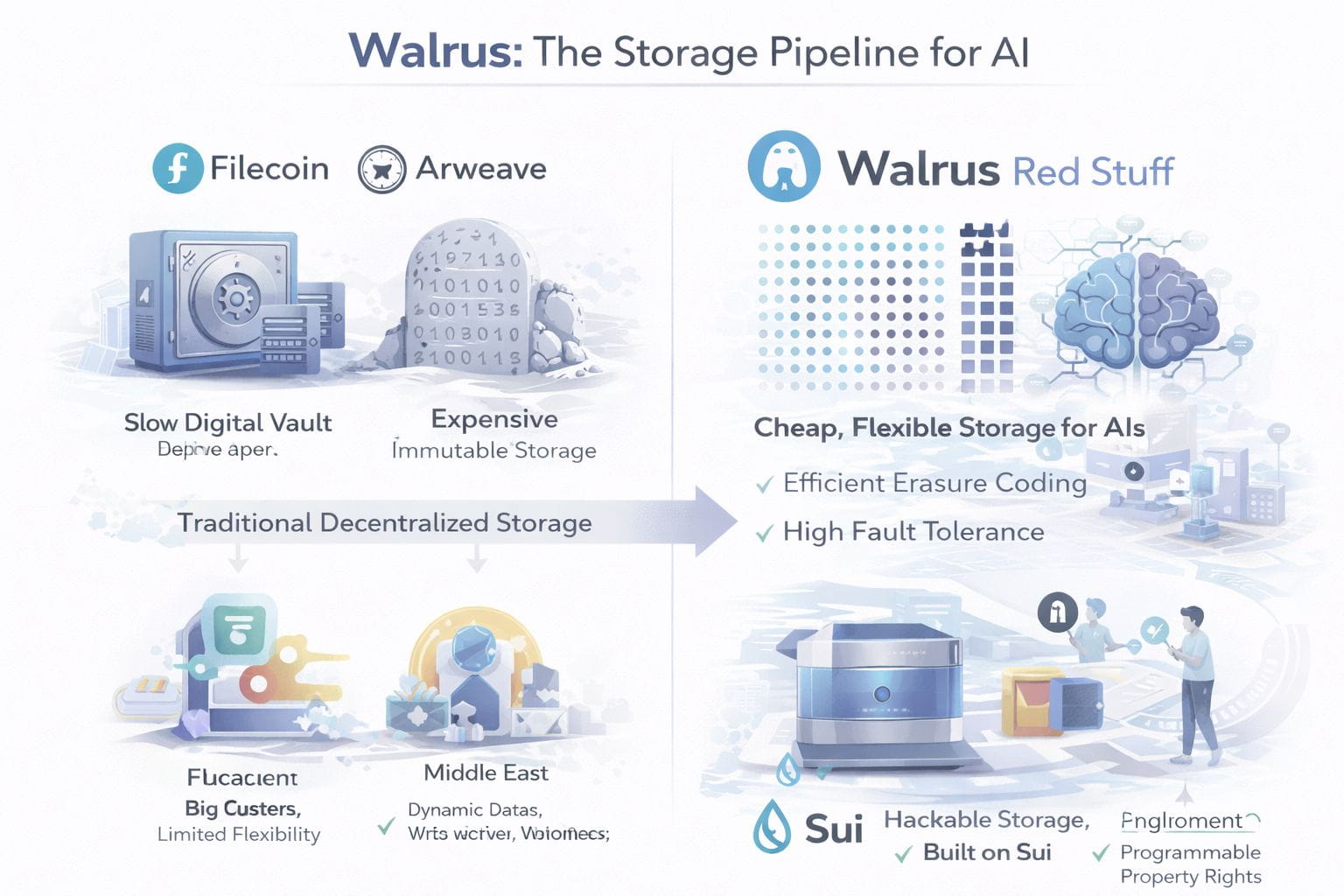
The file system of Walrus splits files into blobs and slices, allowing it only to of 45 occasions to be copied, but provides the same fault tolerance as the competitors.
This math can translate into profit or loss to AI firms being awarded with training models. They have the ability to store gigantic and often-transforming information on Walrus at low prices and, in the event 60 percent of the nodes do go down, the information could be retrieved immediately.
Hackable Storage: The Sui Connection.
Walrus is not a stupid drive, it is an intelligent drive. Being integrated into the Sui ecosystem and written in Move language, therefore, you can code its data storage behavior.
Through Data DAOs, in the year 2026 data will have its own logic. Imagine on a security camera an image of Walrus. The video on other chains is a static file. On Walrus, a video can be automatically deleted after 30 days (gdpr) using a smart contract or the access can be sold in case a specific on-chain payment occurs. This dynamic storage is crucial to next-gen dApps which require moving data not frozen data.
The “AI Granary” Thesis
The most sensible argument to invest in Walrus in 2026 is that it is the Digital Granary of AI. Generalizing such middle results, on the web, trial-and-error thought processes, and short-term log files, autonomous agents generate gigabytes of them as they percolate into the web. It costs money to keep this on Arweave (where it is forever). Leaving it on AWS (central cloud) is a threat to censorship. Walrus is the ideal intermediate cheap, fast, decentralized, and can be deleted.
It is now the ROM of the decentralized web and Arweave its RAM.
Verdict Infrastructure of the Machine Economy.
When common users are pursuing the newest memecoin trend, the shrewder capital moves to infrastructure. The proliferation of AI agents requires a storage that is not sandpaper-slow, as a 2017 blockchain is. Walrus did away with the intricate Proof of Spacetime, and took in its place the simple, rapid throughput. Walrous constructs the most efficient pipeline in a world where information is the new oil. It is not a Sui project only, it is a remarkable project in being the foremost choice to be the main driving force of the autonomous machine economy.



