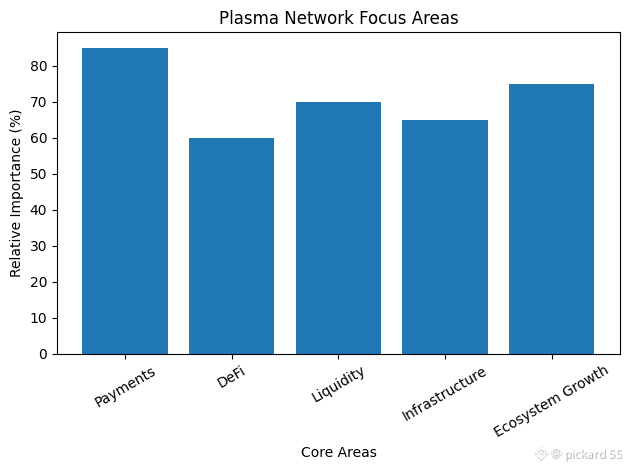
Plasma is trying to solve one very clear problem in crypto: moving stablecoins should feel as easy and normal as sending money on the internet. Today, stablecoins like USDT are already used worldwide for payments, remittances, savings, and business settlements, but the infrastructure behind them is still confusing, expensive at times, and not designed for everyday users. Plasma positions itself as a blockchain built specifically to fix this gap by making stablecoin transfers fast, cheap, and simple at scale.
Plasma is a Layer 1 blockchain that is stablecoin-native by design. Instead of treating stablecoins as just another asset on the network, Plasma treats them as the core use case. The chain is EVM compatible, which means developers can use familiar Ethereum tools and Solidity smart contracts, but the network is optimized around payments rather than speculation. This focus changes everything from fee design to user experience.
The reason Plasma matters is simple: stablecoins already have global demand, but the rails are not good enough. On many blockchains, users still need to hold a separate gas token, deal with unpredictable fees, and wait during congestion. For businesses and normal users, this creates friction and uncertainty. Plasma aims to remove these barriers by offering near-instant settlement, extremely low fees, and in some cases gas-abstracted transactions where users can send stablecoins without worrying about holding another token first. This makes stablecoins feel closer to real digital cash.
At the technical level, Plasma is built for speed and reliability. It uses a high-performance consensus design focused on fast finality, which is critical for payments. When someone sends money, they expect it to arrive quickly and with certainty. Plasma’s architecture is designed to support high throughput without sacrificing security. Because it supports the EVM, developers can easily deploy payment apps, DeFi protocols, and stablecoin-based financial tools without rebuilding everything from scratch.
One of Plasma’s key ideas is reducing gas friction. In many ecosystems, even if users hold USDT, they still need the native gas token to move it. Plasma promotes fee abstraction models where fees can be sponsored or handled in the background, allowing users to think purely in stablecoins. This is especially important for mainstream adoption, because normal users think in dollars, not in gas mechanics. Plasma also points toward future confidential payment features, recognizing that privacy matters for both individuals and businesses, as long as it can be balanced with compliance requirements.
The $XPL token plays the standard but important role of a Layer 1 asset. It is used to secure the network, align incentives, and support long-term governance. The initial supply at mainnet beta launch is 10 billion XPL. The distribution includes 40% allocated to ecosystem growth and incentives, 25% to the team, 25% to investors, and 10% to the public sale. Like most serious projects, these allocations are subject to vesting schedules, meaning supply enters the market gradually over time. From a utility perspective, $XPL supports staking, validator incentives, ecosystem rewards, and protocol coordination.
Because Plasma is focused on stablecoins, its ecosystem naturally attracts payment-centric applications. These include remittance services, merchant payment tools, treasury management platforms, stablecoin-heavy DeFi protocols, and wallets that feel more like fintech apps than traditional crypto tools. Deep liquidity is especially important for a payments chain, and Plasma emphasizes early liquidity support and integrations to make stablecoin movement efficient and reliable.
Looking ahead, Plasma’s direction can be understood in stages. First, proving that the stablecoin rail works smoothly with fast, low-cost transfers and strong wallet integrations. Second, expanding adoption through apps, partnerships, and broader ecosystem growth. Third, adding more advanced features such as privacy-enhanced payments and infrastructure suitable for institutional-scale settlement. The long-term vision is to make stablecoins usable not just for crypto users, but for anyone who needs digital dollars.
There are real challenges as well. Plasma operates in a highly competitive space, with networks like Tron, Solana, and Ethereum Layer 2s already handling large stablecoin volumes. It must clearly differentiate itself through user experience and reliability. There is also stablecoin issuer and regulatory risk, since Plasma’s success is closely tied to stablecoin usage. Another challenge is sustainability: ultra-low or zero-fee models must still support validators and network security without creating excessive token inflation or selling pressure. Finally, balancing privacy with compliance will be critical if Plasma wants to attract serious businesses and institutions.
Overall, Plasma is making a focused bet: that stablecoins are the killer app of crypto, and that the next phase of adoption will be driven by better payment rails rather than speculation. If Plasma can execute on speed, simplicity, and reliability, it has a chance to turn stablecoins into true internet money. The real signals to watch are real payment volume, user-friendly apps, and how the $XPL token economics support long-term network health.