
All block chains proclaim themselves as AI Chain by 2026. That is marketing. In actual sense, marketing is not code as perceived by developers and big companies. At this point, the industry desires a test named Proof of AI Readiness. The test will enable whatever an actual network can support AI agents or breaks down when provided with machine-generated information.
Evidence of AI Readiness is not such as is the case of Proof of Stake. It is an infrastructure check. It poses three difficult questions:
1) Does your chain read code (or see sense)?
2) Does your chain remember yet not injure the users?
3) Does it use your chain to explain to regulators your decisions?
The majority of Layer-1 chains pass none of the three. Numbers are no trouble to them but they disregard human foibles. Vanar Chain is the first chain to possess this audit as it is going to construct a new design rather than repair the old technology.
Semantic Density: The 47 Character Seed. The goal is efficient data. The AI agents require much video, audio, and legal documents. It is too expensive to store them in a regular blockchain. Vanar demonstrates that it is prepared with Neutron, which is its semantic memory layer. It looks at Semantic Density. On Vanar, a 4K video or huge legal PDF (25MB) is not stored as raw data. It is converted to a miniaturized image-semantic item referred to as Seed-47 features.
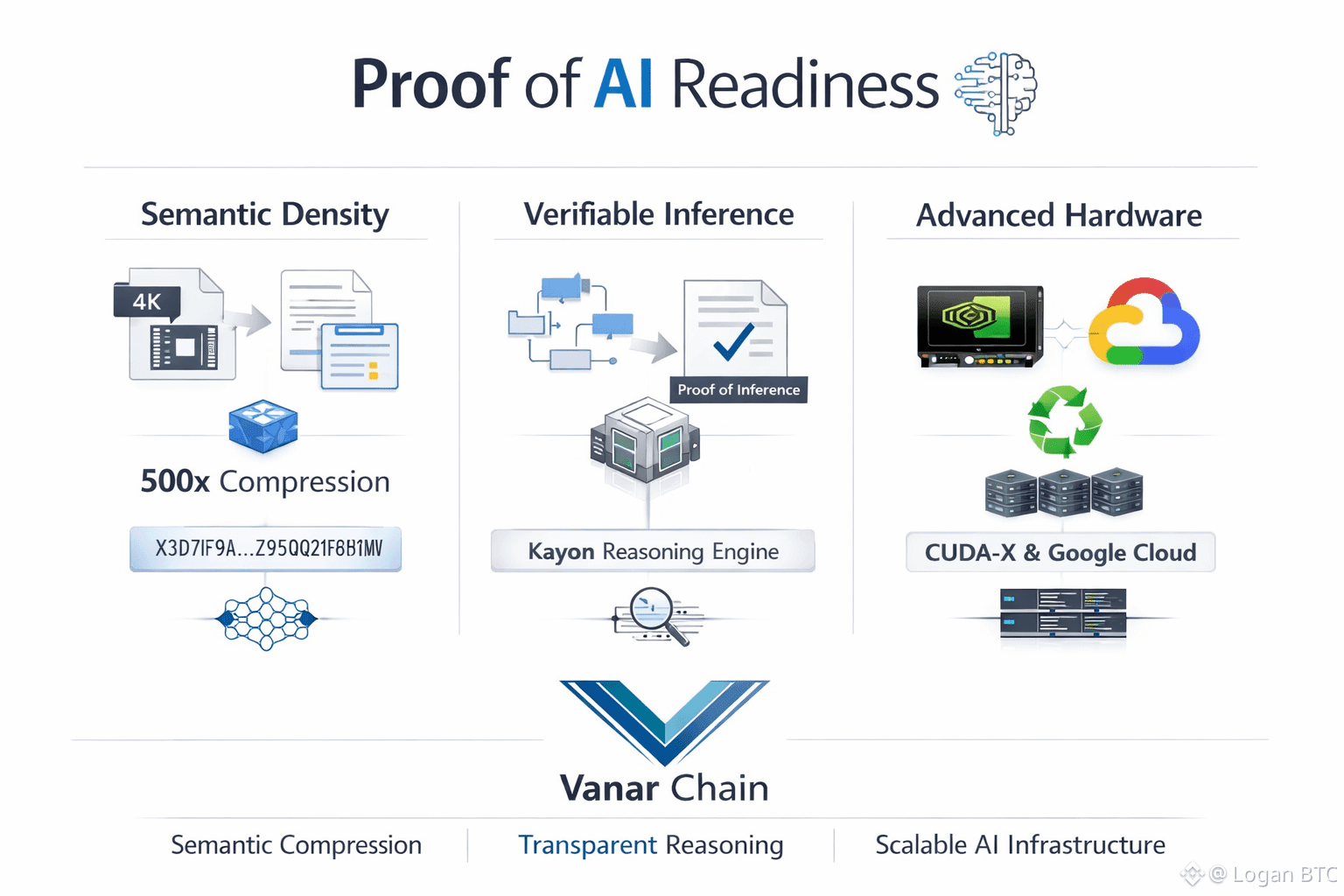
Not only can a server connection fail. It is a cryptographic document of the material, which is embedded on the chain. This allows an AI to read and comprehend the file without downloading the huge file. A 500 -to-1 compression makes on-chain high-speed AI trading and content creation affordable.
Was It Verifiable Inference: Why? The second pillar is explainability. In case an AI sells your stocks or refuses you a loan, then you need to know the logic. An AI on Ethereum or Solana is a black box: you do not know how and why it works, just that you can input and get output.
Vanar manages this through reason engine Kayon. The evidence of inference is demonstrated by Kayon. It leaves a trail of chain-on logic of the AI. It does not just indicate that a choice has been made, but it captures those thoughts which have followed down to the choice. This distinction is important in licensed industries such as health, or finance (PayFi sector of Vanar): it will never be the difference between an illegal bot and a legitimate employee.
Hardware Reality: Google/NVIDIA. Lastly, it requires physical strength. 2020 hardware can not support 2026 AI models.
Vanar demonstrates this by enhancing its physical infrastructure, which most crypto projects do not take into consideration. Through the NVIDIA Inception program, Vanar included CUDA-X AI libraries on its tools that also allows developers to build applications with real GPU throughput. The validator nodes that it uses operate on the Google Cloud and they are powered by recycled energy.
It is not only a green story, but also an action plan. Connections to the largest compute vendors allow Vanar to avoid network congestion when the AI demand rises.
Findings of Verdict: Speed (TPS) is important in the Intelligence Economy, but context is the value. The fact that Vanar does not only transfer tokens but substantial transactions allows it to be referred to as Proof of AI Readiness. It is where AI has the ability to read, comprehend, and sign a contract and pay in one block.
