
In 2026, Bitcoin and Ethereum will not be competing over the control of payments, it will be Plasma (XPL) vs. the traditional credit card firms. Merchants have been forced to pay a 3% per card swipe fee secretly over the decades. The new emphasis of plasma this year is not so much about being crypto friendly, but on saving money to merchants.
Whilst other blockchains are fighting to attract traders, Plasma is all about the Rebellion of the Merchant. By inverting the payment fee, Plasma is inventing a machine in which digital payment is cheaper than cash.
The “Negative Fee” Economy
The most significant effect of plasma in the year 2026 is the manner in which this invention will attract merchants. Normally, when you purchase a 5 dollar coffee, the store retains 4.85 dollars and the remainder is retained by banks and card firms. This is changed with Fee Abstraction and Validator Subsidies by Plasma. The network fees are virtually zero and as such, Plasma can pay merchants to accept XPL stablecoin payments. Plasma Zones are used in southeast Asia and the Middle East, where the merchant offers a discount of 2-3% on purchases made with Plasma One since they no longer need to calculate a 3% discount to a card processor. The Gasless aspect does not just make it easy to use, the Gasless feature elevates the profit margin among small businesses.
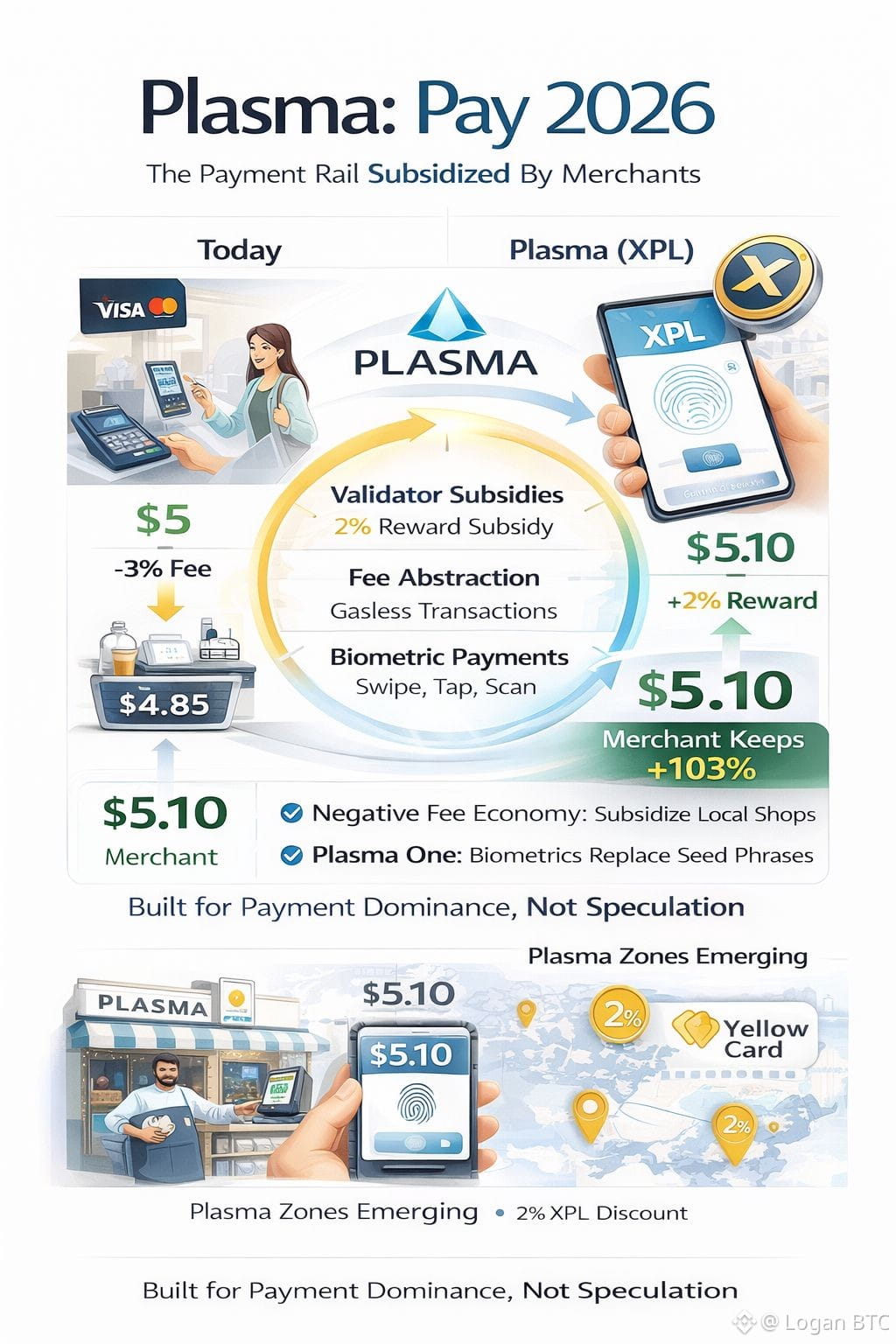
Plasma One: Biometrics Is the New Private Key.
In 2017, the concept of Not Your Keys, Not Your Coins was successful and did not receive many users. Most people will not be able to store a 12-word seed phrase safely, Plasma One realizes. The update of 2026 delivers complete Biometric Enclaves. Your face or fingerprint serves as your private key in the Plasma One application, and your phone has secure hardware that secures your key. This eliminates the largest concern of first time users; the loss of money due to a lost paper phrase. It provides a Venmo-like experience of recovery, with the system remaining a non-custodial system.
The NEAR Connection The Intents Upgrade.
Plasma also merged with NEAR Intents in January 2026. This is a large engineering move that causes Plasma to be less of a closed system. Previously, it was difficult to transfer 1 Ethereum to Plasma to pay for a lunch. Using Intents, a customer types a request such as I want to pay this merchant 10 USDT on Plasma, and the backend servers are used to bridge, swap, and settle that transaction immediately. This makes Plasma the liquidity sink of the entire crypto-space- regardless of where you keep your money, Plasma is the place that you pay it.
The Unlock that involves July 2026.
The tokenomics should be mentioned in a complete analysis. The July 2026 cliff is being monitored by investors when approximately 2.5 billion XPL ( Reserved to early investors and team) will enter circulation.
This possible market pressure is a spike in supply. One has to push high volumes of transactions before July so as to absorb that supply. This was the reason why they drive Yield-Bearing Stablecoins and collaborate with protocols, such as Pendle. They would have XPL become a necessary instrument of generating yield, a demand wall to offset the supply of the impending supply.
The Decision: It is a Payment Rail, Not a Technological Demo.
The plasma is unadorned and this is its great power. It is not trying to be the next Metaverse or AI swarm. It is concerned with transferring USDT between individuals with zero friction.
Plasma takes the space between overpriced Infrastructure and underpriced Apps in 2026. It is not more of a blockchain but rather a neobank that has finally ceased to seek permission.