
The problem of blockchains being too successful is quietly disrupting our infrastructure, in 2026. Very fast chains like Sui, Solana, and Monad can accomplish tens of thousands of transactions per second, and they generate several terabytes of information every month. This is referred to as State Bloat and it is the greatest threat to decentralization at the moment.
It requires 50 petabytes of storage memory to remain in sync with the network of a validator node, which only large data centers can afford. Permissionless computing dies, and great server farms are built. State Expiry, proposed by the industry, will allow the active ledger to be cleared automatically to keep the chain small and fast.
But this brings about a frightening new problem Digital Alzheimer. Without a record of your transactions in 2024 to save space on the blockchain, how do you know that you own your home? Walrus solves this problem. It is not merely a stora system, but also an all-purpose repository of several chains.
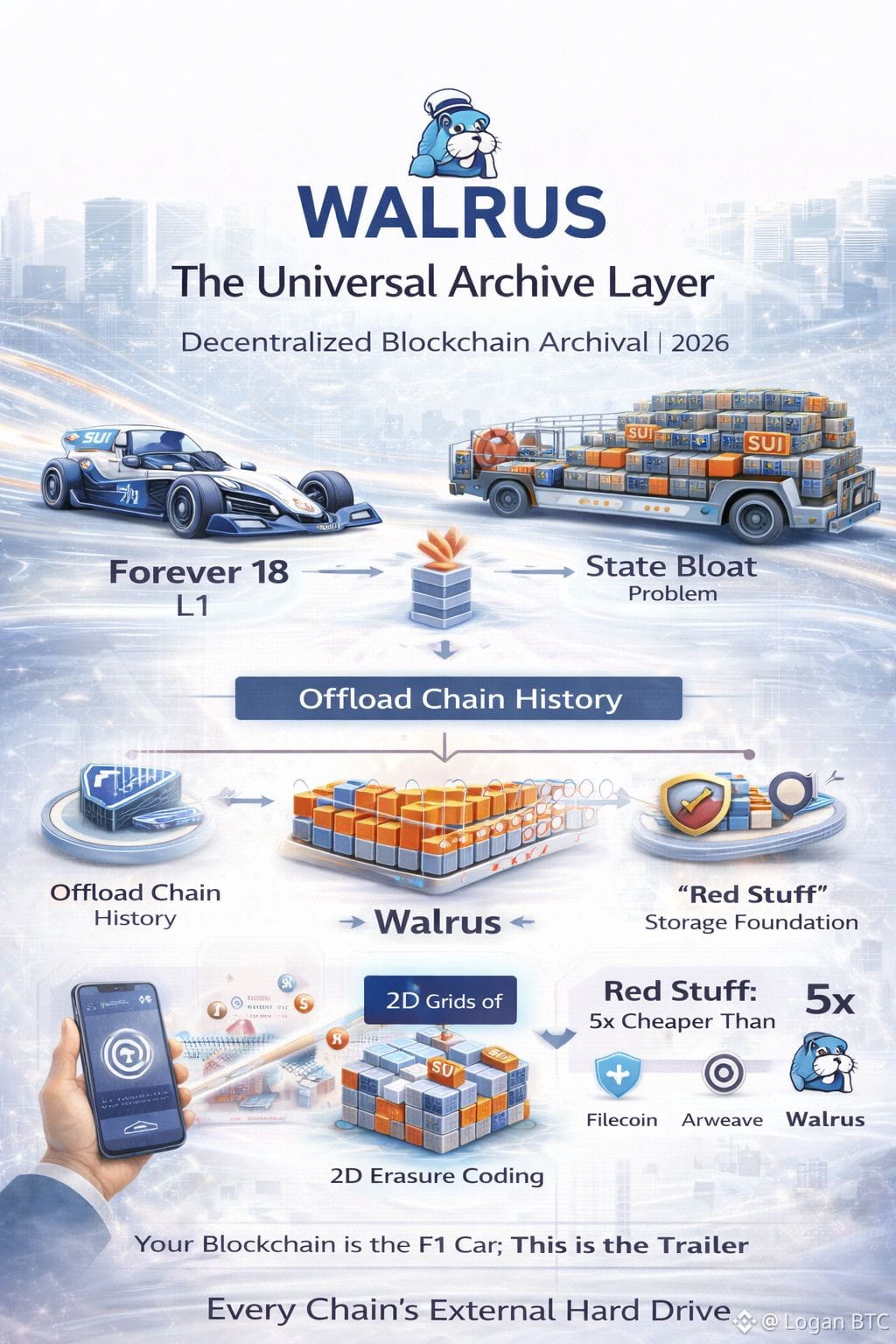
The “Forever 18” Blockchain
The new story by Walrus is that it behaves as an external hard drive in the execution of the main chain.
Consider a high-speed blockchain such as an F1 car. It must remain light to hasten. A ten years history of transactions is a trailer to that car.
By transferring old data to new locations, Walrus can leave chains like Sui Forever 18, always light and fast. Upon the expiry of an object on the main chain it is not erased; it is written to Walrus. Walrus operates with a feature known as Red Stuff (a 2-dimensional erasure coding process) which allows it to maintain massive archives with the promise that the information remains, at just a fraction of the cost as it would in the main-chain.
The reason why Red Stuff Alters the Economics.
Why use Filecoin or Arweave? It all depends on the nature of redundancy.
Regular decentralization of storage multiplies a file numerous times, such as 10 to 50 times, which is expensive. Red Stuff allows Walrus to partition data into 2D grids that consist of minute components known as slivers and blobs. This requires but five times the normal replication to ensure that everything is safe even in case two thirds of the network fail.
This efficiency can be the difference between profitability and bankruptcy of a main-chain that wants to off-load petabytes of history. Walrus is the sole protocol that is inexpensive enough to be the “trash can? of the speediest chains and preserve all the bytes.
The Emergence of Stateless Clients.
The greatest advantage of this design is that it is now possible to have real stateless clients.
It will not take too long until you will not need a massive node to check the chain. Instead, you will have a light client that you can use in your phone. You want a transaction three years old, or something, take out a little fragment, known as a “sliver” out of Walrus, match its evidence to the present main-chain state, and display the outcome immediately.
The design that will bring mass use is to separate execution on the main chain and history stored in Walrus. It allows the chain to span very fast and Walrus continues expanding its memory endlessly.
The 2026 Investment Thesis
People are putting their emphasis on AI agents and gaming when the actual investment money is being invested in data availability and archival.
Walrus now owns state offloading. Each big chain is aware that it cannot store everything of history indefinitely and therefore must have a place to do so. Walrus is that place. It is a simple, technical and necessary foundation upon which the Web3 economy risks losing its own record.



