Dusk Network is built around a very simple but powerful idea: real financial markets need privacy, but they also need rules. Most blockchains today choose only one side. Either everything is transparent, which makes them unsuitable for serious finance, or they are private and closed, which removes openness and composability. Dusk is designed to sit in the middle by being a public, permissionless Layer-1 blockchain that supports regulated finance without exposing sensitive data to everyone.
At its core, Dusk focuses on regulated use cases like tokenized securities, real-world assets, institutional trading, and compliant settlement. In these environments, privacy is not about hiding illegal activity. It is about protecting business data, investor positions, counterparty relationships, and personal information, while still allowing regulators or authorized parties to verify what they need. This is why Dusk treats privacy as a base feature of the network, not an optional add-on.
The reason this matters is simple. Traditional finance cannot run on fully transparent blockchains without serious risks. If every balance, trade, and strategy is public, it becomes easy to front-run orders, copy strategies, or map institutional flows. At the same time, institutions cannot move to systems that ignore compliance rules. Dusk aims to solve this by enabling selective disclosure: transactions and data can remain private by default, but proofs can be shared when required. This approach makes blockchain technology usable for real financial markets, not just experiments.
Technically, Dusk uses a modular design. The base layer, called DuskDS, handles settlement, data availability, and finality. On top of this, execution environments can run, including DuskEVM and Dusk’s native virtual machine. This separation allows the network to keep settlement secure and predictable, while still letting developers build flexible applications. DuskEVM is especially important because it allows Ethereum-style smart contracts and tools to run in a familiar environment, while still settling on Dusk’s infrastructure instead of Ethereum.
Privacy on Dusk is supported through different transaction models that allow both transparent and shielded transactions. This gives developers and users the ability to choose how much information is revealed, depending on the situation. For regulated finance, this flexibility is critical. Some actions must be visible, while others must remain confidential. Dusk’s design reflects this reality instead of forcing a one-size-fits-all model.
For consensus, Dusk uses a proof-of-stake system designed for fast and deterministic finality. Instead of relying on long confirmation times, blocks are proposed, validated, and ratified by committees. Once a block is finalized, it is considered settled. This kind of finality is important for financial use cases, where uncertainty and rollbacks are not acceptable.
A key part of the Dusk ecosystem is its approach to identity and compliance. One example is Citadel, which focuses on zero-knowledge identity and KYC. The idea is that users can prove they meet certain requirements, such as residency or eligibility, without sharing all their personal data every time. This reduces data leaks, improves user control, and still allows platforms to stay compliant. It directly addresses one of the biggest pain points in today’s regulated crypto services.
Dusk also works on bringing privacy into EVM-style finance through components like Hedger. Hedger is designed to combine cryptography techniques such as zero-knowledge proofs with EVM execution, enabling things like confidential trading or hidden order details while still keeping auditability. This is especially relevant for institutional users who need privacy to operate efficiently but cannot avoid oversight.
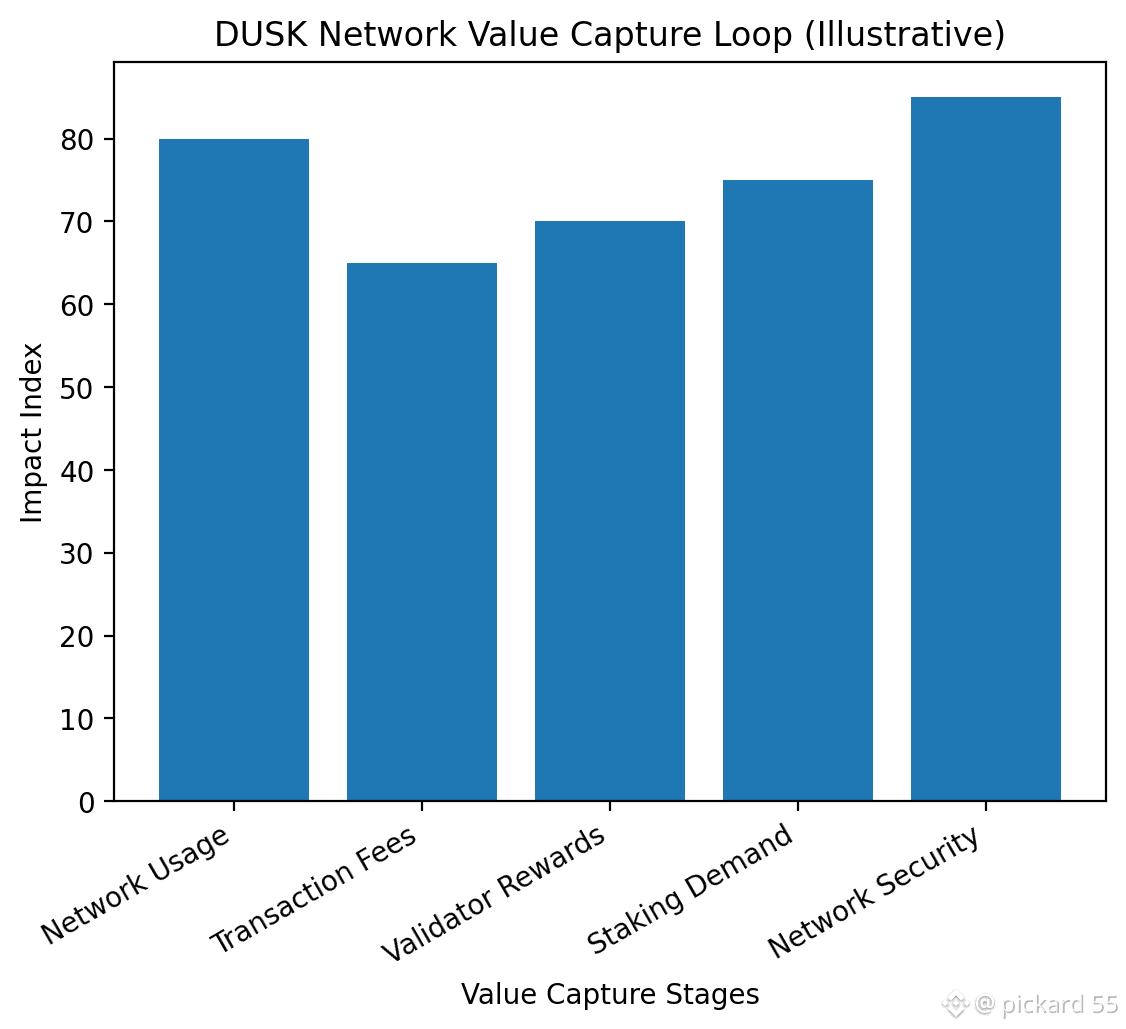
The $DUSK token plays a central role in securing and operating the network. The maximum supply is capped at 1 billion tokens. Half of this supply was allocated initially, while the other half is distributed over time through staking rewards across a long emission schedule of around 36 years. This slow and predictable emission model is meant to support long-term security rather than short-term inflation. $DUSK is used for staking, transaction fees, network participation, and incentives for validators and committees. Fees are measured in smaller units called LUX, which makes pricing flexible and precise.
Within the ecosystem, Dusk is aimed at applications such as tokenized securities, regulated DeFi, compliant trading venues, and payment or settlement rails. The focus is not on anonymous speculation, but on bringing real financial instruments on-chain in a way that institutions can actually use. The project has communicated that mainnet is only the beginning, with continued work on execution environments, privacy engines, identity systems, and real-world deployments.
Like any serious infrastructure project, Dusk also faces challenges. Privacy technology can be complex and resource-intensive, and it must scale without hurting user experience. Adoption in regulated markets is slow and requires trust, legal clarity, and real partners. There is also growing competition in the areas of RWAs, compliance-friendly blockchains, and privacy solutions. Dusk will need to prove its value not just with technology, but with real usage, volume, and long-term reliability.
Overall, Dusk is not trying to be everything for everyone. It is building for a specific future where blockchain is used by real financial institutions that need both privacy and rules. If that future continues to develop, Dusk’s approach makes sense. The real test will be execution, adoption, and whether regulated assets truly settle and operate on the network over time.