

Dusk Network Web3 me ek alag lane choose karta hai. Ye ek aisa Layer-1 blockchain hai jo speculation ya generic DeFi ke liye nahi, balki regulated financial systems ke liye ground-up design kiya gaya hai. Yahan focus simple hai: decentralization ke benefits ko real financial rules ke saath align karna — jahan privacy, auditability aur compliance tino equally important hote hain.
Most public blockchains transparency ko default maan kar chalte hain. Har transaction, balance aur address openly visible hota hai. Open finance ke liye ye approach theek hai, lekin regulated institutions ke liye ye practical nahi hota. Banks, issuers aur financial platforms ko confidentiality chahiye hoti hai, bina auditability lose kiye. Dusk isi problem ko directly address karta hai.
Dusk ka core idea ye hai ki regulatory requirements ko protocol ke andar hi build kiya jaye, na ki baad me add kiya jaye. Iska matlab hai ki confidential balances aur transfers possible hote hain, lekin jab legal ya compliance ke liye disclosure chahiye ho, to system break nahi hota. Privacy aur transparency ko yahan opposing forces nahi maana gaya — dono ko ek hi system ke parts ki tarah treat kiya gaya hai.
Network ka privacy model “privacy by design, transparency when required” principle par based hai. Advanced cryptography aur zero-knowledge techniques ka use karke Dusk transactions ko confidential rakhta hai, jab tak disclosure ki zarurat na ho. Users aur applications ke paas choice hoti hai: normal public transactions ya shielded transactions jahan sensitive financial data public ledger par expose nahi hota, lekin audit ke cases me verify kiya ja sakta hai. Ye balance real financial workflows ke liye critical hota hai.
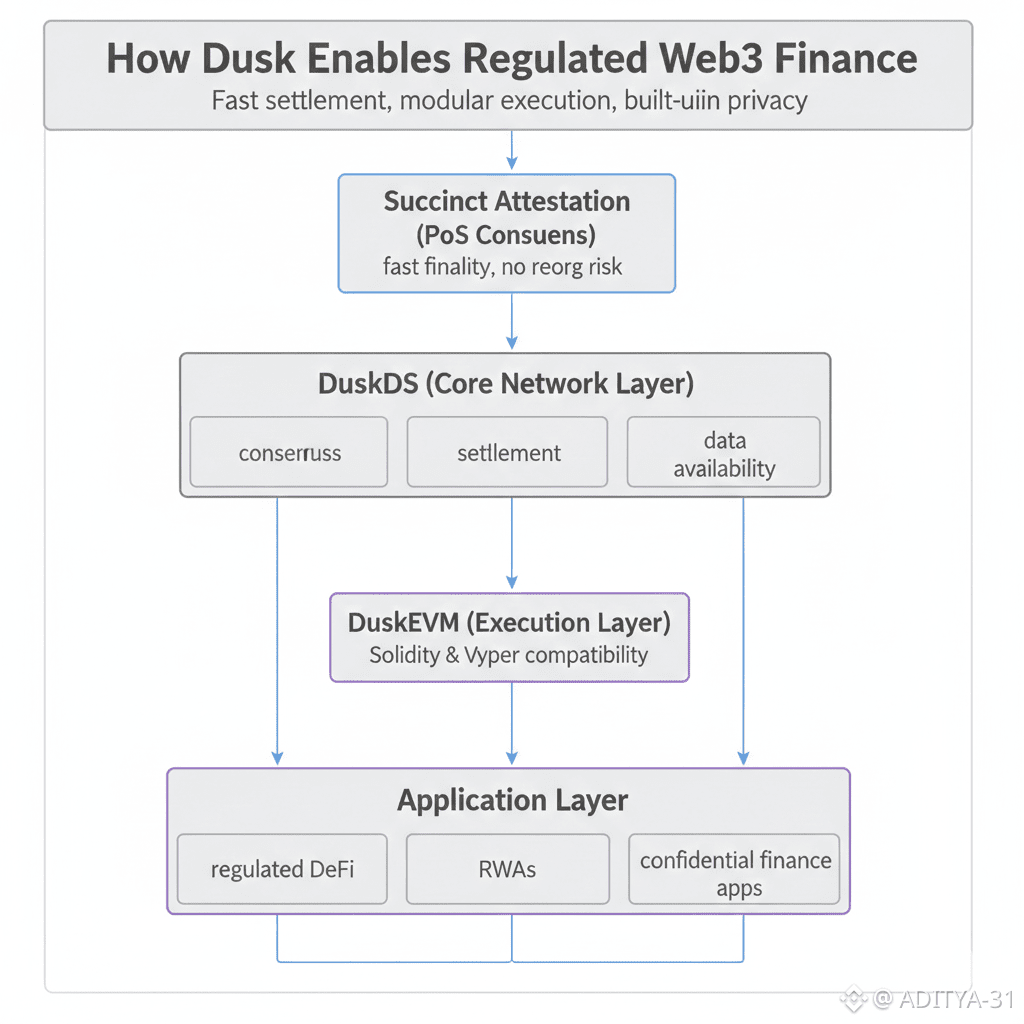
Privacy ke saath-saath Dusk performance ko bhi compromise nahi karta. Network ka consensus mechanism, Succinct Attestation, fast Proof-of-Stake finality deliver karta hai. Iska practical effect ye hota hai ki transactions jaldi aur permanently settle ho jaate hain — jo financial markets ke liye bahut important hai, jahan reorgs ya settlement delays real losses cause kar sakte hain.
Architecture level par bhi Dusk ka approach clean aur modular hai. Settlement aur execution ko alag rakha gaya hai. DuskDS network ke core functions handle karta hai — jaise consensus, settlement aur data availability — jabki DuskEVM developers ko familiar EVM environment deta hai. Solidity aur Vyper contracts wahi tools use karke deploy kiye ja sakte hain jo Ethereum developers already jaante hain. Isse adoption friction kaafi kam ho jaata hai.
Is design ka real impact use cases me dikhai deta hai. Dusk especially un areas ke liye fit hai jahan public blockchains struggle karte hain — jaise tokenized securities, real-world assets, institutional DeFi, confidential settlement rails, aur permissioned financial workflows. Ye sirf theory nahi hai. Regulated exchanges aur compliance-focused infrastructure providers ke saath partnerships dikhati hain ki Dusk legacy finance aur blockchain ke beech ek practical bridge banana chahta hai.
Developers ke liye bhi Dusk ek sensible choice banta hai. Ethereum-style tooling ke saath build karne ki familiarity rehti hai, lekin saath hi privacy aur compliance primitives already protocol level par mil jaate hain. Matlab teams ko privacy logic ya regulatory checks ko off-chain patch karne ki zarurat nahi padti — ye sab chain ke andar hi supported hota hai.
Overall, Dusk Network ka differentiation clear hai. Ye “one more Layer-1” banne ki koshish nahi kar raha. Ye ek aisi blockchain infrastructure build kar raha hai jahan decentralization, privacy aur regulation ek dusre ke against nahi, balki ek hi system ke andar kaam karte hain. Fast finality, modular architecture aur privacy-centric design ke saath, Dusk regulated Web3 use cases ke liye ek serious foundation banne ki direction me move kar raha hai.