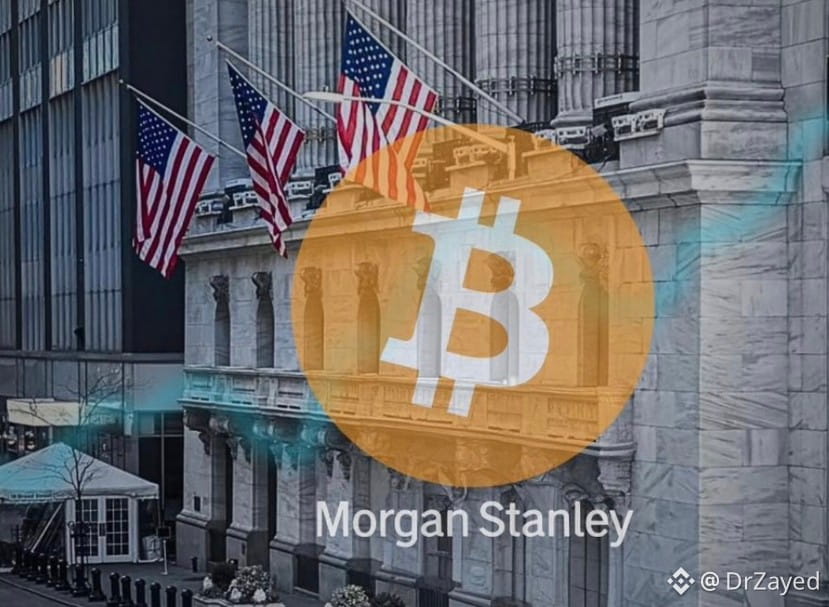
- Follow our account @DrZayed for the latest crypto news.
Grayscale Bitcoin Mini Trust ETF ($ BTC) is now available on Morgan Stanley’s platform, opening access to more than $ 7.4T in advisor AUM.:
The digital asset landscape underwent a permanent shift in January 2026 when Morgan Stanley, a cornerstone of global finance, officially integrated the Grayscale Bitcoin Mini Trust ETF into its massive wealth management ecosystem. This decision effectively unlocked a regulated, cost-effective gateway for over 15,000 financial advisors managing a staggering $7.4 trillion in client assets. By making the BTC ticker available on its platform, Morgan Stanley has not only validated Bitcoin as a legitimate asset class but has also provided the institutional pipes necessary for a generational rotation of capital into the digital economy.
To understand the weight of this development, one must consider the sheer scale of the Morgan Stanley wealth management machine. $7.4 trillion represents a significant portion of the investable wealth in the United States, held by high-net-worth individuals, institutional endowments, and family offices. For years, these clients were largely sidelined from the crypto market due to regulatory uncertainty and the lack of institutional-grade vehicles. The inclusion of the Grayscale Bitcoin Mini Trust ETF changes the equation by offering a product that fits seamlessly into the existing brokerage and advisory workflows that these investors have used for decades.
The selection of the Grayscale Bitcoin Mini Trust ETF is a strategic one, driven by the fund’s unique positioning in the market. Unlike the original Grayscale Bitcoin Trust ($GBTC), which carried a significantly higher expense ratio, the Mini Trust was designed specifically for the cost-conscious, long-term investor. With an ultra-low sponsor fee of just 0.15%, it is one of the most competitive spot Bitcoin ETFs available today. For a financial advisor at Morgan Stanley, the low fee is a critical selling point, as it minimizes the "drag" on portfolio performance over long time horizons, making it an ideal tool for the 2% to 4% "digital gold" allocation that the firm’s investment committee has recently begun to suggest.
The integration process at Morgan Stanley has been a multi-year journey of cautious evolution. In 2024, the firm took its first steps by allowing advisors to offer spot Bitcoin ETFs only on an "unsolicited" basis, meaning the client had to initiate the conversation. By late 2025, the restrictions were further loosened as the firm recognized the growing demand and the maturing regulatory environment. By early 2026, the arrival of the $BTC ticker on the platform signifies the transition to "solicited" access, where advisors can proactively recommend the ETF as part of a diversified, modern portfolio. This move is backed by deep internal research and a sophisticated suite of risk management tools designed to help advisors handle the inherent volatility of the crypto market.
From a technical perspective, the Grayscale Bitcoin Mini Trust ETF provides an elegant solution to the custody and security concerns that once plagued the industry. Investors in $BTC do not have to worry about managing private keys, setting up hardware wallets, or navigating the complexities of on-chain security. Instead, they own shares of a trust that is passively invested in Bitcoin, with the underlying assets held in secure, institutional-grade custody by providers like Coinbase. This "wrapped" exposure allows the asset to be treated like any other security—it appears on monthly statements alongside Apple stock and Treasury bonds, can be held in tax-advantaged retirement accounts, and is subject to the same oversight as any other NYSE-listed ETF.
The timing of this launch is also tied to a broader shift in the American regulatory climate. The 2026 financial landscape is governed by the GENIUS Act and new stablecoin frameworks that have provided the legal clarity Wall Street long demanded. This has allowed Morgan Stanley to move from a position of "observer" to "active participant." In tandem with adding $BTC to its platform, the firm has filed for its own proprietary crypto ETFs and integrated digital asset trading into its E*Trade subsidiary. This holistic approach ensures that Morgan Stanley is not just a distributor of crypto products but a central hub for the entire digital asset lifecycle.
For the broader Bitcoin market, the opening of the Morgan Stanley "advisor pipe" creates a massive, consistent source of buy pressure. Wealth management flows are typically "sticky" and long-term; once an advisor allocates 3% of a $10 million portfolio to $BTC, that position is often rebalanced rather than traded speculatively. This "institutional bid" acts as a stabilizing force, absorbing the volatility of retail-driven cycles. With other major wirehouses like Bank of America and Merrill Lynch expected to follow suit, the inclusion of Grayscale’s Mini Trust is likely the first domino in a trend that will see tens of billions of dollars in new capital enter the Bitcoin ecosystem over the coming year.
Advisors at Morgan Stanley are being trained to view Bitcoin not as a tech stock, but as a unique form of "pristine collateral" and a hedge against the debasement of fiat currency. In an era of high government debt and persistent inflation, the "fixed supply" narrative of Bitcoin resonates deeply with wealth management clients. The Global Investment Committee at Morgan Stanley has highlighted that while Bitcoin remains speculative, its low correlation with traditional asset classes like fixed income makes it a powerful diversifier in a "mid-to-late cycle" economic environment. The BTC ETF provides the most efficient way to capture this "diversification alpha."
Furthermore, the presence of BTC on the platform allows for more sophisticated financial planning. Advisors can now use automated rebalancing software to maintain a client’s target crypto allocation. If Bitcoin’s price surges and the 3% allocation grows to 6%, the software can automatically sell the excess to buy undervalued equities, "locking in" gains for the client. Conversely, if the price dips, the system can buy more, ensuring the client is constantly "buying low and selling high" without the emotional stress often associated with crypto trading. This level of professional management is a key differentiator for Morgan Stanley and a primary reason why high-net-worth individuals are choosing to access crypto through their advisors.
The social and cultural implications of this move are equally significant. For over a decade, Bitcoin was viewed by the financial establishment as a "renegade" asset. By placing it on the same platform as its most prestigious mutual funds and alternative investments, Morgan Stanley has effectively completed the "socialization" of Bitcoin. It is no longer an asset for the "fringes"; it is now a tool for the $7.4 trillion core of American wealth. This shift is attracting a new demographic of investors—older, more conservative, and vastly wealthier—who were waiting for the "Morgan Stanley seal of approval" before entering the market.
As 2026 progresses, the success of the Grayscale Bitcoin Mini Trust ETF on Morgan Stanley’s platform will likely serve as a blueprint for the tokenization of other real-world assets. The firm is already exploring how to bring private equity, real estate, and high-yield credit on-chain. The infrastructure being built today to support BTC will eventually serve as the foundation for a fully digital financial system where all assets are traded and settled with the speed and transparency of a blockchain. In this sense, the "Mini Trust" is just the tip of the spear.
Ultimately, the availability of BTC on Morgan Stanley’s platform represents a victory for accessibility and transparency. It provides millions of investors with a low-cost, regulated, and professionally managed way to participate in the growth of the world’s first decentralized global money. For Grayscale, it is a validation of their strategy to offer specialized, institutional-grade products. For Morgan Stanley, it is a commitment to remaining the premier destination for wealth in the 21st century. And for the Bitcoin network, it is the moment the "gates" truly opened.
The $7.4 trillion in advisor-led assets now has a direct path to the digital future. This is not just a new ticker on a screen; it is the integration of a new monetary standard into the world’s most powerful financial system. As the barriers continue to fall, the distinction between "traditional" and "digital" finance will vanish, leaving behind a single, unified, and more efficient market for all.