- Follow our account @DrZayed for the latest crypto news.
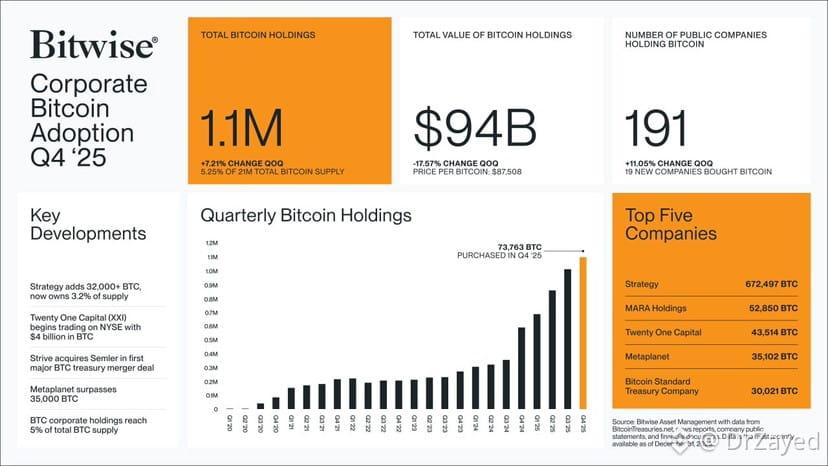
Corporate Bitcoin holdings hit 1.1M $BTC worth $94B in Q4’25, with 19 new public companies entering, per Bitwise report.
The fourth quarter of 2025 marked a definitive turning point in the history of corporate balance sheets, as the global trend of treasury diversification reached an unprecedented scale. According to the latest comprehensive report from Bitwise, corporate Bitcoin holdings have surged to a staggering 1.1 million BTC, representing a market value of approximately $94 billion. This milestone is not merely a reflection of price appreciation but a signal of a structural shift in how public companies view capital preservation and inflation hedging. The report highlights that the narrative of Bitcoin as a fringe asset for tech-centric firms has officially been replaced by its status as a foundational pillar of modern corporate finance, evidenced by the entry of 19 new public companies into the space during this quarter alone.
To understand the magnitude of 1.1 million BTC being held on corporate ledgers, one must view it in the context of the total circulating supply. With roughly 5.2 percent of all Bitcoin currently issued now residing in the treasuries of public and private corporations, the liquidity dynamics of the market are being fundamentally altered. Unlike retail traders who may buy and sell based on short-term sentiment, corporate entities typically adopt a long-term horizon, treating their Bitcoin holdings as a strategic reserve. This institutional absorption creates a supply sink that reduces the available float on exchanges, theoretically dampening downside volatility over time while setting a higher floor for the asset's valuation.
The profile of the 19 new public companies that entered the market in the final quarter of 2025 is particularly revealing. While previous cycles were dominated by companies like MicroStrategy or Tesla, the new wave of entrants spans a much broader array of industries, including energy, logistics, and traditional manufacturing. This diversification suggests that the "MicroStrategy Playbook"—using Bitcoin as a primary treasury reserve asset—has been validated by boards of directors across diverse sectors. These companies are no longer just exploring the technology; they are actively allocating a portion of their cash reserves to protect against the debasement of fiat currencies in a persistent high-inflation environment.
The Bitwise report notes that the average allocation size among these new entrants has also stabilized. Rather than speculative "all-in" bets, most of these 19 firms have opted for a disciplined allocation of between 3 percent and 7 percent of their total liquid treasury. This standardized approach indicates that corporate treasurers are applying the same risk-adjusted portfolio theories to Bitcoin as they do to other alternative assets. The emergence of clear accounting guidelines and the implementation of the GENIUS Act have provided the regulatory comfort necessary for these conservative boards to sign off on such significant financial maneuvers.
A key driver behind this record-breaking quarter was the maturation of the institutional infrastructure. For a public company to hold Bitcoin, it requires more than just a digital wallet; it needs a sophisticated ecosystem of qualified custodians, multi-signature security protocols, and real-time reporting tools that satisfy Sarbanes-Oxley compliance standards. The Bitwise report points out that the proliferation of "Bitcoin-as-a-Service" offerings from major financial institutions like Fidelity and BNY Mellon has significantly lowered the barrier to entry. These new corporate entrants are utilizing "wrapped" institutional products and regulated ETFs to gain exposure without the operational burden of direct custody, allowing them to integrate Bitcoin into their balance sheets with minimal friction.
The financial performance of these holdings has also provided a powerful incentive for further adoption. With the corporate aggregate value sitting at $94 billion, many of the early and mid-stage adopters are now sitting on substantial unrealized gains. These gains are not just academic; they strengthen the companies' balance sheets, improve their credit ratings, and in some cases, provide a source of liquidity through Bitcoin-backed lending. The Bitwise analysis suggests that the "wealth effect" of early corporate adopters is acting as a powerful marketing tool, as CEOs of lagging companies are forced to answer questions from shareholders about their lack of a digital asset strategy.
Another factor contributing to the 1.1 million BTC total is the emergence of "Bitcoin yield" strategies within corporate treasuries. A subset of the companies tracked in the report has moved beyond simple buy-and-hold strategies to participate in regulated staking or lending markets. By generating a 4 percent to 6 percent yield on their Bitcoin holdings, these firms are effectively turning a non-productive asset into a revenue-generating one. This "Internet Bond" narrative has gained significant traction in the Q4 boardroom discussions, as it offers a way to outperform traditional money market funds while maintaining exposure to the upside of the digital asset market.
The geographic distribution of these holdings is also beginning to shift. While U.S.-based companies still lead the pack in terms of total volume, the Bitwise report indicates a notable increase in adoption from companies in Japan, Brazil, and the United Arab Emirates. This global competition for a finite asset is creating a "sovereign-corporate" race, where firms are realizing that waiting too long to enter the market could result in a much higher cost of acquisition. The inclusion of Bitcoin in the corporate treasuries of major international players further cements its role as a global, neutral reserve currency that operates outside the influence of any single central bank.
The Bitwise report also addresses the psychological shift among institutional investors. In 2023 and 2024, the primary question from analysts during earnings calls was "Why do you own Bitcoin?" By the end of 2025, that question has largely shifted to "Why don't you own more?" This normalization is a critical component of the $94 billion valuation milestone. When Bitcoin is viewed as a standard component of a prudent treasury strategy rather than a risky gamble, the cost of capital for these companies may actually decrease, as they are seen as being proactive in protecting shareholder value against macroeconomic headwinds.
Looking ahead, the Bitwise analysis predicts that the 1.1 million BTC mark is merely a stepping stone. If the current trajectory of 15 to 20 new public companies per quarter continues, corporate holdings could exceed 1.5 million BTC by the end of 2026. This would represent nearly 8 percent of the total supply, further tightening the market and potentially leading to a "liquidity crunch" that could drive valuations significantly higher. The report suggests that we are entering a phase of "forced adoption," where companies that do not have a Bitcoin strategy risk being viewed as dinosaurs by a new generation of digital-native investors.
The social and cultural impact of this corporate embrace cannot be ignored. When major public companies, which are traditionally the most conservative entities in the world, commit $94 billion to an asset, it sends a message to the general public that Bitcoin is "safe." This trickle-down effect is likely to drive further retail adoption, as employees and customers see the companies they work for and buy from treating Bitcoin with the same respect as the U.S. dollar or gold. The Bitwise report concludes that the integration of Bitcoin into the corporate treasury is perhaps the most significant milestone in the history of the asset, marking its final transition into the core of global capitalism.
In summary, the Q4 2025 Bitwise report paints a picture of a financial world in the midst of a massive structural realignment. With 1.1 million BTC worth $94 billion now held by corporations, and 19 new public companies joining the ranks in a single quarter, the momentum is undeniable. This is no longer a trend; it is a fundamental shift in the definition of a "healthy" balance sheet. As the world’s leading firms continue to park their capital in a digital, decentralized, and finite asset, the very nature of corporate finance is being rewritten for the 21st century.