
There is a confusion in the field of applying the Artificial Intelligence in association with blockchain technology, which has brought out a reliable misconception, namely the distinction between the gimmick projects and the infrastructure builders. It is often admitted that the typical understanding of an AI Agent is a more intelligent chatbot or a trading bot writing better code. This is however a heinous restrictive perspective. It considers AI as a weapon of the human population, but not a participant in the economy.
Vanar Chain design refutes this fallacy by focusing on the most important missing element to the present-day AI market, Financial Agency.
The Forced Misconception: Intelligence/Autonomy.
The distinction between the terms of intelligence (intelligent) and autonomy is what people mostly misinterpret about AI agents. The creation of intelligence has been successful; LLMs can process data in large quantities and think rationally by referencing complicated problems. Because of the present-day environment of Web3, however, such agents are paralyzed economically.
They are able to propose a trade, however, they are not able to finance it, unless a human clicks upon the button that says approve.
They are able to locate a valuable dataset, but they are not able to purchase it.
They are able to negotiate a service, but settle not the invoice.
An AI agent cannot control this on his/her own and is just a consultant. It is brain in a jar-intelligent, but not connected with the physical and economic reality. To be a really autonomous agent, an agent should be capable of creating the loop: to think, see, make a choice, and compensate.
The reason why Payments Are the Last Mile of Infrastructure.
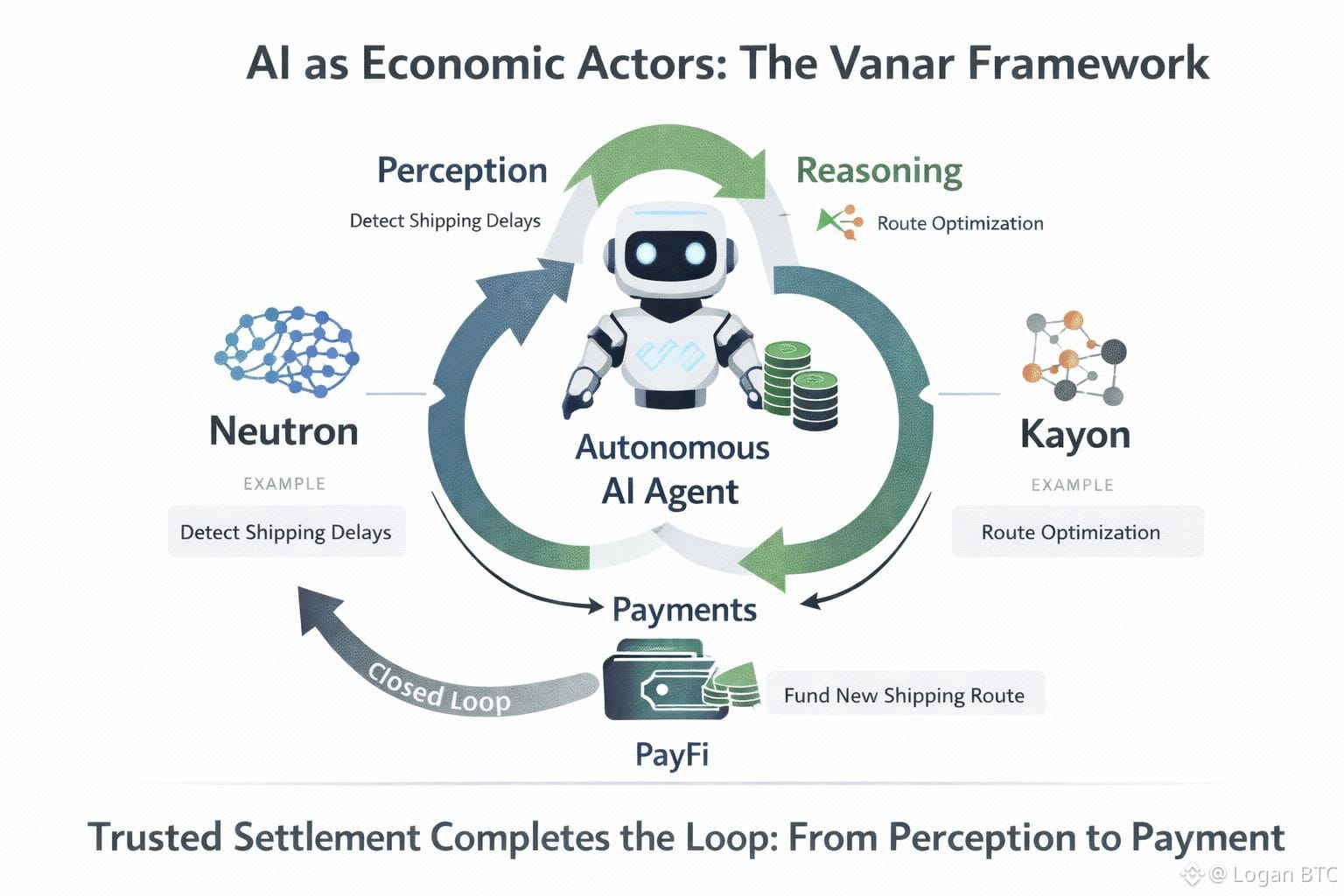
It is here that AI-First infrastructure at Vanar Chain is no longer all about compute or storage. Though other layers such as Neutron (semantic memory) and Kayon (reasoning verification), supply the brain and memory, the payment layer serves as the hands.
In Vanar, it is not the money that they move that is important but the Settlement as a Primitive. A wallet in a traditional blockchain is created with a human in mind having a private key. PayFi (Payment Finance) code infrastructure is used in the ecosystem of Vanar. Here, the agents have the opportunity to have their own wallets, run their own P&L (Profit and Loss), and do transactions with verifiable logic.
Given a working example, an autonomous specialized agent is assigned the duty of maximizing a supply chain.
Perception: It detects that there is a delay in shipping data (stored through Neutron).
Rationalization: It computes the cost of re-routing the shipment as lower than the penalty of delay (confirmed by Kayon).
Action (The Missing Link): It gives an on-the-spot payment to the logistics provider to re-ship the cargo.
Without the payment layer the agent halts at step 2, and makes notification to a sleeping human manager, which has lost the opportunity before it can happen. The economic action is made instant with Vanar payment infrastructure.
The "Economic Actor" Paradigm
Vanar Chain assumes that the billion falsehoods of blockchain will not be human beings but agents. Millions of illegal micro-transactions that are either too minor or frequency cannot be done by human beings will be done by these agents. They will spend on API decisions, buy temporary storage, lease computing power, and cover yield farming locations.
This changes the meaning of infrastructural. A company can not be just EVM compatible or high speed. Authentic AI infrastructure should provide Stateful Economic Identity. Any agent on Vanar is more than a script; it is a verifiable identity with a reputation, its credit history (on-chain) and the liquidity to support the decisions of that agent.
Conclusion: The Closed Loop
The circle on AI infrastructure is finally made complete with the integration of autonomous payments. It takes the blockchain to make it a living, breathing environment of machine-to-machine trade rather than a static record of human activity.
The simple yet deep bet of Vanar Chain is plain as follows: Intelligent people are plentiful, whereas there are few trusted people to execute. Vanar is minting crypto-certainty, but by allowing AI agents to pay and settle, it is enabling much more than app hosting, it is hosting the machine economy. Once an agent is able to think, remember, and pay it is no longer software (but a sovereign economic force).