

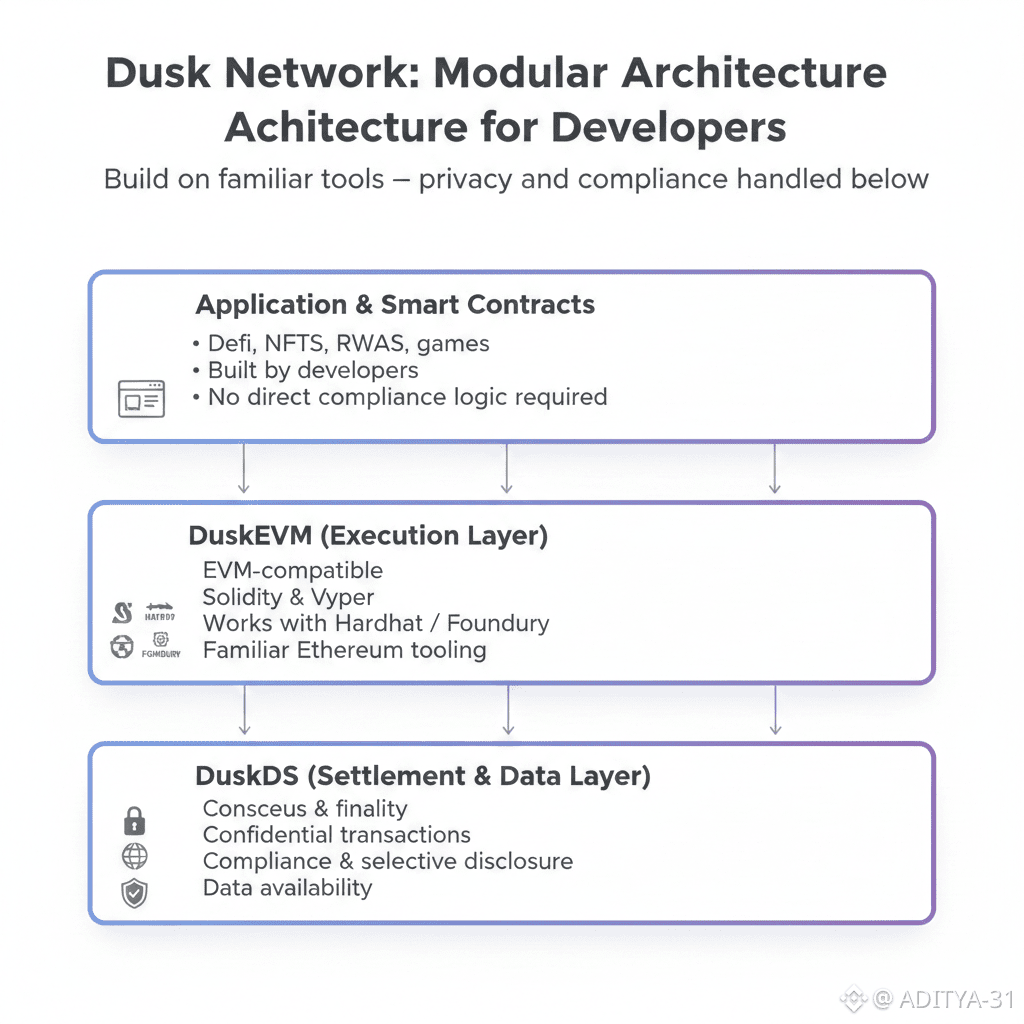
Dusk Network ko dekh kar ek baat clear hoti hai — ye blockchain developers ko experiment karne ke liye force nahi karta, balki unhe practical cheezein build karne ke liye space deta hai. Platform ka core focus ye hai ki teams privacy-enabled aur regulation-friendly Web3 applications bana sakein, bina apna poora tech stack dobara seekhe. Isi wajah se Dusk ka architecture intentionally modular rakha gaya hai, jahan settlement aur execution layers clearly separated hain.
Dusk ke design ka center point uska two-layer approach hai. Neeche settlement aur data layer kaam karta hai, aur upar smart contract execution layer. Developers ko usually sirf upar wale layer ke saath interact karna hota hai, jabki privacy, compliance aur finality jaise heavy responsibilities neeche silently handle hoti rehti hain.
Settlement aur data layer, jise DuskDS kaha jata hai, network ka backbone hai. Ye consensus, transaction finality, data availability aur native transaction models ko handle karta hai. Privacy aur compliance ke jo features Dusk ko generic Layer-1 chains se alag banate hain, wo isi layer me deeply embedded hote hain. Iska matlab ye hai ki applications ko privacy ke liye external tools ya hacks ki zarurat nahi padti — foundation level par hi support mil jata hai.
Iske upar DuskEVM aata hai, jo ek fully EVM-compatible execution layer hai. Yahin par most developers apne smart contracts likhte aur deploy karte hain. Solidity ya Vyper use karna ho, Hardhat ya Foundry ke saath kaam karna ho — sab kuch familiar feel karta hai. Under the hood privacy aur compliance ka heavy lifting DuskDS karta rehta hai, bina developer ko extra complexity me daale.
Is approach ka sabse bada benefit ye hai ki builders ko regulation aur privacy ke beech compromise nahi karna padta. Normal public blockchains transparency ko default bana dete hain, jo regulated finance ke liye problem ban jata hai. Dusk iska ulta karta hai — yahan confidentiality default hai, lekin jab legal ya compliance reasons ke liye disclosure chahiye hota hai, system usko support karta hai. Is balance ki wajah se Dusk institutional aur real-world finance use cases ke liye practical lagta hai, sirf theoretical nahi.
Developers ke liye multiple paths open rehte hain. Most applications — jaise DeFi protocols, NFT platforms, lending systems ya games — seedha DuskEVM par build ho sakte hain. Yahan normal Ethereum-style development hota hai, bas extra benefit ke saath ki privacy aur compliance protocol level par mil rahi hoti hai.
Jo teams zyada advanced use cases par kaam kar rahi hoti hain — jaise settlement-level logic, custom transaction models ya infra-heavy workflows — unke liye DuskDS par native contracts ka option bhi available hai. Ye path Rust aur WASM jaise tools ke saath kaam karta hai aur un builders ke liye hai jo protocol ke aur paas jaana chahte hain.
Smart contracts ke alawa Dusk integration side par bhi flexibility deta hai. Wallets, backend services aur off-chain systems ko connect karne ke liye APIs, SDKs aur tools jaise W3sper available hain, jisse on-chain aur off-chain coordination smooth rehti hai.
Overall, Dusk ka developer experience ek clear signal deta hai: ye chain developers se naya ecosystem adopt karne ko nahi kehta, balki existing knowledge ko leverage karke stronger, compliant aur privacy-aware applications banane ka mauka deta hai. Jaise-jaise ecosystem mature ho raha hai, ye layered architecture regulated DeFi, real-world asset tokenization aur confidential smart contract workflows jaise use cases ke liye natural foundation ban sakta hai — bina unnecessary tooling friction ke.