
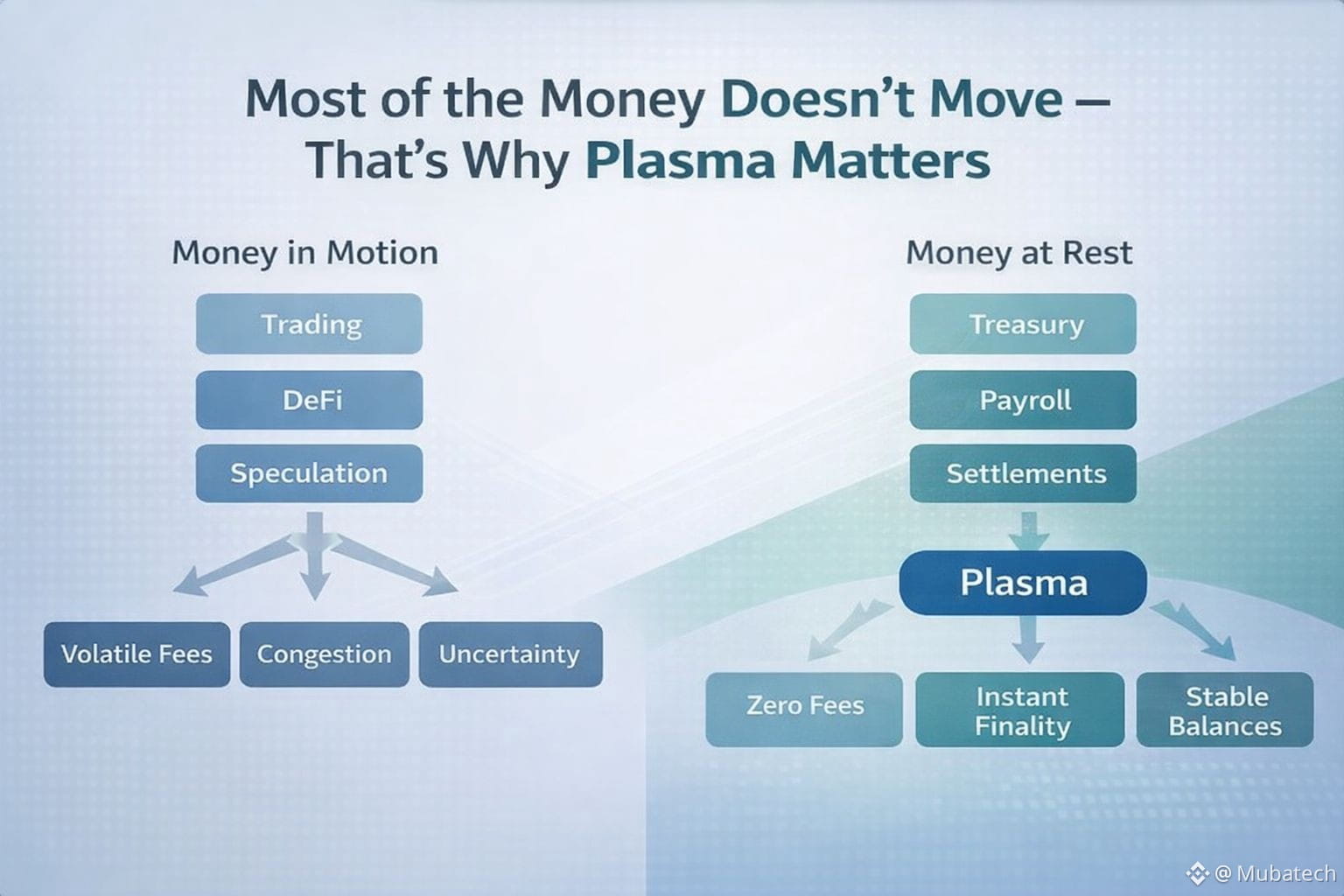
Most blockchain research is obsessed with movement. Faster transactions, higher throughput, more activity per second. That makes sense on the surface—but it also misses something important. When you start thinking about Plasma, the more interesting question isn’t how fast money moves, but why most money doesn’t move at all.
In the real financial world, the majority of money spends most of its time sitting still. It lives in company treasuries, payroll accounts, settlement reserves, merchant balances, and long-term savings. Traditional banks, payment rails, and accounting systems are built around this reality. Stability, predictability, and reliability matter more than constant motion.
That’s where Plasma stands out. Instead of optimizing only for speed and activity, it focuses on the quieter side of finance—the periods when money is parked, waiting, and accounted for. Very few crypto networks design for this kind of “financial stillness,” even though it’s how real economies actually function. Plasma does, and that shift in perspective changes what blockchain infrastructure can realistically support.
Sometimes a single design choice is enough to change how everything works.
Most blockchains are built on the assumption that every user is a trader. Fees move up and down, congestion comes and goes, and transaction finality is often based on probability. That setup works for speculation, but it breaks down for finance teams. In real financial environments, “probably final” isn’t good enough. They need certainty.
Plasma takes a different starting point. Instead of treating users like traders chasing the next move, it treats them like people managing a balance sheet. The goal isn’t to create excitement or volatility. It’s to make money feel boring again—in a good way. Predictable costs, reliable settlement, and something you can confidently explain to an auditor without hand-waving.
Another overlooked shift is how Plasma separates economic activity from economic risk. On most chains, the more a network is used, the riskier it becomes. Fees rise, congestion increases, and settlement uncertainty grows. Usage itself distorts costs. Plasma removes that link. With zero-fee stablecoin transfers, activity doesn’t change the economics.
Finality matters too. PlasmaBFT means that once a transaction is confirmed, it’s done. No waiting. No reorg worries. No probability calculations. Just final settlement. That kind of certainty is rare in crypto, but it’s exactly what real financial systems depend on.
For businesses, this stuff actually matters a lot. Imagine a payroll system telling employees that salaries cost more this week because the network was congested. Or an accounting team trying to explain to regulators why settlement fees keep changing every month. In the real world, that just doesn’t work. Plasma is interesting because it avoids copying traditional finance’s weaknesses while still keeping the benefits—without becoming centralized.
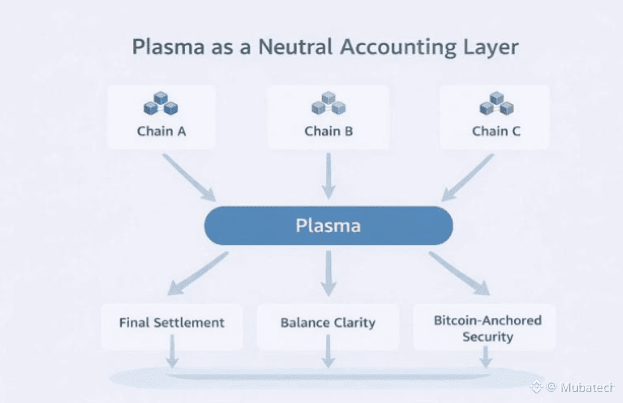
Another angle people don’t talk about enough is Plasma acting as a neutral accounting layer between blockchains. Instead of every chain fighting to host everything, Plasma becomes a stable backbone. Other chains can plug into it. Assets might live elsewhere, but balances and settlements stay clear and readable on Plasma. That’s closer to how clearinghouses work in traditional finance, not how smart-contract platforms usually behave.
What Plasma does with security is also different. It doesn’t try to invent trust from scratch. Instead, it borrows trust by anchoring itself to Bitcoin. Bitcoin isn’t fast or flexible, but it’s widely trusted. Plasma uses that trust as a base, while keeping everyday activity efficient and mostly invisible in the background. Separating trust from execution like this is rare in crypto, and honestly, very powerful.
Privacy is another misunderstood part. This isn’t about hiding bad behavior. It’s about reducing unnecessary noise. Finance teams don’t want every internal transfer, salary payment, or vendor invoice broadcast publicly. Plasma makes confidentiality the default, while still allowing verification when needed. That aligns with real compliance needs instead of fighting against them.
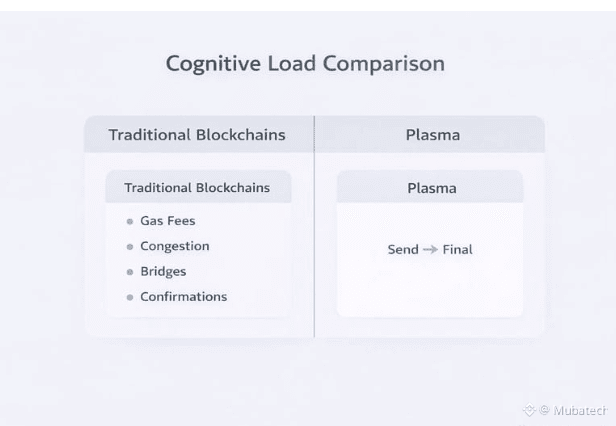
There’s also something subtle but important: Plasma reduces mental effort. Most blockchains force users to constantly think about gas fees, confirmation times, bridges, and liquidity issues. Plasma removes these decisions entirely. When systems stop demanding attention, people adopt them naturally. Trust grows when things just work without needing to be watched.
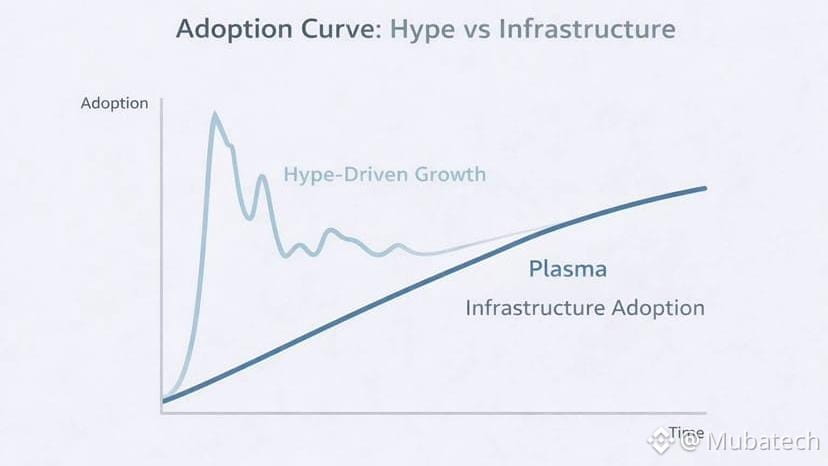
Because of that, Plasma follows a different adoption path. It doesn’t grow through hype or incentives. It grows quietly, through integrations. One treasury connects, then another. A single payroll setup leads to continuous usage. Growth may look slower, but it sticks. This isn’t community hype—it’s infrastructure adoption.
Even decentralization is treated differently. Plasma doesn’t try to decentralize every app. It decentralizes financial truth. Balances, settlements, and records remain neutral and verifiable, while applications stay flexible. It’s similar to the internet itself: shared protocols at the base, freedom at the top.
Resilience might be the most overlooked feature. Plasma isn’t built to depend on high activity or constant excitement. It’s designed to stay valuable even when things are quiet. That makes it strong during market downturns. When speculation fades, Plasma keeps running because speculation was never the goal.
In many ways, Plasma feels like crypto growing up. It accepts that value doesn’t always come from flashy growth metrics. Sometimes value comes from trust, silence, and reliability. That mindset feels uncomfortable in a market obsessed with narratives—but it’s exactly what financial systems need.
Plasma isn’t trying to replace banks overnight. It quietly removes friction instead. Fees fade away. Finality becomes absolute. Accounting gets simpler. Over time, expectations change. Once people experience money that simply works, everything else starts to feel broken.
That’s why Plasma can’t really be compared to fast L1s or DeFi ecosystems. It sits in a different category. It’s not an app platform or just a scaling solution. Financial infrastructure needs to be predictable, explainable, and built to last decades.
And that might be the most radical idea in crypto.
