
Walrus exists because something quietly breaks inside people when they realize how fragile the internet really is. A link you trusted dies. A platform “moderates” a story out of existence. A community’s archive disappears after a policy change or a shutdown. A dataset behind a public claim gets swapped, and suddenly no one can prove what was true last week. Even when there’s no villain, there’s still rot: servers fail, accounts get locked, services pivot, storage bills go unpaid, and the past becomes inaccessible. That small moment—opening something you relied on and finding emptiness—turns into a deeper question: if our digital lives can be erased or rewritten so easily, what does ownership even mean?
Blockchains were born from that question. They make it harder to tamper with records because many independent parties keep verifying the same history. But blockchains have a brutal limitation: they are excellent at storing agreements, not storing the world’s files. The same full-replication model that makes a chain trustworthy becomes a cost and scalability nightmare when you try to put large content directly on-chain. Images, videos, documents, training data, logs—these aren’t small ledger entries. If every validator had to store and serve them, the system would become too expensive to use and too heavy to run. So the uncomfortable compromise has remained: we use blockchains to prove ownership or execute logic, but the actual content still lives somewhere else—often in centralized infrastructure where it can be removed, censored, quietly changed, or simply lost.

Walrus is built around refusing that compromise. Instead of pretending the blockchain should store everything, it separates responsibilities cleanly: use the blockchain to coordinate and enforce rules, and use a decentralized storage and data-availability network to hold the heavy data. In practical terms, Walrus treats files as blobs—large unstructured objects—and focuses on making their availability reliable and verifiable without forcing the blockchain itself to become a storage warehouse. The goal is emotional as much as technical: to reduce the feeling that your data exists only at the pleasure of a gatekeeper.
The resilience comes from erasure coding, which is one of those ideas that sounds abstract until you feel what it means. A blob is transformed into many encoded fragments and distributed across many storage nodes. You don’t need every fragment to survive; you only need enough of them to reconstruct the original. This changes the failure story completely. A few nodes can go offline. Some can act dishonestly. Churn can happen. And the system can still recover the data because the redundancy is not “copy the whole thing everywhere,” it’s “encode it so loss is expected and survivable.” The human translation is simple: it is designed to keep working even when reality gets messy.
Walrus also matters because it isn’t just “storage.” It is positioned as data availability infrastructure, which is the difference between “I uploaded something once” and “anyone who needs to verify this later can still retrieve it.” That second promise is the one that protects truth. Availability is what prevents silent manipulation. It’s what stops an application from claiming it did something fairly while withholding the evidence. It’s what keeps a public artifact from becoming a broken reference when it becomes inconvenient. If you care about verifiability—especially in finance, governance, research, audits, rollups, or public records—availability is not a nice-to-have. It is where trust either survives or dies.
Walrus is designed to run with Sui as its coordination layer, and that choice is not cosmetic. When storage commitments can be represented on-chain as objects and rules, storage becomes programmable rather than merely external. Ownership and lifecycle become enforceable primitives: who paid to store a blob, how long it must remain available, whether its retention can be extended, and how applications can reference it in a way others can check independently. This composability is what makes decentralized storage feel like real infrastructure instead of an optional add-on. A smart contract can require that the blob exists before minting an asset tied to it. A dApp can escrow access to data, release keys conditionally, or attach governance decisions to specific datasets or documents. The relationship between “what the app claims” and “the evidence the app depends on” becomes tighter, less hand-wavy, and harder to fake.
The WAL token sits inside this system as the economic engine intended to keep the network honest and alive. In decentralized infrastructure, reliability is not a moral virtue; it is an incentive design problem. WAL is used to pay for storage services, creating demand tied to real usage rather than purely speculative narratives. It is also used in staking and delegation, aligning operators and delegators with the health of the network by tying rewards to participation and performance, and by introducing the possibility of penalties for low-quality service. Governance mechanisms linked to WAL are meant to tune protocol parameters over time as real-world conditions change—because no protocol gets the trade-offs perfect on day one, and the difference between “promising” and “dependable” is whether it can adapt without breaking trust.
It’s also important to be honest about the word “privacy,” because it can be used as a shortcut for reassurance. A storage protocol can be censorship-resistant and integrity-preserving without automatically making data confidential. Confidentiality usually comes from client-side encryption and key management: you encrypt the blob before uploading, and only those with keys can read it. That can provide strong privacy properties, but it’s a layer that applications and users must handle correctly. So the clearest way to understand Walrus is as infrastructure that strengthens availability and verifiable integrity, and that can support privacy-preserving applications when combined with encryption and access control patterns that don’t collapse under poor key hygiene.
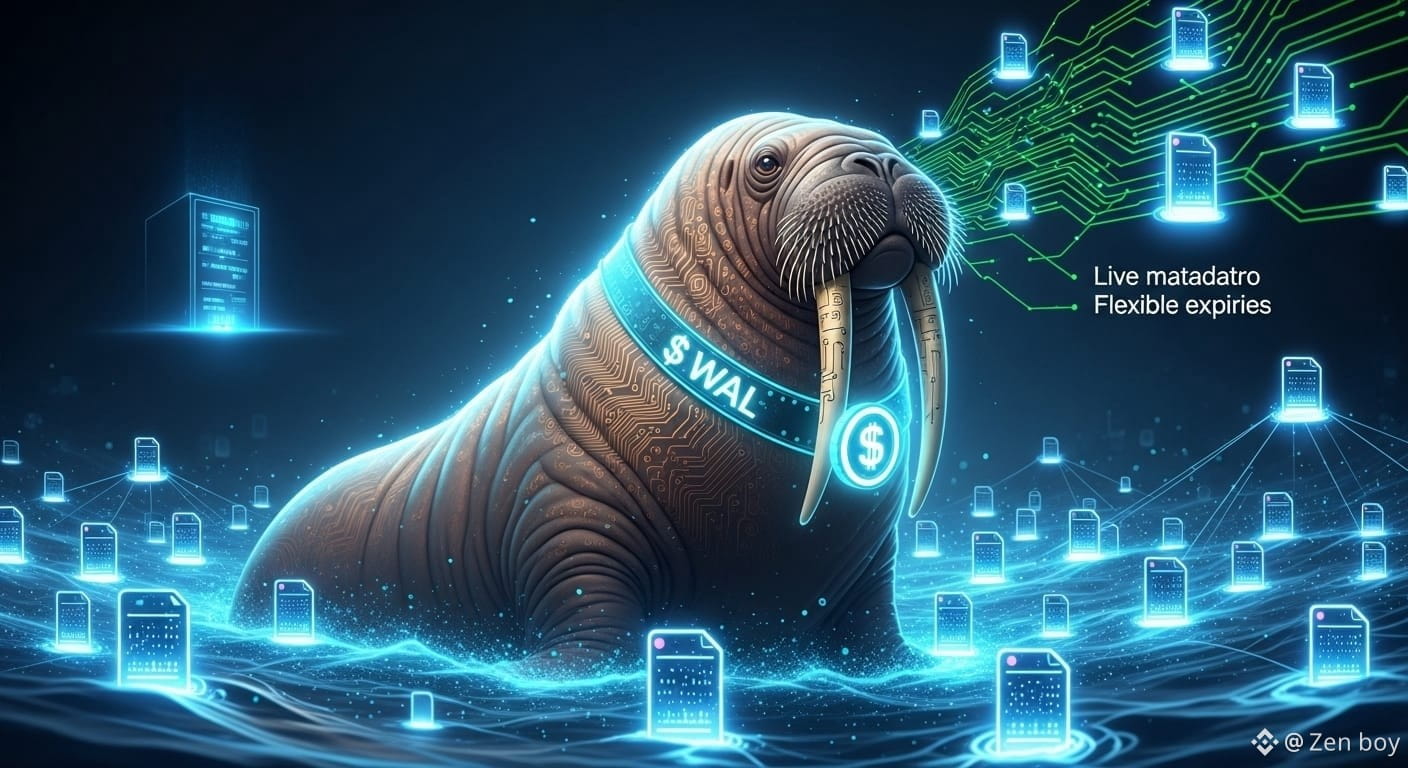
The strongest use cases are the ones where losing data is not merely inconvenient—it is damaging. Creator economies where media needs to stay retrievable. Communities preserving archives that shouldn’t depend on a platform’s goodwill. Decentralized finance and governance systems that must anchor decisions and audits to immutable references. Rollups and high-throughput chains that need cheap, dependable data availability so others can verify state transitions. AI and research workflows where datasets and model artifacts should be tamper-evident and consistently referenceable over time. In each of these, the value proposition is not “decentralization as aesthetics.” It is the feeling of not being helpless. The ability to point to something and know it can’t be quietly erased or rewritten when it becomes uncomfortable.
A serious analysis also admits the hard questions that decide whether a protocol like this becomes a public utility or a brief experiment. Retrieval performance has to feel real; developers won’t adopt infrastructure that makes users wait or randomly fail at the worst moment. Incentives must cover actual operating costs, otherwise reliability decays once hype fades. Delegated staking systems often drift toward concentration because users chase the biggest and most reliable operators, so decentralization requires deliberate counterweights and ongoing vigilance. Governance must be strong enough to evolve but stable enough that rules do not change unpredictably under users’ feet. These aren’t minor details; they are the pressure points where trust can be lost faster than it was gained.
Still, the deeper reason protocols like Walrus matter is emotional and human: people want digital life to be less fragile. They want their work, their records, their evidence, their history, and their creations to outlast a single company’s roadmap or a single platform’s mood. Walrus is a bet that we can build an internet where “gone” isn’t the default outcome, where the past isn’t so easy to edit, and where availability is not an act of permission but a property of the system itself.