
When people talk about Web3, they usually focus on tokens, smart contracts, and blockchains. But there’s a quieter problem that most users never notice: where does all the actual data live?
Blockchains are excellent at recording transactions and enforcing rules, yet they are inefficient and expensive for storing large files like videos, images, NFT media, game assets, or AI datasets. Because of this, many “decentralized” apps still depend on centralized cloud servers. That creates a contradiction decentralized logic running on centralized infrastructure.
Walrus exists to fix that structural weakness. Built on Sui and developed by Mysten Labs, Walrus is not another app or token trend. It is infrastructure a decentralized storage and data availability protocol designed specifically for large, real-world data.
A Different Way to Think About Storage
Traditional decentralized storage networks often rely on heavy replication. They copy the same file again and again across many nodes. While this improves reliability, it is extremely wasteful and expensive. Costs rise quickly, and scaling becomes difficult.
Walrus takes a smarter approach using erasure coding, known internally as Red Stuff. Instead of copying entire files, Walrus splits data into small encoded pieces called slivers and spreads them across independent nodes.
Here’s the key idea:
You don’t need every piece to recover the whole file.
Even if several nodes go offline, the original data can still be reconstructed. This method achieves high availability with far less redundancy roughly 4–5× overhead instead of massive replication. That means:
• Lower storage costs
• Better scalability
• Faster recovery
• Less wasted resources
It’s a design optimized for efficiency, not ideology.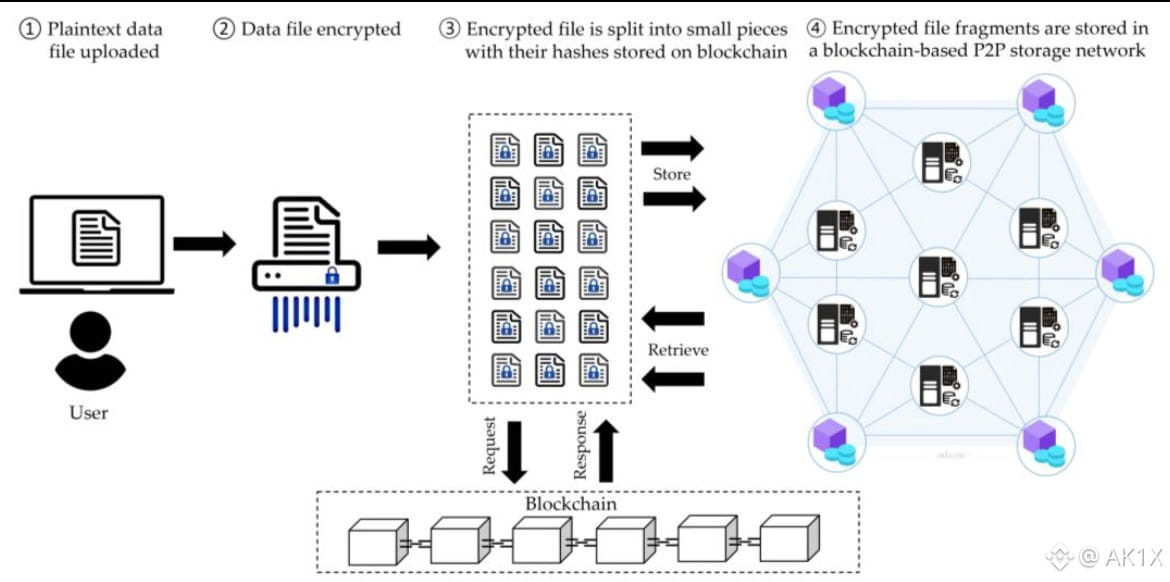
Storage That Smart Contracts Can Actually Use
One of Walrus’s most interesting innovations is that it treats storage as programmable, not passive.
Normally, storage systems sit outside the blockchain. Apps upload files somewhere else and just store links on-chain. That approach breaks composability and trust. If the external server disappears, the data disappears too.
Walrus integrates deeply with Sui’s object-based architecture. Stored data isn’t just “hosted”; it can be referenced directly by smart contracts.
This unlocks new possibilities:
• NFTs with permanent, verifiable media
• Fully decentralized websites
• On-chain games with large assets
• AI models and datasets with provable availability
• Rollups and scaling layers needing reliable data availability
In simple terms, Walrus turns storage into a first-class blockchain primitive.
Incentives Matter: The Role of WAL
Technology alone isn’t enough. Storage networks only work if participants are motivated to behave honestly.
That’s where the WAL token comes in.
WAL isn’t just for speculation. It has real utility:
• Users pay WAL for storage
• Node operators earn WAL for serving data
• Staking secures the network
• Poor performance can lead to penalties
This creates a system where reliability is economically rewarded. Operators who keep data online earn more. Those who fail lose out.
The result is a sustainable, long-term infrastructure model rather than short-term hype.
Why Walrus Matters Now (Not Later)
The timing of Walrus is important. Web3 is moving beyond simple token transfers. Today’s apps are heavier:
• NFT marketplaces host media
• Social platforms store content
• Games handle large files
• AI projects rely on massive datasets
All of this requires serious storage capacity. Without decentralized blob storage, Web3 simply can’t scale into mainstream use cases.
Walrus positions itself exactly at this bottleneck.
It doesn’t compete with DeFi apps or social protocols. Instead, it quietly supports them all like roads support cities. Most users won’t even know Walrus is there. But if it disappears, everything above it breaks.
That’s the nature of real infrastructure.
The Bigger Picture
Walrus represents a shift in how we think about decentralization. It’s not enough to decentralize money or governance. If the data layer remains centralized, the system is still fragile.
By combining efficient erasure coding, programmable storage, and strong incentives, Walrus offers something Web3 has long needed: decentralized storage that is practical, affordable, and production-ready.
In the coming years, as AI, gaming, media, and consumer apps grow on-chain, protocols like Walrus may become less visible but far more essential.
Because the future of Web3 won’t just run on blockchains.
It will run on data.
And Walrus is building the place where that data lives.

