

The 30-day change in $BTC Apparent Demand is showing early signs of stabilization after an extended period of negative readings.
Historically, sustained negative Apparent Demand reflects a phase where newly supplied coins exceed market absorption capacity often coinciding with distribution, post-rally cooling, or macro-driven risk-off environments. This dynamic was clearly visible during recent months, as demand failed to keep pace with available supply despite price resilience.
However, the latest data suggests a shift in short-term dynamics. Negative demand pressure has moderated, and recent readings are moving closer to neutral territory. While not yet a confirmation of strong accumulation, this transition is meaningful: it indicates that sell-side pressure from new supply is being increasingly absorbed rather than aggressively distributed.
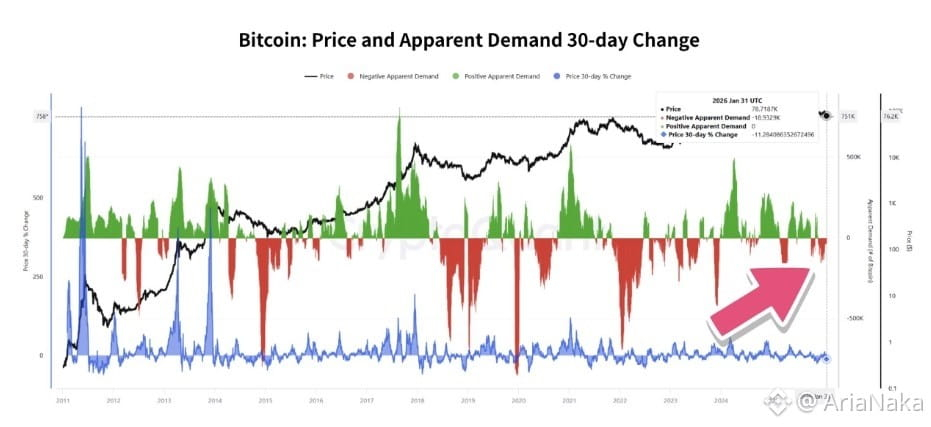
From a macro perspective, such inflection points often emerge when leveraged excess has been flushed out and marginal sellers diminish. Price action during these phases typically becomes more range-bound, with volatility compressing as the market searches for a new equilibrium between spot demand and supply issuance.
Importantly, previous cycles show that sustained recoveries in Apparent Demand tend to precede stronger directional price trends, but only when supported by broader liquidity expansion and risk appetite. Without these conditions, the market may remain in a consolidation regime rather than transitioning immediately into a new impulsive leg.
In short, Bitcoin is not yet in a clear accumulation phase but the data suggests that the distribution-heavy environment is easing. Whether this develops into a structurally bullish setup will depend on follow-through in demand and macro liquidity conditions.