
Hy Plasma
I am Helena💕
Instead of trying to do everything Plasma focuses on stablecoins, which have become one of the most widely used parts of the crypto economy. Every design choice reflects this focus on efficiency, usability, and reliability.
At its core, Plasma enables instant and low-cost stablecoin transfers, with USDT as a primary example. Basic payments can be sent without users needing to think about gas fees, balances for network costs, or complex wallet management. This makes Plasma especially suitable for everyday transactions, cross-border payments, and settlement use cases where speed and clarity matter more than speculation.
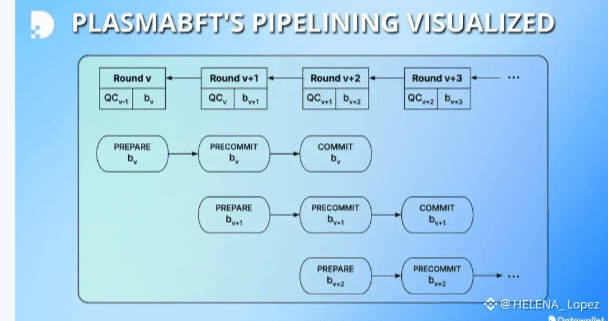
Plasma Chain operates as a full Layer 1 network with its own consensus system called PlasmaBFT. This system allows transactions to reach final confirmation within seconds, removing uncertainty around reversals or delays. Unlike networks that rely on probabilistic confirmations, Plasma aims for immediate and irreversible settlement, which is important for payment-focused applications.
To strengthen security, Plasma periodically records cryptographic checkpoints onto the Bitcoin blockchain. This anchoring mechanism ensures that Plasma’s transaction history cannot be altered without also altering Bitcoin’s ledger. The result is a layered security approach where Plasma handles speed and execution, while Bitcoin provides long-term integrity.
The network is compatible with the Ethereum Virtual Machine, meaning developers can deploy existing smart contracts with minimal changes. This allows Plasma to support a wide range of decentralized applications, including payments, trading, lending, and stablecoin-focused financial tools. Developers benefit from familiar tooling, while users experience faster confirmations and lower friction.
XPL is the native token of Plasma Chain. It plays a role in securing the network through staking, supporting governance, and enabling advanced interactions beyond simple transfers. The total supply of XPL is fixed at 10 billion tokens, with allocations for public participants, ecosystem growth, the team, and early investors. The structure is designed to support long-term development while encouraging early usage.
Plasma has also taken steps toward regulatory clarity, particularly in Europe, by aligning its disclosures with established crypto asset frameworks. This approach reflects a broader goal of making the network suitable for institutions, payment providers, and compliant financial applications.
While Plasma is still in its early stages, its direction is clear. It is not positioned as a general-purpose experiment, but as infrastructure meant to support real economic activity. By prioritizing stablecoins, fast settlement, and simple user experiences, Plasma aims to become a foundational layer for digital payments.
As stablecoin usage continues to grow worldwide, networks like Plasma highlight a shift toward blockchains built for specific, practical roles. Whether it achieves wide adoption will depend on execution, developer participation, and real-world usage, but its focus offers a clear example of where blockchain infrastructure may be heading next.