


The majority of crypto infrastructure collapses due to a mere fact that when the network is overloaded people cannot observe what is happening. Operators must make guesses, shippers put in the deliveries without trying, and dashboards turn into unreliable screens. Walrus is doing things differently. It sets out to render network health, availability and performance verifiable and not merely visible.
The article is concerned with this special angle. Walrus is actually creating a storage and data-availability network, only with its largest success being the addition of the last layer to transform a protocol into real infrastructure: trustworthy measurement.
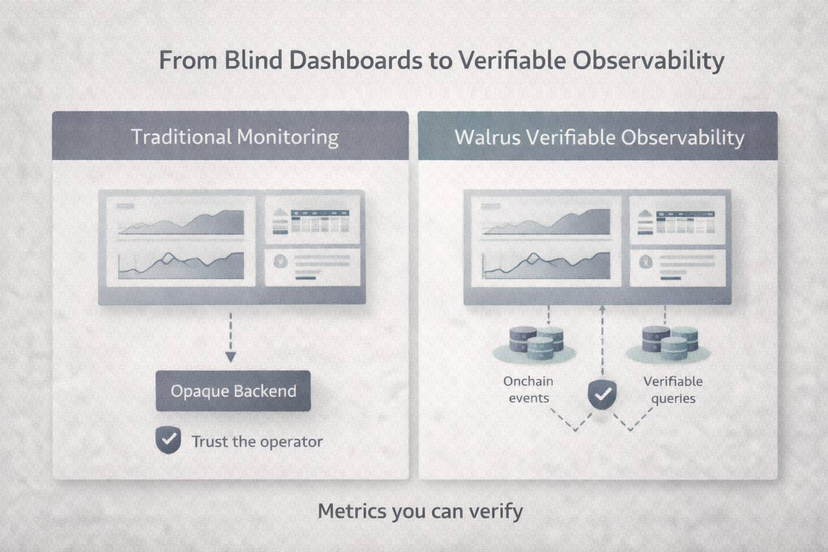
The bottleneck of observability is the reason adoption is impossible.
With Web2 there is no argument about system up or down by SREs. They just analyse metrics, traces and logs. The problem is that in Web3 even when systems give out data, you frequently need to trust the host of the dashboards, the option of queries or the presentations.
This is lethal in decentralized storage. In the case an application assumes the availability of the blobs in a readable state, it needs to respond to simple questions: Is the network healthy now? Are some regions failing? Is the read slowness due to overloading the cache or due to the storage nodes not having the fragments? The frequency of production of proofs? Serious products cannot run on top without some clear answers.
Walrus is not an afterthought on observability, it is a protocol feature that is consciously being made. This direction is reflected by the ecosystem emphasis on operator tools and network monitoring and the fact that Walrus is a data layer, the correctness and health of which can be verified.
The design implementation that facilitates observability.
Walrus purposely employs a split brain. The data plane of Walrus is managed by Sui which manages the control plane and coordinates, metadata, and on-chain components. Walrus describes this architecture by saying Walrus is the data layer, and Sui is the control plane, where the division is connected to simplicity, efficiency, and security.
This is important to observability since the control plane staples facts. A blob being certified or a proof minted is something important and can be anchored and is difficult to counterfeit. Systems with an on-chain control plane also make key events public, whereas logs can be edited with regular systems.
It is not that on-chain functionality is cool. Instead, they are more like an untrusted, time-stamped notebook with which one can read anyone without being dependent on one server.
The concept of the Proof of Availability transcends being security, it is a signal of operation.
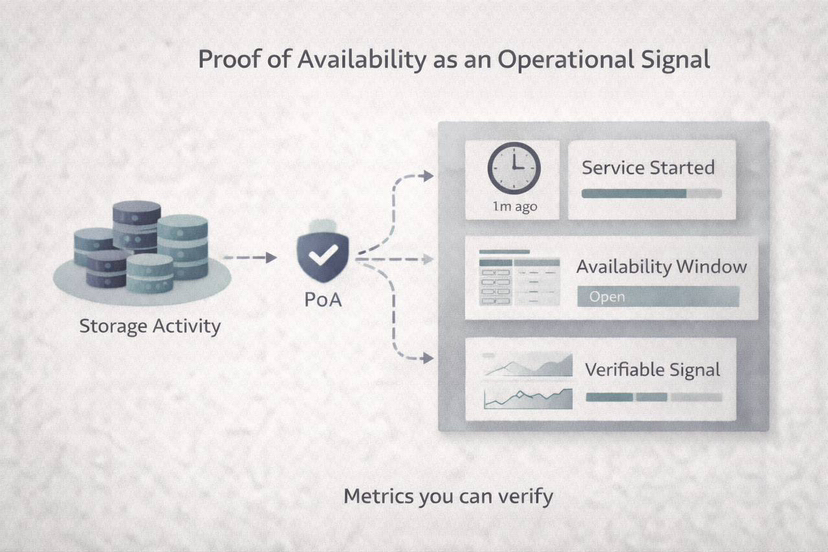
Walrus supports Proof of Availability as a security guarantee a verifiable on-chain receipt that a storage service has begun. The second and more significant impact is that operations are also indicated by proofs.
In simple terms: an app, which has access to evidence activity, can know whether storage is being done as the protocol states. This eliminates speculations with what can be seen.
That is why Walrus describes the usage of incentivized proofs as a way of storage security. It goes beyond protection against attackers, it is offering the network a reliable story about itself.
Walrus Explorer the weird trick of verifying analytics.
Another genuinely interesting development: Walrus released a collaboration with Space and Time to enable Walrus Explorer, a collection of verifiable analytics and monitoring instruments to developers and operators.
Most crypto explorers are simply dashboards which display charts; you have faith in their backends. Walrus is focused on reversing that and enabling analytics to be asked and checked, instead of eaten.
The work of Space and Time is the analysis of network activity based on the concept of ZK -proven computation, or so-called Proof of SQL. This allows teams to execute queries with enhanced trust assurances than with a centralized analytics pipeline.
This silent revolution of decentralized storage, which requires monitoring more than most protocols, is needed. Trades are visible on-chain on a DEX, and off-chain performance and availability are the most challenging elements on storage. Walrus is an attempt to inspect that off-chain reality.
The case change: it is no longer about how to trust the network but audit the network.
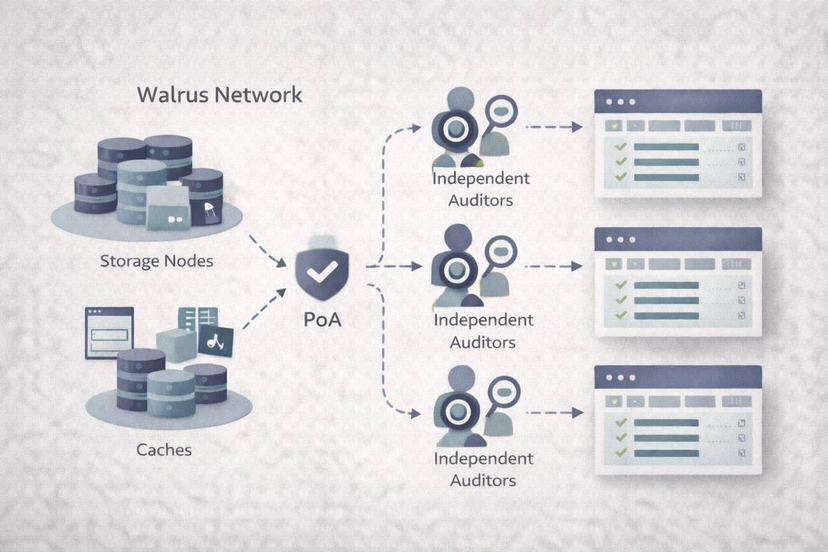
This change opens up a new psychological thinking to constructors. The majority of storage networks require you to believe redundancy. Walrus provides an approach that allows auditing the quality of services, uptime trends, operator reliability, latency trends, and proof activity, cross-validated by third parties.
Being able to audit a network, you have the ability to build with confidence. You will have SLAs, route reads the ones that a particular cache will store, select the operators that have a better operating history–just the way Web2 teams make infrastructure measurable.
It is not some trifling improvement. It makes the decentralized storage storage that you can build a business with.
The obscure murder aspect: verifiable surveillance brings competition that enhances the network.
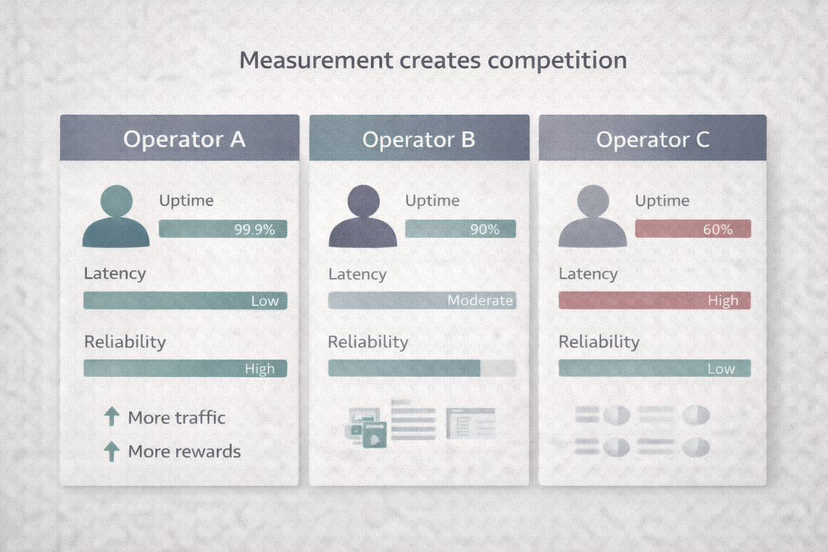
In case of high observability, operators are no longer able to hide. These realities manifest themselves when publishers, aggregators, or caches are performing poorly, e.g. when storage node clusters are flaky, or when some regions are always doing well. Performance that is visible generates markets.
That is the way CDNs became successful: performance measurement was turned into the competitive edge. The same dynamic is prepared by Walrus: the design of its control-plane and the proofs it provides make it difficult to believe its performance claims to be marketing.
Stated differently, the ability to verify observability rewards the developers and restructures incentives to allow the best operators to emerge organically.
What this is important to enterprise-ish adoption, without claiming to make Walrus an enterprise.
Enterprise Most of these crypto projects are not ready to be enterprise. Walrus does not look upon that. Rather, it addresses enterprise-level issues in the background: responsibility, auditing, tracking, and upgrades.
Publication of documentation on Walrus in ecosystems focuses on organized deployments and security programs such as bug bounties that make the protocol more resilient in the long run. It is precisely how infrastructure takes the issue of infrastructure very seriously: not it is perfect, but it is measurable, testable and it can only be improved with incentives.
In the actual world, humans are embracing emerging infrastructure because they are able to quantify risk. The quantification of that risk is observability.
The easiest way to tell a builder what Walrus is at this moment--is to chop out the jargon and get down to what it is.
Today explaining Walrus to someone who does not care about crypto buzzwords I would say it like this: Walrus allows to have on-the-side the large data, but still to have on-the-side the on-the-side-of-the-system type of trust: when the storage has been initiated, whether it is maintained, and whether the system is in a healthy state. The tooling and proof systems created by Walrus will allow you to monitor the network as any serious backend service.
This is why Walrus provides well-known interfaces - Web API to communicate with storage services. It is aimed at normalizing the integration and keeping the verification story powerful.
My concluding thesis: the future will be trust -minimized operations, and not trust -minimized storage.
The majority of projects are terminated at the data layer. Walrus intrudes into the layer directly above it, operations, monitoring, analytics, and visibility. I suppose that is where the moat is shaped.
A network is the type of network that can be observable in a verifiable manner; therefore, it can be easily constructed compared to other types. Teams never select the infrastructure according to ideology; they select the infrastructure that they can debug at 3a.m., that which they can measure, and that which they do not need to trust off since they can trust it.
Walrus is heading in that direction: storage which can be checked, and more and more a network which can be checked. There is the distinction between a protocol with a token and infrastructure that is mindshare generating over years.