
Most people celebrate low latency like it’s a universal good.
“Faster blocks.”
“Sub-second finality.”
“Execution that rivals centralized venues.”
But here’s the part nobody likes to admit:
When latency drops, market structure changes.
And not everyone benefits equally.
That’s why Fogo is more than a performance story. It’s a structural pressure test for how protocols design fairness under speed.
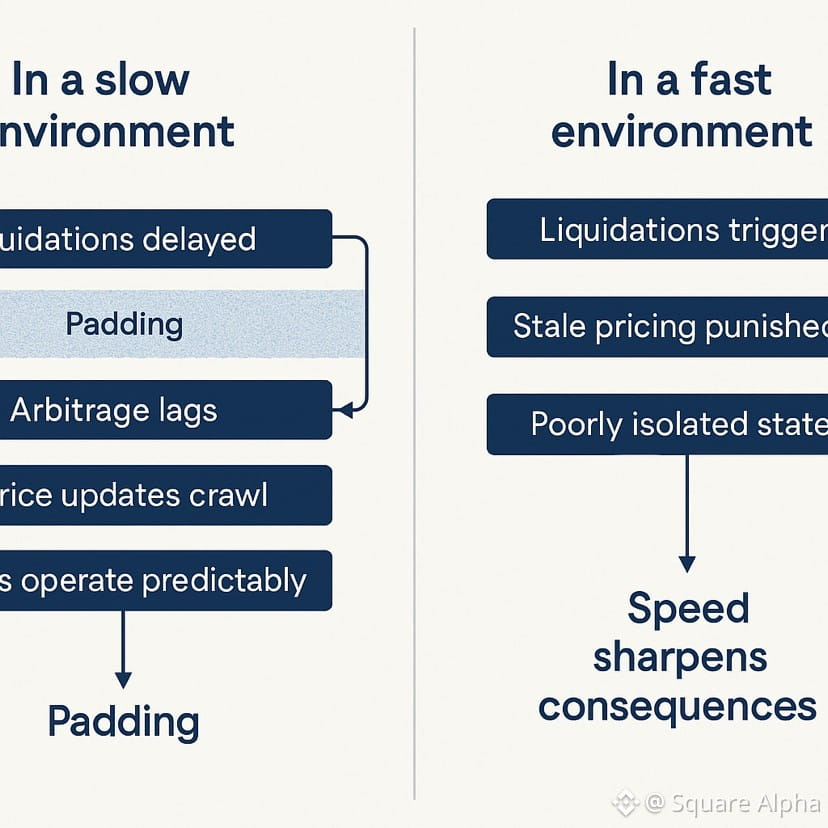
In slow environments, inefficiency hides everywhere.
Liquidations are delayed.
Arbitrage lags.
Price updates crawl.
Bots operate in predictable windows.
The friction almost acts like padding.
But once execution tightens — once transactions finalize quickly and independently — that padding disappears.
Now liquidations trigger precisely.
Now stale pricing gets punished instantly.
Now poorly isolated state collides under real load.
Speed doesn’t just improve UX.
It sharpens consequences.
Here’s the uncomfortable reality:
Low latency amplifies design flaws.
If your liquidation engine relies on a shared writable account, it becomes a bottleneck the moment volatility spikes.
If your oracle settlement path touches global state every time, it serializes under stress.
If your matching logic mutates one hot account repeatedly, parallelism collapses exactly when volume surges.
And users won’t blame your architecture.
They’ll blame the chain.
But the chain didn’t fail.
Your layout did.
There’s also a deeper market dynamic at play.
When execution becomes near-instant and state access is explicit, competition shifts from “who is fastest to react” to “who designed their system to avoid collisions.”
That’s subtle.
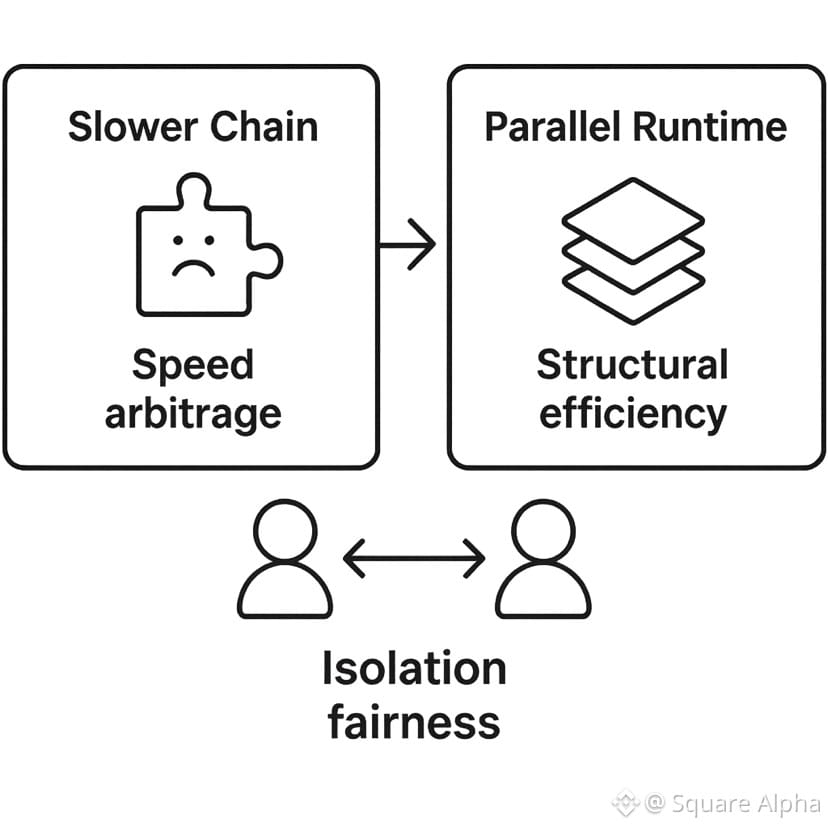
On slower chains, raw speed arbitrage dominates.
On parallel runtimes, structural efficiency dominates.
If two actors submit independent transactions, they can truly execute together — but only if the protocol doesn’t force them into the same write set.
That means fairness isn’t just about latency.
It’s about isolation.
I’ve started to think about Fogo less as a speed upgrade and more as a behavioral filter.
It filters out sloppy contract design.
It filters out centralized choke points hidden in “decentralized” systems.
It filters out lazy global accounting habits.
Because the moment you bring real user traffic into a low-latency SVM environment, your bottlenecks stop being theoretical.
They become visible in production.
This matters most in volatile conditions.
Volatility compresses time.
If the runtime is fast and your architecture is collision-heavy, you don’t degrade gradually.
You jam.
And once jamming begins, ordering becomes distorted.
Now users are competing for locks instead of competing on strategy.
That’s not just a performance issue.
That’s a market integrity issue.
The protocols that will thrive on Fogo aren’t the ones that shout about TPS.
They’re the ones that:
Partition user state aggressively
Minimize shared writable accounts
Separate settlement from reporting
Treat global metrics as derived, not mutated
Those sound like backend engineering details.
They aren’t.
They determine who gets filled, who gets liquidated, and who gets stuck.
Here’s the part I find interesting:
As chains get faster, blame shifts.
On slow systems, congestion feels like infrastructure failure.
On fast systems, congestion often reveals application design failure.
That’s uncomfortable for builders.
It removes a convenient excuse.
Fogo’s real bet isn’t just that speed attracts users.
It’s that speed forces maturation.
Because once you remove latency padding, the only thing left protecting your system is architectural discipline.
And discipline is rare in speculative cycles.
Low latency doesn’t guarantee fairness.
Parallel execution doesn’t guarantee scalability.
They simply create an environment where good design compounds and bad design collapses faster.
That’s why I don’t see Fogo as “another fast chain.”
I see it as a chain that compresses architectural consequences.
And in markets, compressed consequences are brutal — but honest.
The real question isn’t whether Fogo is fast.
It’s whether builders are ready for what that speed exposes.
