
A deep dive into the real quantum threat, what breaks, what survives, and how crypto
 Quantum computers use qubits that operate in superposition and entanglement. Unlike classical bits (0 or 1), qubits can represent multiple states at once, allowing certain mathematical problems to be solved exponentially faster. This computational shift threatens the mathematical foundations of public-key cryptography.
Blockchains rely on elliptic curve cryptography for ownership. If Shor’s algorithm runs on a sufficiently powerful quantum computer, private keys could be derived from public keys. That would allow forged signatures and stolen funds.
Grover’s algorithm weakens hash functions by reducing brute-force security roughly in half. SHA-256 drops from 256-bit theoretical security to about 128-bit against ideal quantum attacks. Hashing is weakened — not destroyed.
Today’s quantum computers are noisy and not fault-tolerant. Breaking blockchain cryptography requires thousands of logical qubits and deep, error-corrected circuits. We are not there yet — but migration takes years.
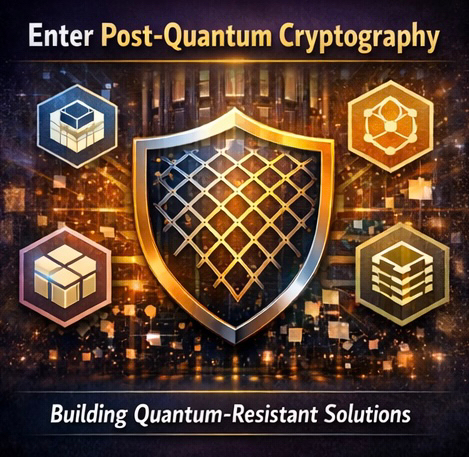
Post-quantum cryptography (PQC) introduces lattice-based, hash-based, and code-based schemes designed to resist quantum attacks. Standards are already finalized and ecosystems are preparing for transition.
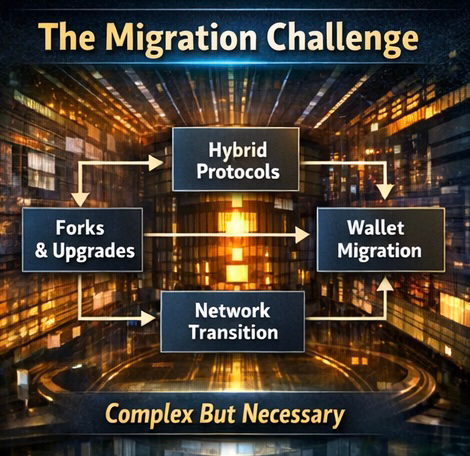
Upgrading a blockchain affects wallets, exchanges, hardware devices, validators, and governance processes. Hybrid signatures, forks, and address migrations are possible paths — each with trade-offs in size, fees, and complexity.