If you look at most young ecosystems, liquidity usually arrives before usage. Incentives attract capital. Yields spike. TVL charts look impressive. But underneath, activity is thin. Capital sits idle, waiting for rewards rather than facilitating real economic flow.
@Fogo Official feels different at this stage.
What we’re seeing is liquidity forming around actual participation. Staking isn’t just happening because of emissions. It’s happening because validators are active, liquid staking is integrated, and DeFi rails are already live. That changes the foundation.
Liquidity becomes structural when it connects to utility.
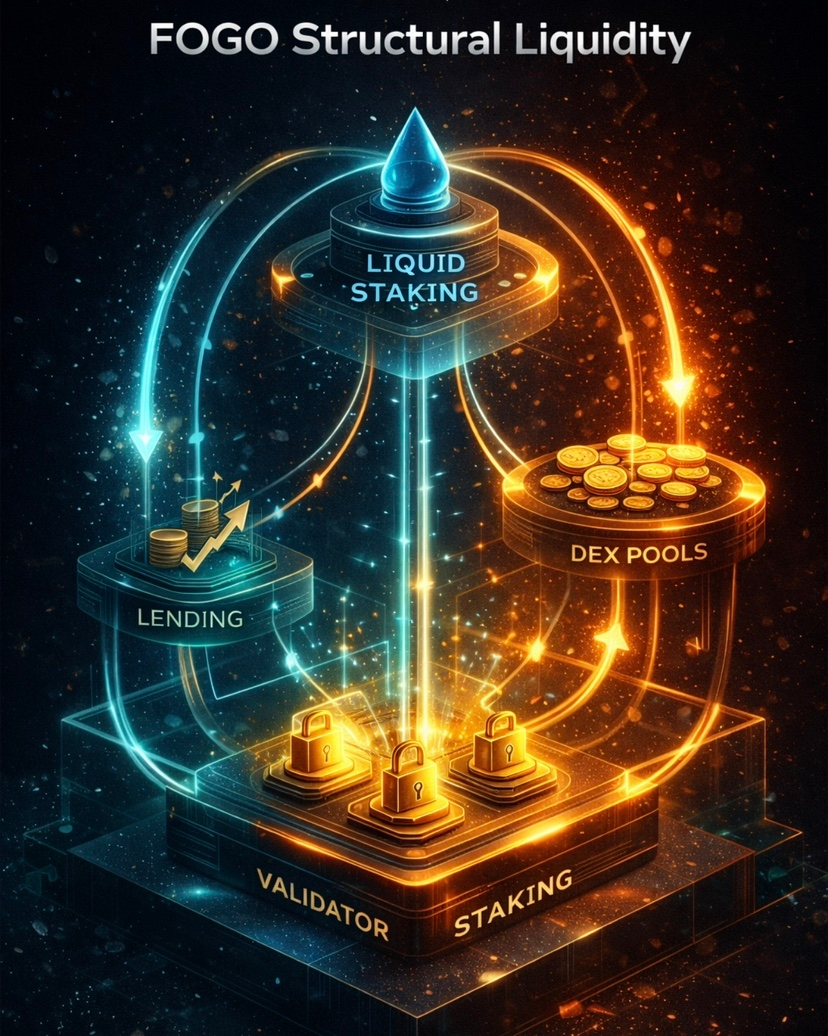
Take staked FOGO. When tokens move into validator-backed staking pools, they are not removed from the economy. Through liquid staking integrations, that same capital can circulate across lending, LP positions, and trading pairs. The base layer secures consensus. The derivative layer supports DeFi. Both layers reinforce each other.
That loop matters.
Because structural liquidity doesn’t disappear when incentives decline. It remains embedded inside economic behavior. When users stake for network participation and simultaneously use derivatives for capital efficiency, liquidity becomes sticky. Sticky liquidity builds stability.
Another dimension is distribution.
FOGO’s staking design encourages delegation across multiple validators rather than centralizing around a single dominant operator. That reduces governance risk while keeping capital productive. When stake spreads and remains liquid, decentralization and usability grow together.
Early ecosystems often struggle with this balance. They either optimize for speed and sacrifice distribution, or optimize for distribution and sacrifice efficiency. FOGO’s model is attempting to merge both — performance standards at the validator layer and flexible liquidity at the user layer.
This is important because liquidity is more than depth on a chart.
It influences price stability, reduces slippage, improves borrowing efficiency, and strengthens institutional perception. When external observers evaluate a chain, they don’t just check token movement. They check whether liquidity can absorb volatility without collapsing.
Liquidity that is distributed, validator-backed, and DeFi-integrated has resilience.
And resilience compounds over time.
We are still early in FOGO’s lifecycle. That means patterns forming now will shape its structural identity. If staking participation continues expanding while integrations deepen, liquidity stops being a temporary metric and becomes a permanent feature of the ecosystem.
My perspective is simple.
The next stage for FOGO is not just growth in numbers. It’s growth in cohesion. Cohesion between staking, delegation, liquid derivatives, lending, and DEX activity. When those elements align, liquidity stops being reactive and starts being foundational.
That’s when ecosystems mature.
And that’s when structural value begins to show.