

$BTC clings to the $60K–$70K range, but analysts warn the worst may still be ahead
Consolidation or the Calm Before Another Storm?
Bitcoin has spent the past 12 days trading sideways between $60,000 and $70,000 following a sharp selloff on February 5th. While some market watchers have interpreted this range-bound behavior as a sign of stabilization potentially marking a cycle bottom a growing chorus of analysts is pushing back on that optimism.
The key question isn't whether Bitcoin is holding support. It's whether that support will last.
Willy Woo's Volatility Warning
Prominent on-chain analyst Willy Woo is among the skeptics, and his reasoning centers on one often-overlooked metric: volatility. According to Woo, Bitcoin officially entered bear market territory when volatility spiked sharply upward a signal that institutional quants closely monitor to identify trend shifts.
What's more concerning, in his view, is that volatility has continued climbing since that initial spike. Historically, bear markets don't bottom out at the first volatility peak. Instead, the true macro low tends to emerge at the second or third, smaller volatility spike a process that can stretch over many months.
Woo also outlined what a deeper bear cycle could look like in practice. A broader deterioration in global equity markets could trigger Bitcoin's second bear phase, while the final phase would be marked by peak capital outflows from the crypto market altogether. In short, BTC holding above $60K does not, by itself, signal that the bottom is in.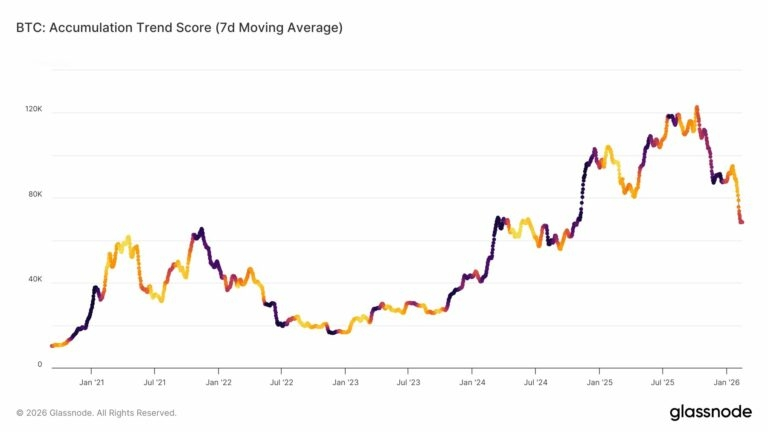
On-Chain Data Raises Flags
Glassnode's Accumulation Trend Score adds further nuance to the picture. The metric tracks whether large market participants are buying or selling on aggregate. Readings near 1 shown as darker shades indicate aggressive accumulation, while readings near zero suggest distribution by big players.
Historically, meaningful market bottoms have coincided with intense accumulation. The November 2025 drawdown, for instance, followed a similar pattern to post-LUNA and post-FTX environments, where heavy buying eventually arrested the decline.
The current reading, however, remains ambiguous. For the $60K–$70K zone to function as a genuine floor, it needs to attract the kind of aggressive buying that characterized those prior recoveries. Without that conviction from larger players, another leg lower cannot be dismissed.
Options Market Tells a Different Story For Now
Not everyone is bracing for further downside. Options market data points to a more nuanced, and somewhat contrarian, short-term outlook.
Aurelie Barthere, Principal Research Analyst at Nansen, noted that call options have outpaced put buying over the past week particularly among block trades typically placed by professional investors. The most popular strike price? $75,000 well above the current consolidation range.
This suggests that a segment of the market is positioning for a breakout rather than a breakdown. Whether that bullish positioning translates into actual price action depends heavily on whether buyers step in decisively if Bitcoin tests the lower end of its current range.
The Bigger Picture: Macro and Policy Headwinds
Beyond charts and derivatives, the broader macro environment could prove decisive. Barthere cautioned that a durable recovery may remain out of reach until several key catalysts align: progress on the U.S. CLARITY Act for crypto regulation, the outcome of the upcoming midterm elections, and a shift in the broader risk-on sentiment across global markets.
Until those factors clear, even a short-term bounce toward $75K may struggle to evolve into a sustained trend reversal.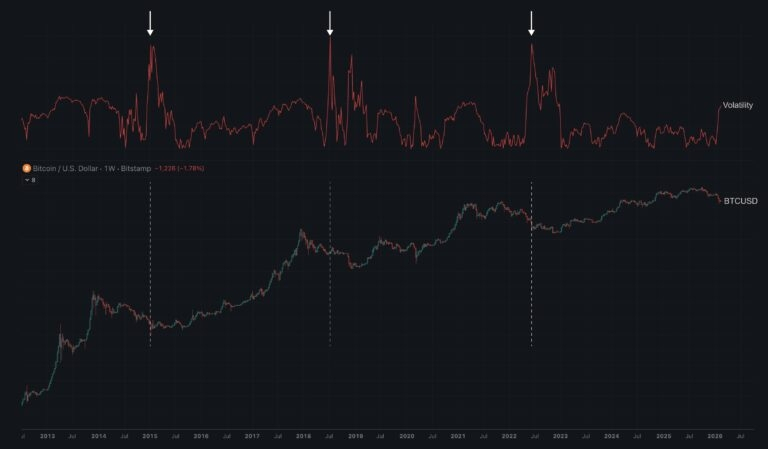
What to Watch
The $60,000 level remains the line in the sand. Aggressive buying at that price reflected in on-chain accumulation scores would lend credibility to the bull case. Failure to defend it, however, could open the door to the second bear phase Woo described.
For now, the market sits at a crossroads: options traders are cautiously optimistic, but the structural indicators suggest patience may be more prudent than conviction.