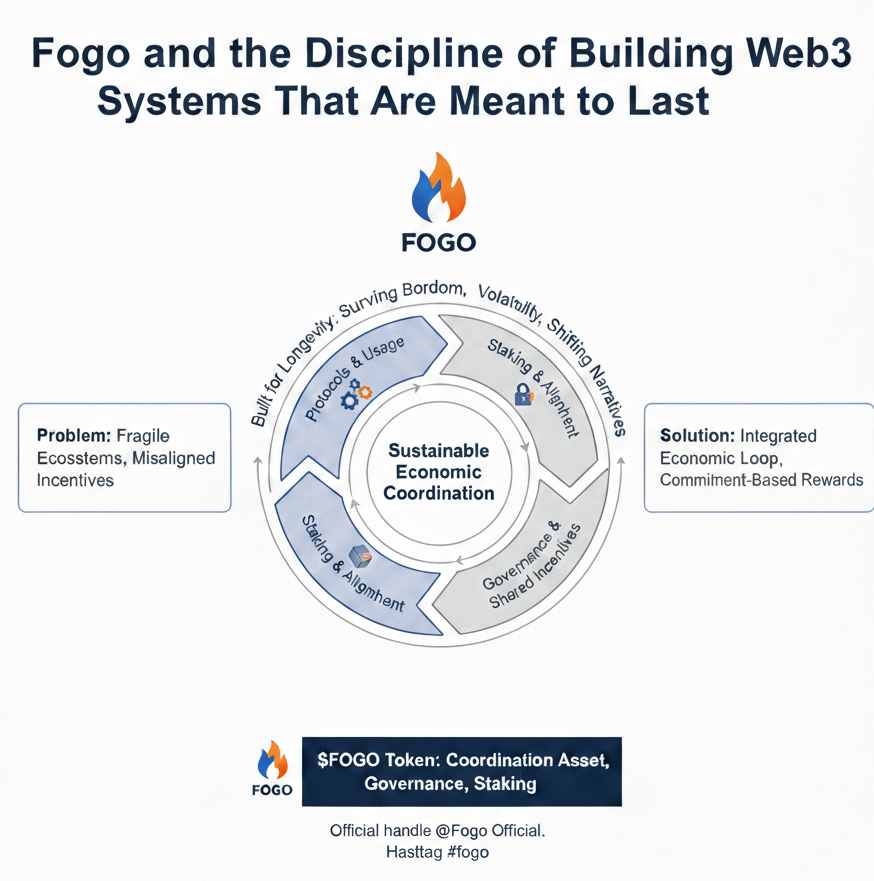
Fogo exists because much of crypto still optimizes for momentum instead of durability. Over multiple market cycles, the industry has learned how to launch fast, attract liquidity, and manufacture engagement, yet it continues to struggle with retaining committed users once incentives weaken. Fogo is built on the idea that Web3 will only mature when its economic systems are designed to survive boredom, volatility, and shifting narratives. The project does not try to outshine the market with spectacle. It tries to correct a structural flaw that has quietly limited the long term impact of decentralized ecosystems.
At a high level, Fogo is an on chain ecosystem focused on sustainable economic coordination. It treats protocols, governance, staking, and community participation as parts of one system rather than separate features stitched together after launch. The motivation behind this design is simple. When ownership, usage, and decision making are disconnected, ecosystems become fragile. Users extract value without responsibility, governance becomes symbolic, and tokens lose meaning beyond speculation. Fogo exists to realign these layers into a single economic loop.
The problem it addresses is not new, but it is still unresolved. Many Web3 projects confuse decentralization with distribution. Tokens are widely held, but decisions are rarely thoughtful. DAOs exist, but participation is shallow. Vaults and yield mechanisms attract capital, but only for as long as emissions are high. When conditions change, liquidity leaves and communities dissolve. Fogo approaches this problem by slowing things down intentionally and designing incentives that reward commitment rather than speed.
The Fogo ecosystem is structured around participation that compounds over time. Protocols within the ecosystem are not meant to compete for attention but to reinforce one another. Staking is a central mechanism, but it is framed as a form of alignment rather than passive income. Those who stake are not just earning rewards. They are signaling long term belief and gaining influence over how the ecosystem evolves. This influence extends to governance decisions that shape fees, treasury deployment, and protocol parameters.
Governance in Fogo is treated as operational infrastructure. DAO mechanisms are used to formalize decision making, but the emphasis is on accountability and economic clarity. Proposals are expected to address real tradeoffs and long term outcomes, not just short term incentives. This creates a governance culture where voting has weight and consequences, and where participants are encouraged to think like stewards rather than spectators.
Core components such as staking vaults, protocol layers, and community governed treasuries work together to keep value circulating inside the ecosystem. Rather than relying on constant external inflows, Fogo aims to gradually build internal economic activity that sustains itself. Fees generated by usage are not treated as extractive costs, but as inputs that fund development, reward contributors, and reinforce network security. Over time, this reduces dependence on inflationary incentives and speculative cycles.
The $FOGO token plays a critical role in this structure. It is not positioned as a shortcut to upside, but as a coordination asset. $$FOGO s used for governance, staking, and economic signaling across the ecosystem. Holding and staking the token aligns participants with the long term health of the network, while also granting them a voice in its direction. This dual role helps ensure that influence is earned through sustained involvement rather than temporary capital deployment.
Community is not an afterthought in Fogo. It is treated as an economic actor. Contributors, validators, builders, and active participants are all part of the same value system. Decentralization is approached as a social and economic challenge, not just a technical one. The project acknowledges that trust, transparency, and shared incentives matter just as much as code. This perspective shapes how decisions are communicated and how responsibility is distributed across the network.
Looking ahead, Fogo fits naturally into the broader evolution of Web3. As decentralized finance matures and intersects with gaming, digital identity, and on chain economies, the need for durable coordination becomes more pressing. Games need economies that do not collapse when rewards decline. Digital communities need governance systems that people actually engage with. Financial protocols need users who care about outcomes beyond yield. Fogo provides a framework that can support these emerging use cases by prioritizing economic coherence over growth at any cost.
What sets Fogo apart is its restraint. It does not promise to replace existing systems overnight or to unlock instant scale. Instead, it assumes that the future of Web3 will favor projects that are structurally sound and socially aligned. This is a less glamorous approach, but it is likely the one that endures. In an industry that often celebrates speed, Fogo argues for discipline. In a market driven by narratives, it focuses on incentives. And in a space obsessed with launches, it quietly builds for longevity.
If Web3 is to fulfill its original promise, it will need more ecosystems that value alignment over attention. Fogo represents that direction. Not as a loud declaration, but as a carefully constructed system designed to hold together over time. That kind of conviction, grounded in economic design rather than hype, is what the next phase of crypto will demand.