
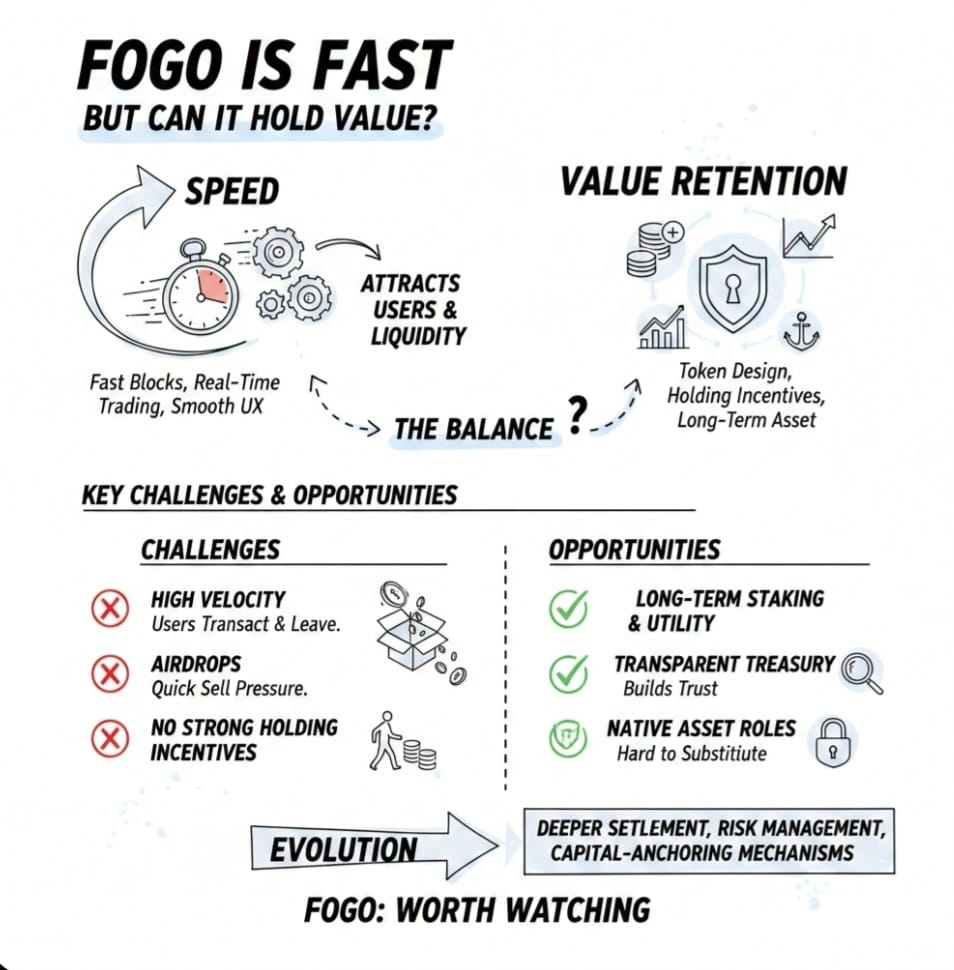
I keep coming back to the same simple thought about Fogo.
The tech can be excellent. The chain can feel incredibly smooth. But none of that automatically answers the harder question: will people actually hold the token once real usage shows up?
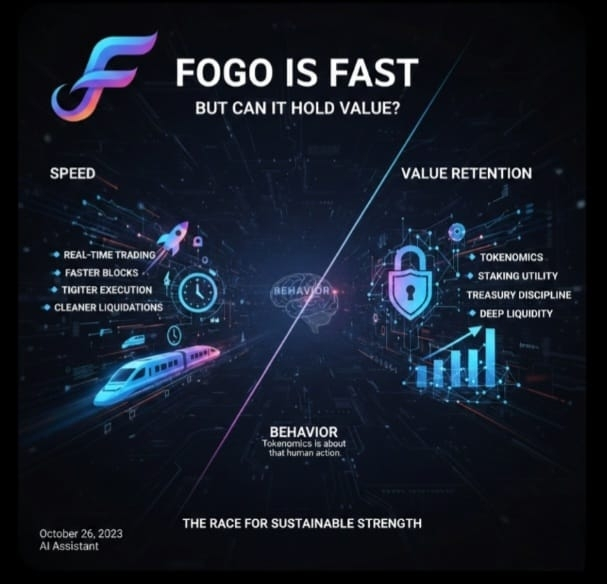
Because speed makes a network feel good.
Token design decides whether value stays.
Right now, Fogo’s direction is very clear. It is trying to build a chain where on-chain trading feels close to real-time. Faster blocks, tighter execution, fewer wallet interruptions — all of that points toward one goal: make the experience clean enough that serious liquidity is comfortable operating on-chain.
That matters more than many people think.
Why Fogo’s approach is interesting
Most chains talk about being fast. Fogo is trying to make speed consistent and usable, especially for trading environments where milliseconds actually matter.
If they succeed, a few things naturally follow:
market makers can quote tighter
liquidations become cleaner
strategies that need quick execution become viable
and on-chain venues stop feeling like the “slow version” of markets
That’s the upside case, and it’s real.
But there’s another side of the story that people often ignore.
The hidden problem high-performance chains face
When everything works smoothly, users don’t keep large balances.
They come in, do what they need to do, pay the fee, and move on.
If the ecosystem is heavily trading-focused, this behavior becomes even sharper because traders are extremely capital-efficient. They don’t like idle inventory sitting in wallets.
So ironically, the better the experience becomes, the more the token can start behaving like a temporary tool instead of a long-term asset.
This is where token velocity enters the picture.
When velocity rises, tokens move quickly from hand to hand. And when that happens consistently, it often creates steady background sell pressure — even while the chain itself looks healthy.
That’s the part many people miss.
Tokenomics is really about behavior, not distribution
A lot of discussions around tokenomics focus on charts and allocations.
But the deeper reality is simpler.
Tokenomics is a blueprint for human behavior.
You are not just deciding who receives tokens.
You are deciding what the rational thing is for them to do next.
If the easiest profitable move is receive and sell, the token struggles to hold value.
If the easiest profitable move is hold because holding unlocks real advantages, the token has a chance to build long-term strength.
Everything flows from that.
Airdrops: powerful but double-edged
Airdrops help projects grow fast. They spread ownership and attract attention.
But they also put tokens into the hands of people who:
didn’t pay for them
don’t feel attached to them
and have no strong reason to be patient
Most recipients selling quickly is not malicious — it is simply rational behavior.
For Fogo, the key question is whether those distributed tokens eventually settle into committed hands or continue to circulate quickly.
Distribution alone is not enough.
Retention is what changes the game.
Treasury behavior quietly shapes market confidence
Another thing experienced capital always watches is treasury discipline.
When a foundation controls a meaningful liquid supply, the market is constantly asking:
Is spending predictable?
Is it transparent?
Is it building long-term retention or just short-term activity?
If treasury actions feel measured and strategic, it builds trust.
If they feel reactive or noisy, the market starts to price in the risk of an invisible seller — and that alone can keep larger capital cautious.
Unlock schedules create psychological pressure
Long vesting schedules help early alignment, but they also create calendar tension.
Markets rarely wait for the actual unlock date. Traders start positioning months in advance. Narratives form early.
If organic demand is not clearly strengthening before major unlock windows approach, sentiment can become fragile very quickly.
So the network needs real, visible demand growth — not just activity spikes — as time moves forward.
Adoption does not automatically equal price strength
One of the most misunderstood dynamics in crypto is this:
More usage can sometimes mean more selling.
Why?
Because fees often flow to validators and operators, and many of them sell regularly to cover costs.
If the token does not have strong holding incentives built into the system, increased network activity can quietly increase recurring sell pressure.
That’s why pure activity metrics never tell the full story.
Bridged liquidity is helpful — but not sufficient
Bringing in stablecoins and major assets can help Fogo grow faster. It makes the ecosystem more usable early.
But there is a tradeoff.
If users can do most of what they want while holding minimal amounts of the native token, operational demand stays relatively weak.
Over time, strong networks usually give the native asset roles that are hard to substitute — roles tied to security, risk management, governance, or deep liquidity mechanics.
That is where long-term value usually comes from.
What would strengthen the long-term picture
From a neutral observer’s view, the signals that would meaningfully increase confidence include:
more supply moving into long-horizon staking with real utility
token roles that cannot be easily bypassed
disciplined and transparent treasury behavior
infrastructure that makes holding feel like owning part of the system
and ecosystem growth that looks sticky, not purely incentive-driven
None of this requires slowing the chain down.
It requires slowing the token’s circulation speed.