
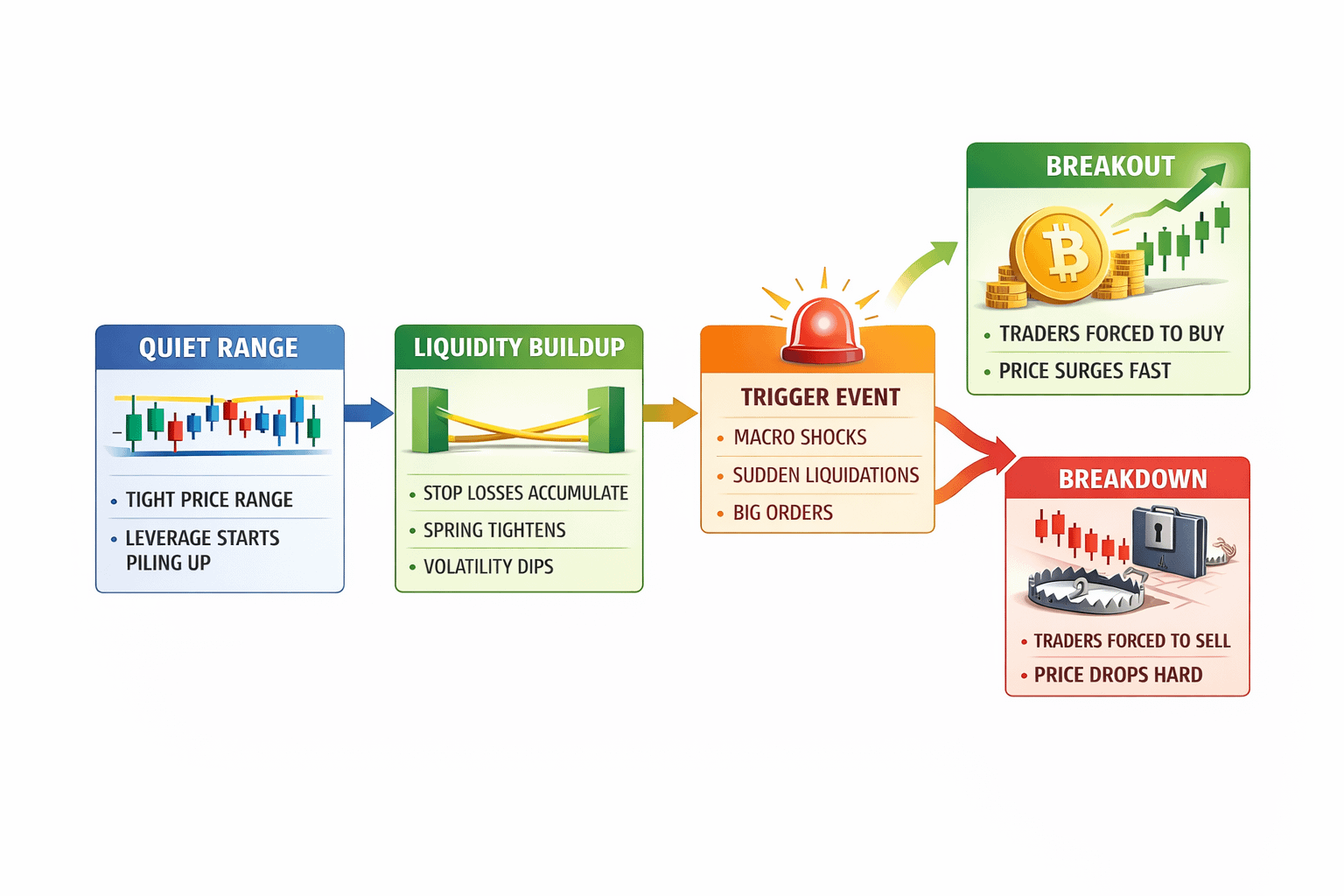
Bitcoin has a way of making the whole market feel personal. Even if you came here for altcoin speed, new narratives, or quick rotations, it always comes back to BTC because it still controls the emotional gravity. When Bitcoin is calm, everything else gets permission to dream. When Bitcoin tightens up and turns heavy, the entire market starts walking more carefully, like it can feel a trap forming under the floorboards. Right now, Bitcoin feels like that kind of market. Not dead, not broken, not euphoric. Just tense, compact, and selective, the way it gets when the next major decision is close enough to smell but not close enough to name.
What I’m seeing is a textbook professional environment disguised as boredom. Price compresses into a range, volumes become inconsistent, and the crowd starts begging for direction. Traders who need action call it “chop.” Traders who understand structure call it “inventory.” In this zone, Bitcoin isn’t just moving up and down, it’s redistributing risk. It’s giving late buyers a chance to escape, letting strong hands accumulate without paying a premium, and quietly punishing anyone who treats every green candle like a breakout. It becomes clear that this is not a market designed to reward impatience. It is designed to identify who is over-leveraged and who is prepared.
The biggest mistake people make in ranges like this is believing the range is the story. The range is not the story. The range is the process. Bitcoin compresses because two forces are temporarily balanced: buyers who see value and step in on dips, and sellers who still have enough supply overhead to slap price down when it lifts. That balance creates repeated tests of the same levels, not because the market is indecisive, but because it is grinding through orders. Every retest is a question asked again: is there still supply here, is demand still real, is the bid getting stronger or weaker. If this continues, the market eventually stops needing to ask, and that’s when the move arrives fast enough that people swear it happened “out of nowhere.”
A pro-trader lens starts with volatility and liquidity, not opinions. Bitcoin is most dangerous when it looks safe, because tight ranges invite leverage. Tight ranges convince people they can place stops close and size bigger, and that’s when the market begins engineering pain. It’s not evil, it’s mechanical. Liquidity clusters around obvious levels, and Bitcoin’s job, as a price discovery machine, is to find where the most size is hiding and test it. When volatility is low, the cost of building big positions falls, and that’s when the market is quietly loading the spring. We’re watching that spring load in real time.
There’s also a deeper layer to this moment that matters more than any single candle. Bitcoin is trading inside a world that is still obsessed with liquidity, rates, and macro expectations. That reality changes the rhythm. In easy liquidity regimes, Bitcoin rallies like a story that writes itself. In tighter liquidity regimes, Bitcoin trades like a professional risk asset, grinding, faking, and forcing confirmation. It becomes less about belief and more about flows. That’s why you will see sessions where everything looks bullish and then suddenly fades, not because Bitcoin “failed,” but because the broader market is still pricing uncertainty. If you trade Bitcoin like it exists in a vacuum, it will punish you. If you trade it like a global liquidity instrument with a unique reflexive engine, it starts to make more sense.
And that reflexive engine is still the most thrilling part. Bitcoin is not just a chart, it’s a feedback loop between spot demand, derivatives positioning, and psychology. When spot demand is real and steady, leverage can ride safely behind it. When spot demand is thin, leverage becomes the market, and the market becomes fragile. This is why liquidations feel like avalanches. It’s not only that price falls, it’s that falling price forces more selling, and forced selling becomes fuel. On the upside, it’s the same story in reverse. A strong reclaim can trigger shorts to cover, covering becomes buying, buying pushes price, and suddenly the market is sprinting. In those moments, Bitcoin doesn’t feel like an asset, it feels like weather.
The cleanest way to read Bitcoin on Binance in this kind of phase is to stop looking for a single prediction and start tracking whether the market is paying you for risk. In a healthy trend, good trades feel almost easy because continuation is rewarded. In a hostile range, the market charges you. It charges you with slippage, with wicks, with fake breakouts, with slow bleed after entry. That’s not a sign to quit, it’s a sign to adjust. When the market is charging you, the edge shifts away from “being right” and toward execution discipline. Position sizing gets smaller, entries get more patient, and invalidation levels become sacred. It becomes clear who is trading to feel something and who is trading to survive.
One of the most underrated signals in Bitcoin is not direction, it’s behavior around obvious levels. When Bitcoin approaches a ceiling repeatedly and keeps getting slapped down hard, that’s not bullish, that’s supply. When it approaches that same ceiling and the rejections get weaker, dips get bought faster, and the pullbacks become shallow, that’s not noise, that’s absorption. The market is chewing through sell orders. The same logic applies at the floor. If dips keep bouncing with strength, the bid is real. If each bounce becomes weaker, the floor is eroding. This is why a range is not “nothing.” A range is a slow conversation between buyers and sellers, and the tone of that conversation changes before the breakout happens.
Now let’s talk like traders talk when nobody is watching: execution quality. Bitcoin’s edge is not only about being early, it’s about being clean. A clean market is one where spreads behave, fills feel fair, and stop placement is meaningful. A dirty market is one where you get slipped, wicks hunt your stop, and continuation never arrives. Bitcoin goes through dirty phases, especially when liquidity thins or when the entire market is on edge. In those moments, the best traders don’t force trades, they reduce frequency and increase selectivity. They wait for the market to show its hand, then they strike with structure behind them, not hope.
What makes Bitcoin uniquely powerful is that it still attracts the deepest liquidity and the most attention, so when it moves, the move tends to be respected across venues. That is why it remains the coin that serious traders keep on their main screen even when they are rotating alts. If Bitcoin breaks, everything feels heavy. If Bitcoin recovers, everything gets oxygen. It’s not just correlation, it’s hierarchy. BTC is still the center of gravity for crypto risk.
This is also why the most important thing in a Bitcoin analysis is not the story you tell the crowd, it’s the risk you can manage when the story is wrong. Bitcoin will make liars out of everyone eventually. The market doesn’t care about your thesis, it cares about where you are positioned. It will go quiet long enough to make you bored, then spike hard enough to make you emotional, then reverse fast enough to make you question your sanity. And that cycle is not random. It’s what happens when an asset is traded globally, 24/7, by humans, machines, and funds, all with different time horizons and different pain thresholds.
If this continues, the next major move will likely come from a place that feels frustrating first. It often starts with a fake. A breakout that doesn’t follow through, a breakdown that snaps back, a wick that humiliates both sides. That humiliation is not an accident, it’s a cleansing. It flushes weak positions, resets funding pressure, and creates the conditions for a real directional run. When the real run begins, it tends to feel smooth compared to the chop, like the market is suddenly cooperating. That’s when people who were bored become believers again, and that’s when traders who stayed patient get paid.
But there’s no romance without risk. Bitcoin can still fail any short-term setup. It can still break down through a floor that looked solid all week. It can still rally hard and then fade in a single session. That’s why the professional mindset matters. You don’t marry a position. You don’t argue with price. You treat the chart like a map and your risk like oxygen. In Bitcoin, oxygen is capital. Lose it and you don’t get to participate in the next move, which is always the one that matters most.
The hope, and it’s real hope, is that Bitcoin continues to mature into an instrument that rewards discipline more than luck. Not because it becomes gentle, it will never be gentle, but because it becomes more structurally tradeable, with deeper liquidity, stronger spot participation, and healthier cycles. The fear is also real: sudden liquidity shocks, sharp de-risking events, or cascading derivatives unwind can still turn a calm market into chaos in minutes. Both truths can live in the same chart. That’s what makes Bitcoin the purest arena in crypto.
So if you’re trading Bitcoin on Binance and you want a grounded way to approach this moment, hold onto this feeling: the market is building something. The chop is not meaningless. The compression is not weakness by default. It is preparation. It is the slow construction of a move that will look obvious only after it happens. We’re watching the coil tighten. We’re watching risk get redistributed. And when it finally releases, it won’t ask permission. It will just go, and the only thing that will matter is whether you were positioned with discipline, or positioned with emotion.