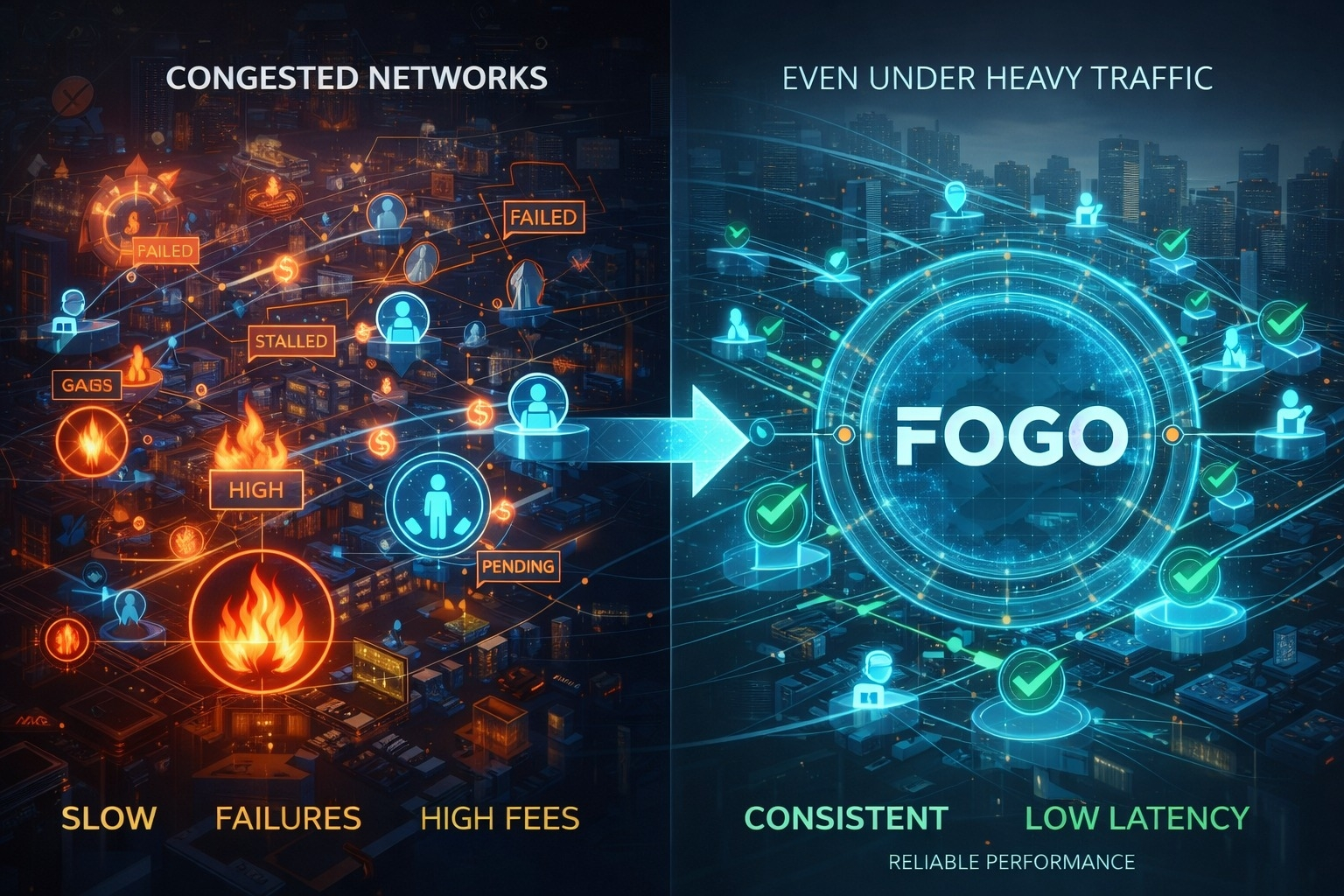
I didn’t really get what was missing in blockchain infrastructure just by reading whitepapers or watching launch hype. I figured it out by actually using different networks when things got busy. When traffic is light, everything feels great, transactions go through fast, fees don’t jump around, the whole thing just works. But as soon as the volume ramps up, the cracks start to show. Suddenly, confirmations drag, fees get weird, and sometimes your transactions just hang there, stuck in limbo. That happened to me enough times that I started wondering, if blockchain tech keeps advancing, why does it still choke the moment people actually use it?
After a while, it hit me: most networks are built to look impressive, not to stay impressive. They’re all about showing off how fast they can go in perfect conditions. But real life isn’t perfect. People trade during wild markets and pile in during traffic spikes. We expect these systems to act like the rest of the internet snappy, reliable, always on. When they don’t, it’s not just a technical letdown. It’s just plain frustrating.
From what I’ve seen, speed on its own isn’t the real issue. Lots of blockchains are lightning fast, until they aren’t. The real test is whether they stay consistent when things get hectic. A network that’s blazing fast with no traffic but bogs down in rush hour? That’s not actually fast. That’s only fast sometimes. And when reliability depends on luck, trust starts to fade.
That’s why I started paying attention to a new approach to infrastructure. Instead of obsessing over the fastest possible speeds, I wanted to know: does this thing actually hold up when the action never stops and nobody knows what’s coming next? That shift in mindset is what pulled me toward @fogo, $FOGO, and the whole #fogo ecosystem.
What caught my eye wasn’t one flashy stat. It was the focus on keeping latency low and execution steady, not as a flex, but as the baseline. The idea is simple but it matters: build for the way people actually use blockchains, not just for demo day. In real terms, that means making sure confirmation times stay tight, everything runs predictably, and the network doesn’t freak out when the crowd shows up.
I think about it like city traffic. Any road feels fast when it’s empty. The real test is rush hour. That’s when you find out where the bottlenecks are, where delays pile up, and where the whole system gets pushed to its limit. In blockchain, rush hour means failed trades, transactions stuck waiting, crazy fees, or apps that suddenly slow to a crawl. Technically, the network’s still up, but it doesn’t feel reliable anymore.
Looking at Fogo, what stands out is how they treat low latency as a requirement, not a record to break. If confirmation times stay solid, everything changes, trading feels instant, games run smoothly, and financial apps act more like real-time tools instead of clunky batch processes.
This all points to a bigger question: what actually keeps things stable? A lot of networks try to scale by piling on layers, bridges, and different modules, spreading out the traffic. Sure, this can boost capacity, but it also adds a mess of complexity. For users, that usually means more steps, more waiting, and more ways for things to break.
What I like about the #fogo approach is the push for a more unified system. The less users have to bounce around between different environments, the fewer headaches they run into. Even if the tech under the hood is complicated, the experience on top feels easier and more dependable. That’s what keeps me interested.
I’ve been seeing a bigger shift in crypto lately, and honestly, it lines up with what I’ve been thinking. For years, everyone obsessed over scalability and clever new architectures. Now, people are finally talking more about user experience. It’s not just about how much a network can handle on paper, it’s about how it actually feels to use. All that fancy fragmentation, endless layers, and hopping across environments might be efficient for engineers, but for regular users? It often just means delays and confusion.
Building for real people brings its own set of headaches. If you want low latency and stable performance, you end up tightening control over everything, network efficiency, resources, execution. Suddenly, you can’t ignore the tradeoffs between decentralization, speed, and consistency. And honestly, when it comes to Fogo, I don’t care much about flashy early numbers. What matters is whether those numbers stick around when things get busy and unpredictable.
I also pay close attention to what developers do. You can have the fastest infrastructure in the world, but it only matters if people actually build demanding apps on it. There’s this loop: developers are way more likely to launch high-pressure stuff, think trading platforms or real-time games, on networks they trust to hold up under load. But the only way a network proves itself is when those apps actually run and get hammered by real users.
For end users, it’s even simpler. Most people don’t care about block times, consensus, or throughput stats. They just notice if something happens instantly, if it fails, or if it feels like the kind of software they’re used to. Adoption isn’t really about tech breakthroughs, it’s about removing the weird moments where blockchain feels clunky compared to everything else online.
This is where Fogo’s approach stands out to me. It’s less about winning a numbers race and more about matching what people already expect from modern software. When the network just works the way you assume it should, the technology fades into the background. And for infrastructure, that’s usually the goal, you want people to forget it’s even there.
The $FOGO token also feels more grounded in real participation than just hype. Infrastructure tokens usually struggle if performance doesn’t turn into actual use. But if apps keep growing because the network holds steady under pressure, the token actually matters because people are using it, not just speculating. That connection is still early, but it’s a clear sign things are shifting toward real utility.
Uncertainty’s always part of the deal, though. I’ve seen networks launch strong, only to hit trouble when demand ramps up. Keeping things consistent as user numbers grow and traffic shifts around the world is a long-term test. The real judgment for any infrastructure project starts after the initial buzz fades and people just use it, day in and day out.
And the competition’s getting fierce. Pretty much every big blockchain is now chasing faster execution, lower latency, better experience. For me, the real difference will come down to focus. Some networks chase headline-grabbing numbers, optimizing for big peaks. Others treat performance as a core foundation and optimize for steady reliability. Over time, users feel that difference, ven if they can’t explain exactly why.
That’s why I find the @Fogo Official conversation interesting. It’s not about test results or demo day. It’s about what blockchain feels like when people really use it, during chaos, high traffic, or just on a normal day. If things keep moving in this direction, Fogo’s real value might be something quiet: not being the fastest in perfect scenarios, but being one of the most dependable when it counts.
And honestly, that’s what matters most to me. Not which blockchain shouts the highest numbers, but which one I stop thinking about because everything just works. The infrastructure projects that last aren’t the loudest, they’re the ones you barely notice, because the friction is gone and you can finally focus on what you came to do.