
Opening Perspective on Fogo’s Cross Chain Direction
For a long time I believed DeFi promised freedom but quietly delivered fragmentation. Every chain built its own ecosystem, its own liquidity pools, its own tools, and its own friction. Instead of one open financial system, traders ended up managing several disconnected environments. When I first heard about Fogo, the headline sounded familiar because every new network talks about speed. But after watching the project develop more closely, I started seeing a different ambition forming. The goal does not appear limited to faster execution. It looks more like an attempt to remove the borders between blockchains altogether and treat them as parts of one trading environment.
From my perspective, this matters far more than raw performance metrics. Traders rarely suffer because transactions are slow in isolation. The real frustration appears when capital cannot move quickly enough between ecosystems to respond to opportunity. A fast chain means little if liquidity remains trapped elsewhere.
The Real Problem Traders Face Today
Liquidity in crypto is scattered. Ethereum holds deep capital, Solana hosts fast execution environments, and other networks specialize in different niches. Moving between them still feels like navigating separate countries with incompatible banking systems. Every transfer introduces extra steps, new risks, and delays that destroy timing advantages.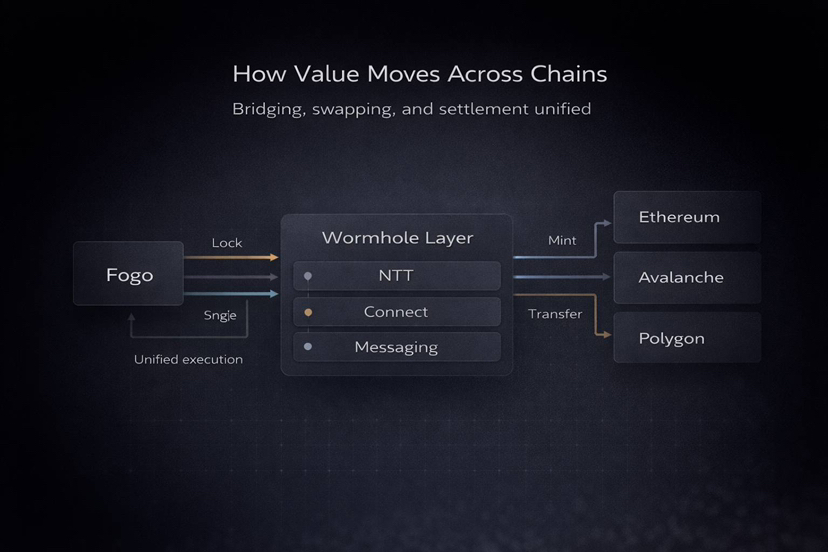
I have personally experienced moments where volatility created a clear hedge opportunity on another chain, yet bridging funds took long enough that the trade stopped making sense. That delay turns speed advantages into marketing rather than reality. A trading focused chain therefore cannot exist as a closed ecosystem. It has to function as connective infrastructure.
Fogo’s direction seems to recognize this clearly. Instead of encouraging users to stay inside one network, the architecture leans toward enabling movement across many networks as naturally as possible.
Wormhole as the Core Interoperability Layer
Rather than building a completely new bridge from scratch, Fogo integrates deeply with Wormhole infrastructure. That decision feels practical to me because interoperability is less about novelty and more about reliability.
One important mechanism is Native Token Transfers. In simple terms, tokens can be locked on one chain while equivalent representations appear on another, and later redeemed back into their original form. The locked assets remain secured within custody contracts, allowing value to travel without permanently leaving its origin network.
Another piece that stands out is the Connect aggregation flow. Bridging, swapping, and final settlement can occur within a single interaction instead of forcing traders through multiple manual steps. For someone used to complex bridging workflows, this begins to resemble the smooth internal transfers people expect from centralized trading platforms, except without giving up custody.
Cross chain messaging adds another dimension. Smart contracts on different networks can exchange information and trigger actions. This means positions, collateral checks, or liquidation events can react across chains instead of remaining isolated. A lending protocol on one network could validate activity occurring on Fogo before granting credit. That level of coordination moves interoperability beyond simple asset transfers.
Moving Beyond Bridges Toward True Composability
Bridging alone does not solve fragmentation. Real composability means applications can interact across chains as if they share a common environment.
When contracts can send messages across networks, entirely new financial structures become possible. Insurance mechanisms could protect positions located on another chain. Exchanges could aggregate liquidity globally and execute trades where pricing is most efficient. Credit systems could allow collateral and borrowing to exist on different networks while remaining synchronized.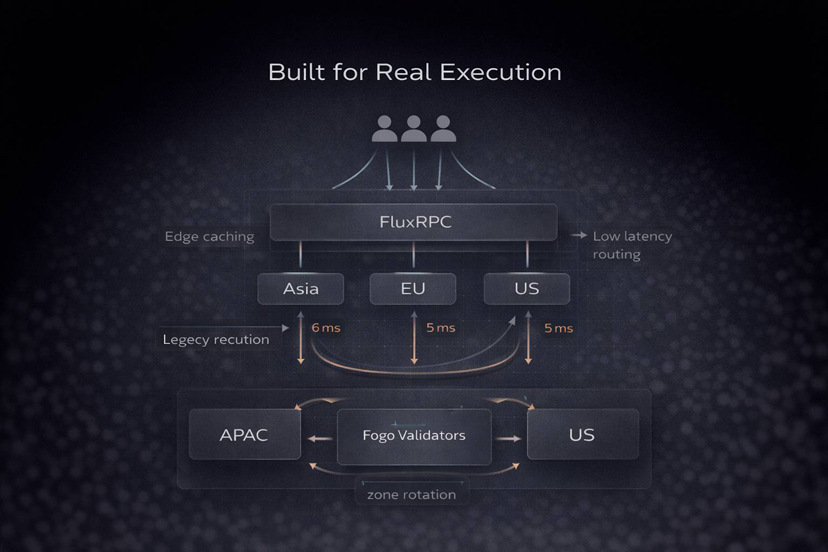
These ideas stop sounding theoretical once infrastructure supports reliable communication between chains. Events like Fogo Fest discussions highlighted how high speed oracle feeds, open protocol networking, and simplified fiat on ramps begin to fit together when cross chain messaging becomes normal rather than experimental.
From my viewpoint, this signals a shift away from chain competition toward chain coordination.
Reliability Matters More Than Connectivity Alone
Interoperability only works if execution remains stable. Traders care less about theoretical connectivity and more about whether systems remain operational during stress.
Fogo combines Solana style execution foundations with a multi local consensus approach. Validators operate within geographic zones that rotate periodically. Keeping active validators closer together reduces communication delay, while rotation prevents the system from depending permanently on one region.
The architecture tries to balance speed with resilience. Local coordination improves latency, while geographic rotation protects against regional outages. Early testing revealed challenges during zone transitions, especially around connectivity and routing, which required improvements in caching and RPC handling. I actually find those issues reassuring because they reflect real engineering problems being addressed rather than ignored.
The FluxRPC layer further separates user access from validator operations. Edge caching and load balancing allow requests to be served by nearby infrastructure without overwhelming validators. For traders and developers, this means real time data access without degrading network stability.
Incentives That Extend Across Ecosystems
Technology alone does not attract liquidity. Incentives coordinate behavior. Fogo’s Blaze program encourages participation across multiple chains by allowing assets such as ETH, staked ETH, or FOGO to be used within cross chain staking structures. Participants earn points that may translate into future rewards, encouraging early experimentation with interoperability rather than isolated usage.
Token distribution also appears structured around longer timelines, with large portions locked through cliffs and delayed unlock schedules. Whether one agrees with the model or not, the intention seems focused on reducing early sell pressure while infrastructure adoption develops.
To me, incentives matter because cross chain systems only succeed when users actually move capital through them repeatedly.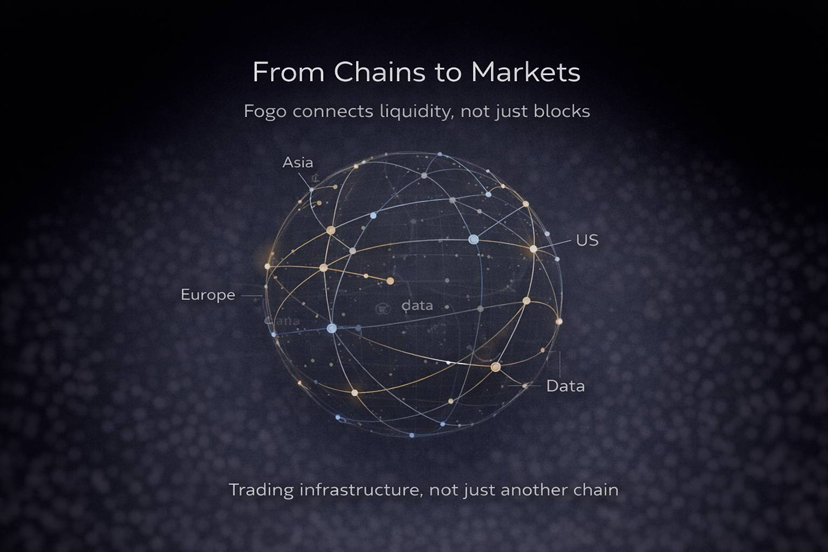
A Chain Designed for a Multi Chain Reality
What makes Fogo interesting is not a claim of replacing existing networks. Instead, it assumes the opposite. Multiple chains will continue to exist, each with strengths and communities. The opportunity lies in making movement between them seamless enough that traders stop thinking about network boundaries altogether.
If sending assets or triggering actions across chains becomes as simple as sending a message, the concept of choosing a single blockchain begins to fade. Liquidity becomes global rather than siloed, and execution venues compete on quality rather than isolation.
Remaining Risks and Open Questions
None of this eliminates risk. Cross chain bridges remain a historical attack surface across crypto. Governance decisions around validator zones must remain transparent to maintain trust. Infrastructure complexity increases when coordination spans multiple ecosystems.
The important question is whether reliability improves as usage scales. Interoperability must survive real market stress, not just controlled environments.
Closing Thoughts on a Borderless Trading Vision
What draws me toward Fogo’s approach is its recognition that traders do not care about chains as identities. They care about execution, liquidity access, and timing. By treating blockchains as interconnected components rather than competitors, Fogo attempts to build a trading layer that operates across ecosystems instead of within one.
If that vision works, the biggest change will not be a faster chart or a larger TPS number. The change will be psychological. Traders will stop asking where their assets are located and start focusing only on what opportunities exist.
In a market still divided by invisible borders, that idea alone feels ambitious enough to matter.
