
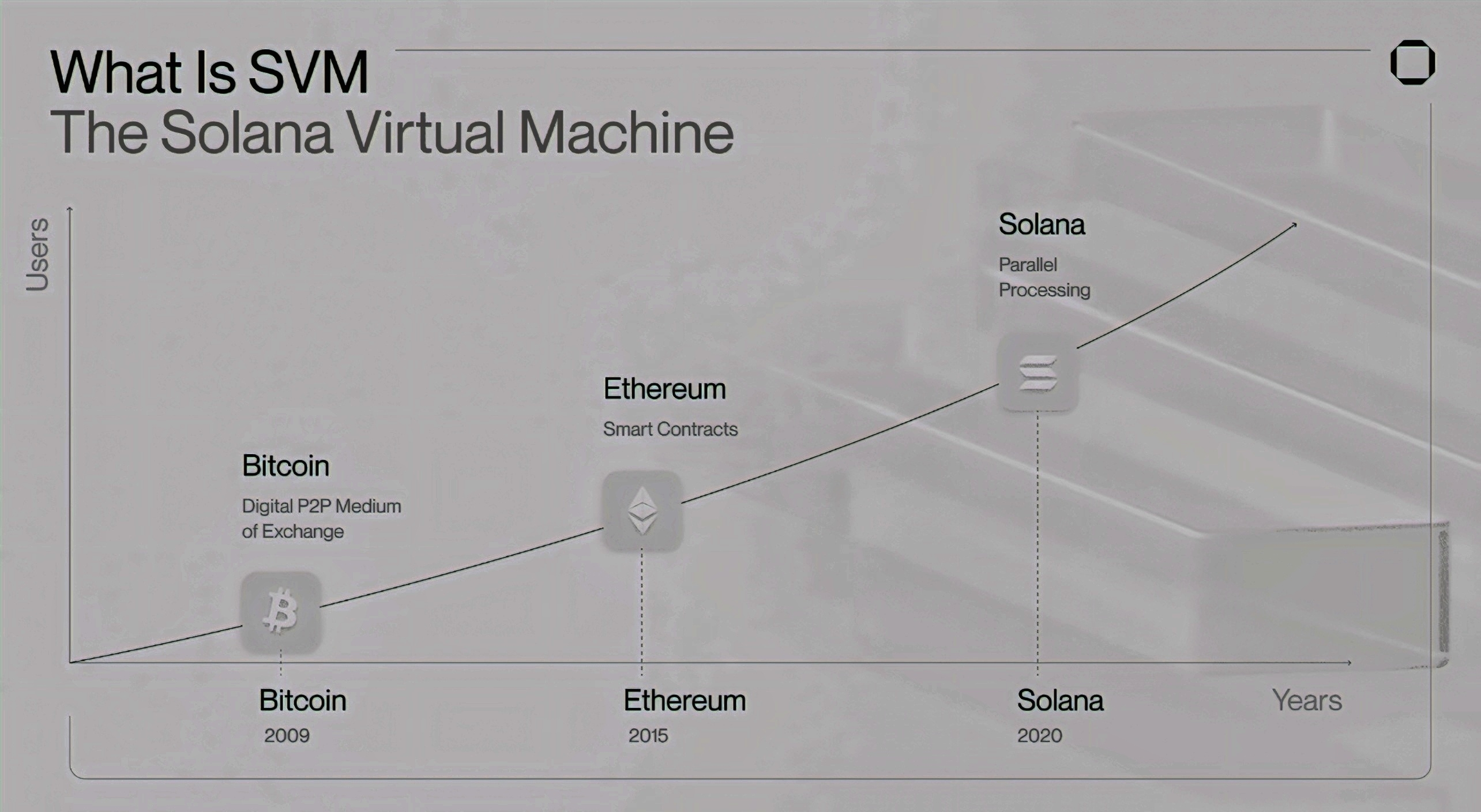
When we say @Fogo Official runs on the Solana Virtual Machine (SVM), we’re talking about the powerhouse engine that processes its smart contracts.
Unlike traditional EVM chains that process transactions one-by-one (sequentially), the SVM is built for Parallel Execution.
Why this matters for Fogo:
Parallelism: Processes multiple transactions at once (as long as they don't hit the same accounts).
High Throughput: Massive TPS (Transactions Per Second) without network congestion.
Efficiency: Account-based state management that optimizes data flow.
Deterministic Speed: Predictable, lightning-fast performance every single time.
The Bottom Line: Parallelism isn't just a feature—it is the core of Fogo’s performance strategy. By leveraging the SVM, Fogo delivers Web2 speed on a Web3 foundation.
The adoption of the Solana Virtual Machine (SVM) by Fogo represents a strategic shift toward high-performance, parallelized blockchain execution. Unlike traditional sequential processing models, the SVM enables Fogo to handle multiple transactions simultaneously, provided they involve distinct accounts. This architectural choice is not merely about compatibility; it is a deliberate move to leverage a proven, high-throughput engine that offers deterministic performance and a robust developer ecosystem. By utilizing the SVM, Fogo eliminates the need to build a new VM from scratch, allowing for seamless developer portability and immediate access to an established suite of tools and SDKs.
However, Fogo distinguishes itself by extending the standard SVM model through specialized engineering. By integrating a Firedancer-optimized client, Fogo achieves hardware-level efficiency and significantly reduced latency variance—a critical requirement for consistent execution under market stress. Furthermore, Fogo employs a Validator Colocation Strategy, placing infrastructure in high-performance data centers to minimize propagation delays. While this may initially favor performance over extreme geographic decentralization, it ensures the low jitter and predictable timing essential for professional trading environments.
Ultimately, Fogo is not a general-purpose blockchain but a specialized execution hub for High-Frequency Trading (HFT), Perpetual DEXs, and complex derivatives. By tuning its infrastructure specifically for financial logic, Fogo aims to centralize liquidity and drive structural demand for the $FOGO token through gas utility and validator staking. While risks such as liquidity fragmentation and competition from the Solana mainnet remain, Fogo’s focus on institutional-grade stability and parallel execution positions it as a formidable contender in the evolution of on-chain finance.
Final Assessment
Fogo’s use of the Solana Virtual Machine is not just about compatibility.
It is about:
• Leveraging parallel execution
• Optimizing latency
• Engineering validator topology
• Specializing in real-time financial infrastructure
If the market moves toward institutional-grade on-chain trading, Fogo’s SVM-based architecture could position it as a performance-focused execution hub within the broader ecosystem.