
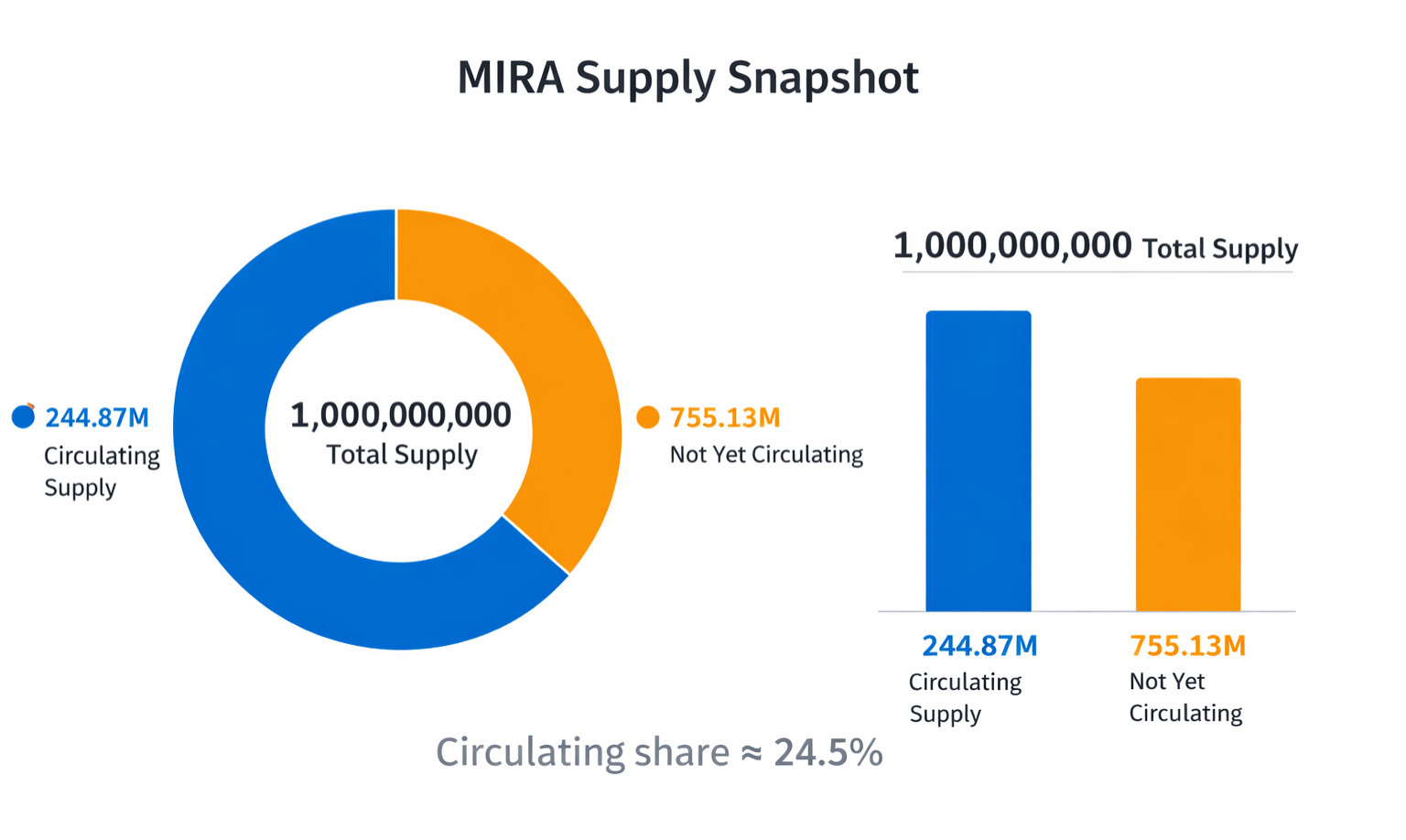
I usually start with the number when I analyze tokenomics. For me, tokenomics are mostly about understanding a single number : the total amount of tokens issued, and the amount already in circulation. The MIRA tokens are limited to 1 billion. The current circulating supply is about 244.87 million or approximately 24.5% of the total stock.
So the headline figure is clean indeed, but the better point is that majority of the supply remains outside the circulation. The mere fact of this doesn't make the token good or bad. It simply means that in order to judge the model, future unlocking, token issuance, and network usage will have to be pivotal factors.
Then, the next natural question will be, what is the actual use of MIRA?
That is exactly the point where the project becomes more intriguing compared to a typical “fixed supply” story. The token is described by Mira as a native asset of a trust layer network for AI outputs. The network is based on Base and the token standard is ERC-20. Simply put, the token is supposed to be doing its thing within the network operations and not just be a speculative tag.
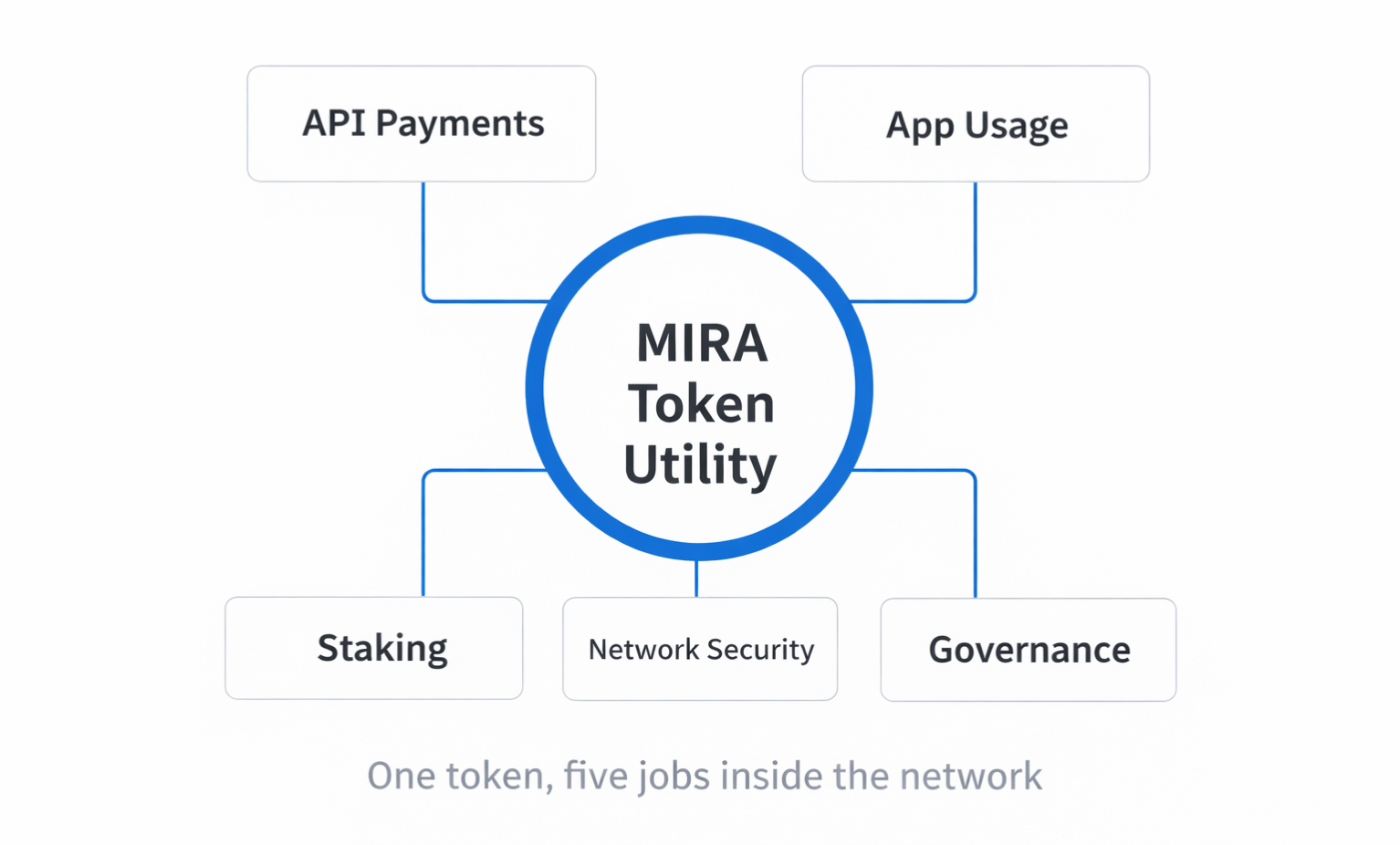
The first and second utility layers are probably the most straightforward.
API In the first place, access. Mira claims that MIRA as a token is being used as a form of payment for API access so that AI verification can be integrated by developers into their apps. Secondly, application-level usage. Binance Research presents MIRA as the token that is utilized throughout all the Mira ecosystem apps, that is, for log-in and premium features.
I actually believe that this is the aspect that is largely overlooked by people, since utility seems more authentic when a token is linked with repeated product usage rather than with just single time staking narratives. It will be a great base layer for the other four layers to build on.
Layer three and four deal with the network being trustworthy.
Other than that, MIRA is also the token used for staking and network security. According to the official sources, any token holder can stake MIRA in order to become a part of the network’s verification process, while node operators are required to stake MIRA if they want to participate in AI validation and help secure the system.
In addition, stakers are entitled to receive rewards. This makes the loop work quite nicely: work, verification, stake, reward. It is not eye-catching, but it works. And to be honest, that is probably what most people would want to see in tokenomics. Utility should prevent bad behavior rather than being just a nice illustration of the concept.
Finally, the last, fifth, layer is the governance, and that is the point where the model is the closest to being full-fledged.
Those who have staked their tokens will be able to vote on the network proposals, with the voting power being proportional to the number of tokens staked. Binance Research also portrays MIRA as a base pair asset within the ecosystem, which brings another economic role related to liquidity and token design at the application level. All in all, the five layers represent very well the tokenomics: API payments, app usage, base-pair role, staking/security, and governance.
For me, that is the correct interpretation of MIRA’s tokenomics. Not as an exciting figure, but rather a question of whether each layer will generate genuine demand within the network over a period of time.