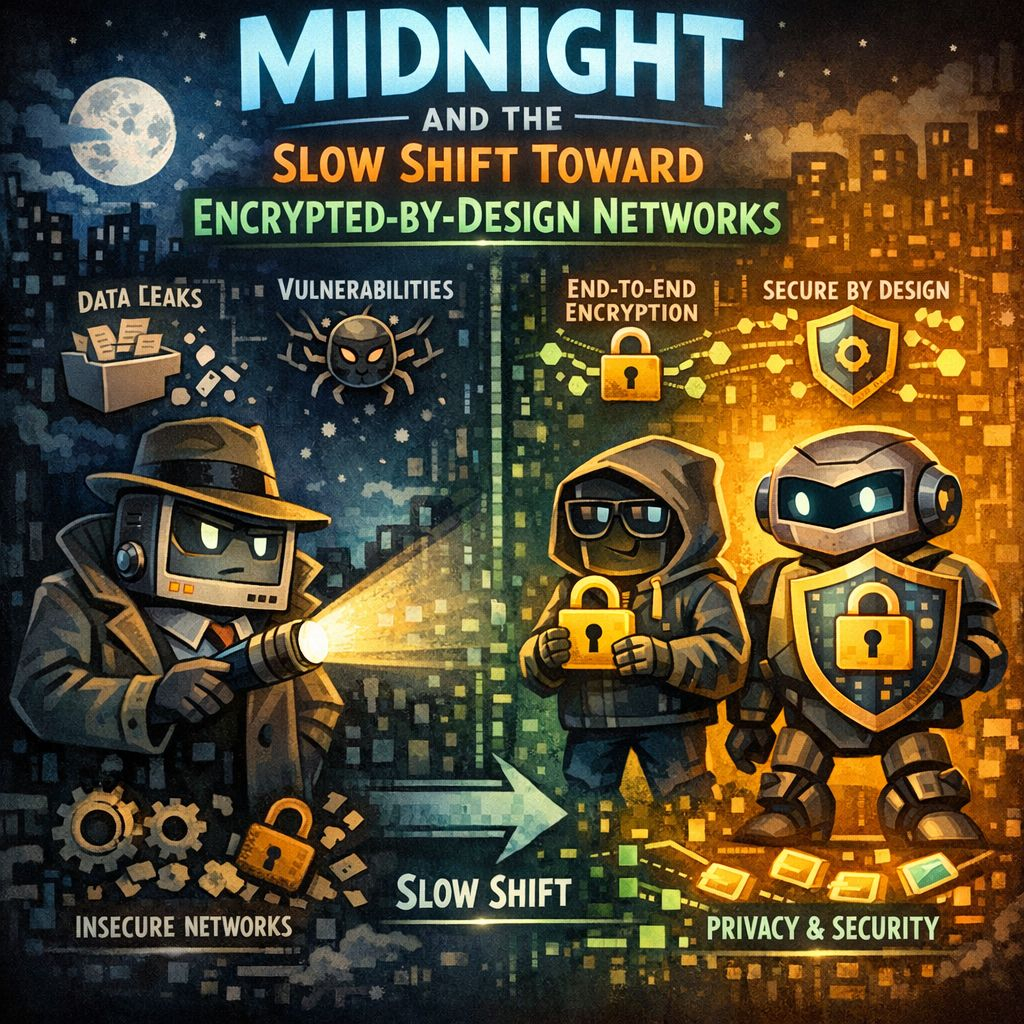
It’s strange how quickly people claim to care about privacy, yet how slowly they move toward anything that genuinely protects it. Midnight, tucked into conversations about new Web3 infrastructure, sits right in the middle of that contradiction. You hear people say privacy matters. You rarely see them change their behavior. And that tension—between belief and action—says more about the future of encrypted-by-design networks than any technical explainer ever could.
I keep noticing this quiet shift. It doesn’t roar in with bold promises. It creeps in through small frustrations and small fears: the feeling that your data leaks through too many cracks, or that every action online carries a faint trace you can’t fully erase. People don’t articulate this clearly. They just sense something’s off. Midnight steps into that blurry discomfort with a proposition that feels almost too simple: what if the base layer didn’t expose so much in the first place?
That sounds obvious. Almost boring. But maybe the boring part is the point. Encryption—real encryption, not a buzzword slapped onto a whitepaper—forces you to rethink what a network shows by default. For years blockchains leaned toward transparency, almost aggressively so. Every transaction, interaction, and contract screamed its details to anyone staring at a block explorer. And for a while, people accepted that. Transparency gave them trust, or at least the illusion of it. But it also boxed them in. You can’t run most real-world use cases when everything is exposed to everyone all the time.
Midnight seems to challenge that old assumption. It doesn’t reject transparency entirely; it rearranges it. It treats privacy not as a special feature or a rare mode you toggle on, but as the ground floor. An encrypted-by-design network means you reveal what’s necessary, when it’s necessary, and only to the people who need to see it. The rest stays quiet.
I like that idea. But I also hesitate. Because if privacy is so important, why hasn’t the shift been faster?
Maybe the truth is uncomfortable: privacy is inconvenient. It breaks habits. It complicates the way developers design smart contracts. It forces people to think about data boundaries they usually ignore. It introduces the fear that if something is hidden, maybe something else is being hidden from you. Humans are odd like that. We say we want protection, then complain when protection feels unfamiliar.
Despite that tension, Midnight taps into a growing recognition that transparency has unintended consequences. A business can’t run payroll on a fully public ledger without exposing salaries. A DAO can’t negotiate anything sensitive without tipping its hand. Even individuals hesitate to interact when their entire history trails behind them like a spotlight. So the shift toward privacy isn’t happening because the technology got suddenly exciting. It’s happening because the old defaults became too limiting.
Encrypted-by-design networks flip the default. Instead of publishing everything and hiding selectively, they hide everything and reveal selectively. That’s a huge mental shift. Midnight uses zero-knowledge proofs—mathematical techniques that let you prove something is true without exposing the underlying data—to make that possible. You don’t need the equations. Just picture it like showing someone a sealed envelope and convincing them you know the contents, without ever opening it.
The practical consequences could be subtle at first. A developer might build a contract that handles sensitive business logic without exposing it. A user might interact with a dApp without leaving a visible breadcrumb trail. A company might finally consider moving certain processes on-chain because it no longer feels reckless. These aren’t headline-grabbing moments. They’re quiet, incremental ones—the kind that don’t trend on social media but slowly reshape expectation.
But the shift is slow for another reason: people have trust issues with privacy tech. They worry privacy equals hiding wrongdoing. They worry encrypted networks will feel like walled gardens. Some of these fears come from misunderstanding; others come from legitimate caution. Midnight has to navigate that landscape carefully. It can’t just say “trust us, everything is private now.” That would unsettle people even more.
Instead, the model Midnight leans toward is selective disclosure. Think of it like carrying a passport with pages you can reveal individually. You don’t show your entire identity to everyone; you show the part that's relevant. That level of control is almost mundane when you say it out loud, yet for blockchains it’s a pretty big shift. And maybe that’s why the momentum, though slow, feels persistent. People don’t need a grand promise. They need a network that works the way the real world works.
There’s also a cultural angle here: developers who grew up building in public now face a new set of design questions. What should be private? Who gets access? How much friction is acceptable? I’ve watched people wrestle with these questions in other privacy-focused projects, and it’s rarely straightforward. Midnight pushes that conversation forward, gently, without forcing a rigid philosophy. It seems to accept that privacy isn’t a moral flag—it’s a tool. Sometimes you need it tightly. Sometimes you loosen it. That flexibility might be why it’s gaining quiet attention.
Still, I won’t pretend to know how far this shift will go. People are unpredictable. They embrace privacy when they’re scared and ignore it when they’re comfortable. Infrastructure-level change is always slow. And networks designed with strong privacy from the start have to earn trust in ways public chains didn’t. Transparency sold itself. Encryption has to persuade.
But even with those uncertainties, something about Midnight’s approach feels grounded. It doesn’t try to rebuild the internet overnight. It just nudges developers and users toward a default that feels more aligned with how humans already live. We reveal ourselves selectively. We share context depending on who’s asking. We protect certain details because they matter. Maybe infrastructure should reflect that, instead of forcing every detail into the open.
If the shift toward encrypted-by-design networks continues—and I think it will—it won’t be because someone wrote a visionary manifesto. It’ll be because people got tired of feeling exposed. Because small moments of discomfort added up. Because tools like Midnight offered an alternative that didn’t demand perfection, only intention.
And maybe that’s enough to move things forward, even if just a little at a time.