
@MidnightNetwork I was still at my desk after midnight listening to the soft rattle of my ceiling fan and rereading Midnight’s latest notes because this part of crypto has started to feel unusually practical to me. I kept circling one idea in my notebook and could not quite let it go: why does DUST matter right now?
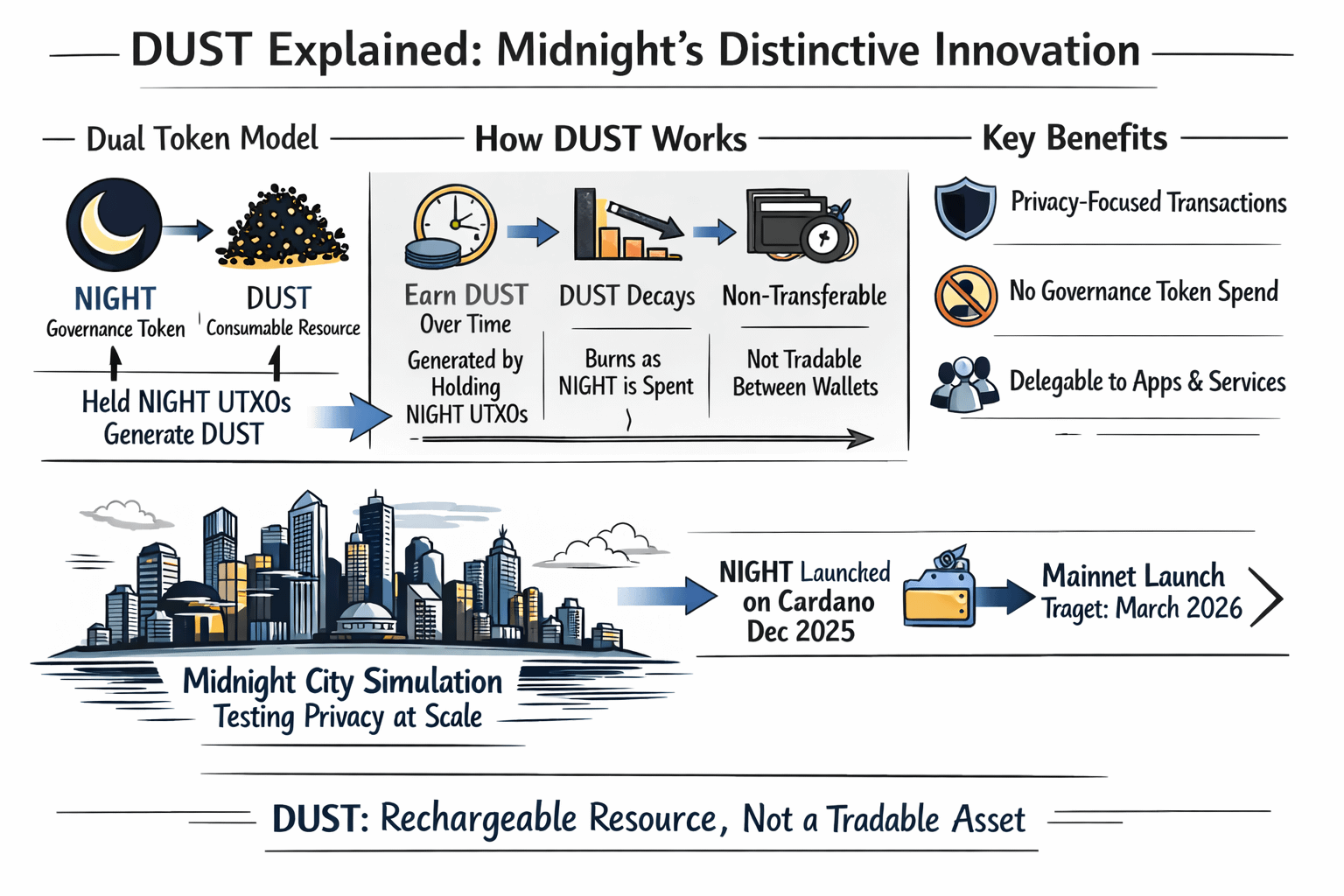
I care about DUST because it tries to solve a familiar blockchain problem without pretending the problem is new. Most networks make users spend a tradable token every time they do anything meaningful and that can turn normal use into a small budgeting exercise. In privacy-focused systems it also raises harder questions about what is being transferred or tracked at each step. Midnight separates those roles more deliberately. On this network NIGHT is the core token tied to governance while DUST is the consumable resource used for fees and privacy-enhancing smart contract activity. Midnight describes DUST as non-transferable and consumable rather than a financial asset.
What makes the design distinctive to me is the way DUST is generated. It is not something I buy on an exchange and send around like cash. Midnight’s documentation says DUST is produced over time by held NIGHT UTXOs up to a cap and then begins to decay when the backing NIGHT is spent. That makes it feel more like rechargeable fuel than a second coin looking for a market price or another round of speculation. I find that interesting because it shifts the discussion away from price watching and toward access and routine network use.
I think that is why DUST is trending now instead of sitting quietly in a whitepaper. The recent context is concrete and hard to miss. Midnight says NIGHT launched on Cardano in December 2025 after a large community distribution and the roadmap is now pointed at a mainnet launch in late March 2026. In the past month the project has also been naming federated node operators and publishing mainnet-readiness material for developers while showing Midnight City as a simulation meant to demonstrate privacy-preserving activity at scale under live-like conditions. DUST sits at the center of that transition.
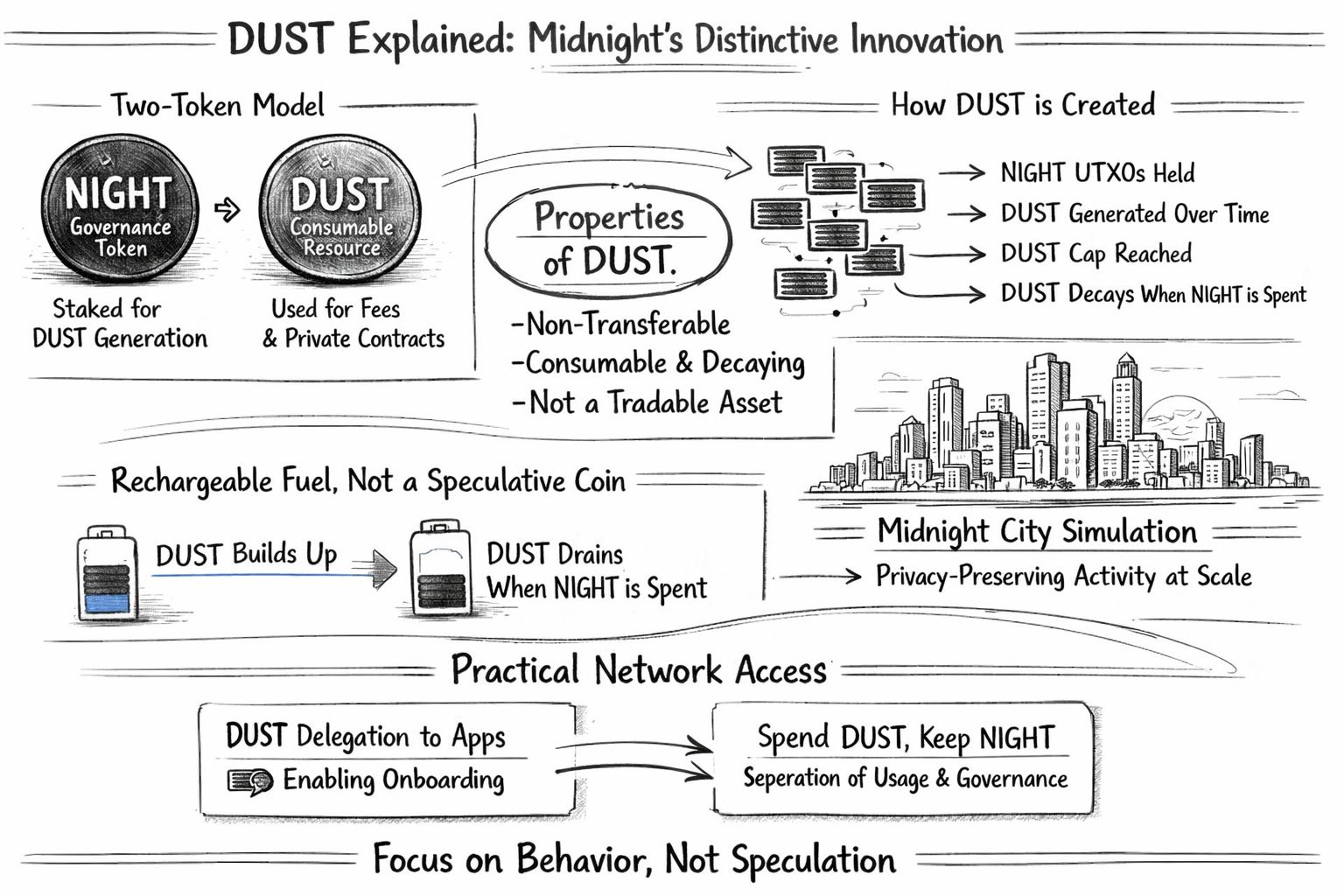
The real progress as I see it is not just that Midnight invented a separate fee resource. It is that the network has connected that resource to onboarding in a way that feels practical. Midnight explicitly says users spend DUST rather than NIGHT so participating in the network does not automatically eat into governance rights. It also says DUST can be delegated and that gives developers a path to power applications for users. I do not read that as a magic fix. I read it as a serious attempt to reduce the awkward moment when a new user wants to try an app but first has to buy the right token in the right place for the right fee without preloading a fresh wallet balance.
What stays with me most is the restraint of the idea. Midnight is not presenting DUST as money with better branding. It is framing DUST as a bounded network resource that cannot be transferred between wallets to buy goods or settle debts. That choice will not silence every criticism and I doubt it is meant to. Still it gives Midnight a cleaner answer to the old objection that privacy networks blur the line between protecting data and obscuring value transfer. I find that distinction more relevant in 2026 because privacy debates have matured and more institutions builders and regulators are watching.
I come away from DUST with cautious respect. It does not make Midnight simple and it does not remove the harder questions about adoption developer demand or whether users will understand a two-part economic model. But I can see why people are paying attention. DUST is one of the few blockchain mechanics I have read lately that feels designed around behavior instead of mythology. As Midnight moves toward mainnet that may be its most distinctive innovation: not louder privacy but a quieter and more usable way to pay for it in everyday practice.