
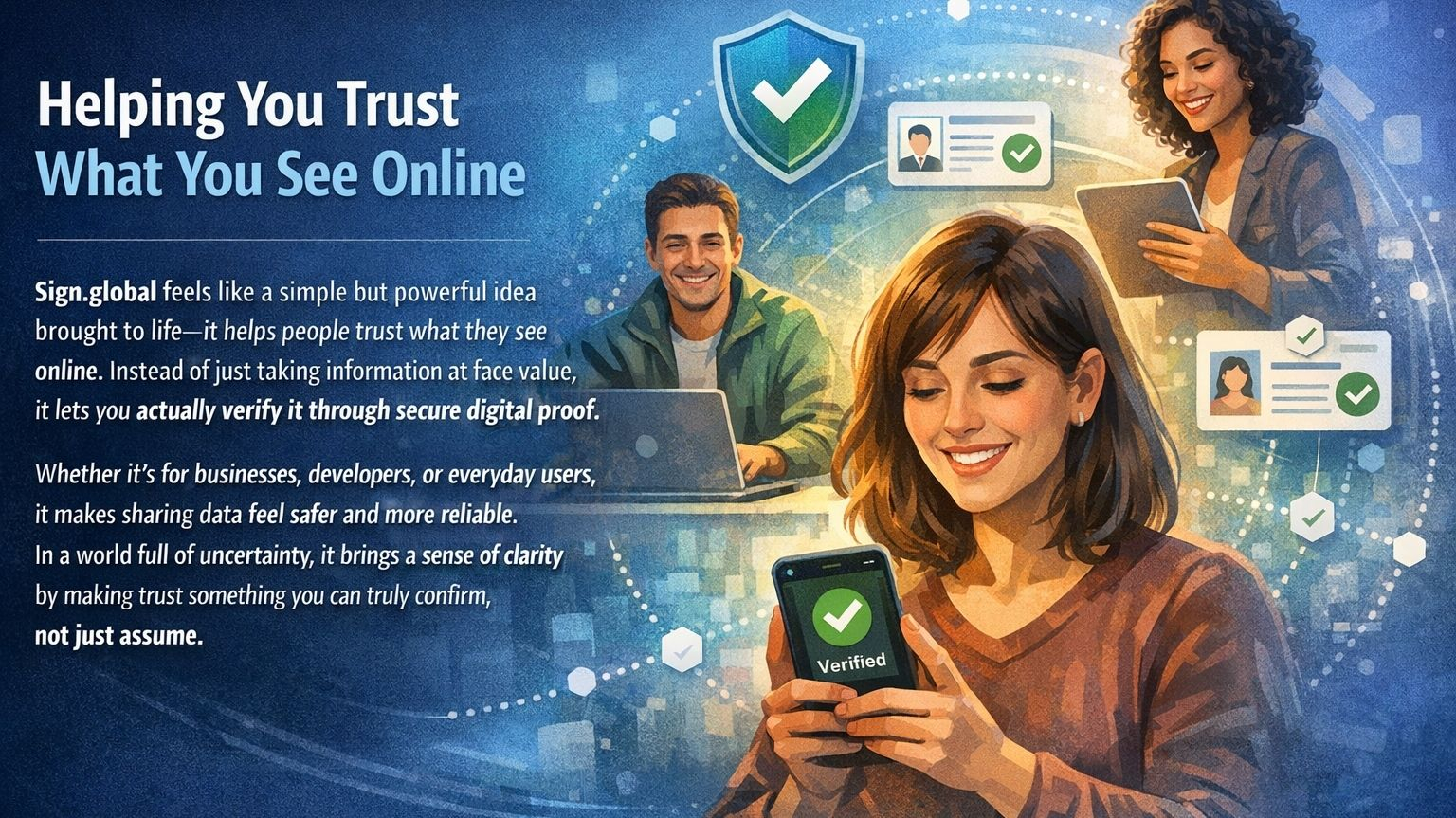
If you’ve spent any time online—working, earning, applying, or even just exploring—you’ve probably felt that small sense of doubt. Is this profile real? Did this person actually do what they claim? Am I truly eligible for this reward, or is it just another system that won’t work the way it should?
That quiet uncertainty has become part of the digital experience. We’ve learned to live with it, even though it slows things down and makes everything feel a little less reliable. SIGN steps into that exact gap, not with big promises, but with something much simpler and more powerful: proof.
At its heart, $SIGN is about making things verifiable. It focuses on two areas that touch almost every digital interaction today—credentials and token distribution. In plain terms, it helps answer two very human questions: Who are you, really? and Do you deserve this?
Instead of relying on trust alone, SIGN creates a way to back those answers with clear, checkable evidence.
Think about how often you’ve had to prove something about yourself online. Maybe you uploaded documents for a job, verified your identity for a platform, or tried to qualify for some kind of reward. It’s usually repetitive, sometimes frustrating, and often slow. You provide the same information again and again, hoping each system accepts it.
SIGN changes that experience in a subtle but meaningful way. Once your credentials are verified, they don’t lose their value. They become something you can reuse, something that carries its own credibility wherever it goes. You’re not starting from zero each time—you’re building on what’s already proven.
And that shift feels different. It saves time, of course, but more importantly, it builds confidence. You’re no longer asking, “Will this be accepted?”—you already know it will.
Now take that same idea and apply it to token distribution. In many online communities and projects, tokens are used to reward participation, loyalty, or early support. But if you’ve seen how these distributions sometimes work, you know they’re not always fair. Bots sneak in, duplicate claims happen, and genuine users can end up missing out.
SIGN brings clarity to that process. Instead of handing out rewards based on loose conditions, it ties them to verifiable actions or identities. If someone qualifies, they can prove it. If they don’t, they simply can’t claim what isn’t theirs.
It sounds straightforward, but the impact is significant. When people trust that a system is fair, they engage more honestly. They participate with intention instead of trying to game the system. Over time, that creates stronger, healthier communities—ones built on transparency rather than chance.
What makes SIGN especially interesting is how natural it feels to use. You don’t need to understand the technology behind it. There’s no steep learning curve or complicated setup. It’s designed to fit into your experience without getting in the way.
Behind the scenes, though, a lot is happening. SIGN is constantly verifying, securing, and validating information so that what you see on the surface feels smooth and reliable. It’s the kind of system you don’t have to think about—and that’s exactly the point.
There’s also an important shift in control happening here. In many traditional systems, your data lives with the platform. You hand it over, and they decide how it’s stored, used, or shared. With SIGN, the idea is different. You stay in control. You decide what to share and when to share it.
That might not sound revolutionary at first, but in a world where data privacy is a growing concern, it matters a lot. It puts power back in the hands of users without making the process harder.
Another thing that stands out is how flexible SIGN is. It’s not built for just one purpose. The same system that verifies someone’s credentials for a job could also help a community distribute rewards fairly, or allow a platform to confirm user eligibility instantly. It adapts to different needs without losing its core purpose.
Of course, like any new approach, it won’t change everything overnight. People are used to the systems they already know, even if those systems aren’t perfect. Moving toward verifiable proof instead of assumed trust takes time. It requires both individuals and organizations to think a little differently.
There’s also a common belief that anything involving verification must be complicated or technical. $SIGN quietly challenges that idea. It keeps the complexity in the background and focuses on making the experience feel simple and intuitive. You don’t need to understand how it works to benefit from it.
If you’re thinking about how this fits into real life, the best way to see its value is through small changes. Maybe it’s making a verification process faster. Maybe it’s ensuring rewards go to the right people. Even these small improvements can make a noticeable difference in how systems feel and function.
And when you zoom out, something bigger starts to appear. The internet is slowly shifting. It’s moving away from a space where appearances are enough, toward one where proof actually matters. People don’t just want to believe anymore—they want to know.
SIGN fits naturally into that shift. It doesn’t try to overwhelm or overcomplicate. It focuses on doing one thing well: making trust visible and verifiable.
At a human level, that changes how we interact. When you’re confident that something is real, you spend less time questioning and more time engaging. You participate more freely. You rely on systems without second-guessing them. That kind of confidence is rare, but incredibly valuable.
In the end, SIGN isn’t just about credentials or tokens. It’s about removing doubt. It’s about creating a digital environment where things work the way they’re supposed to—fairly, clearly, and without unnecessary friction.
We’ve spent years building systems that ask for trust. Now, we’re starting to build systems that can prove it. And once you experience that difference, it’s hard to go back.
