
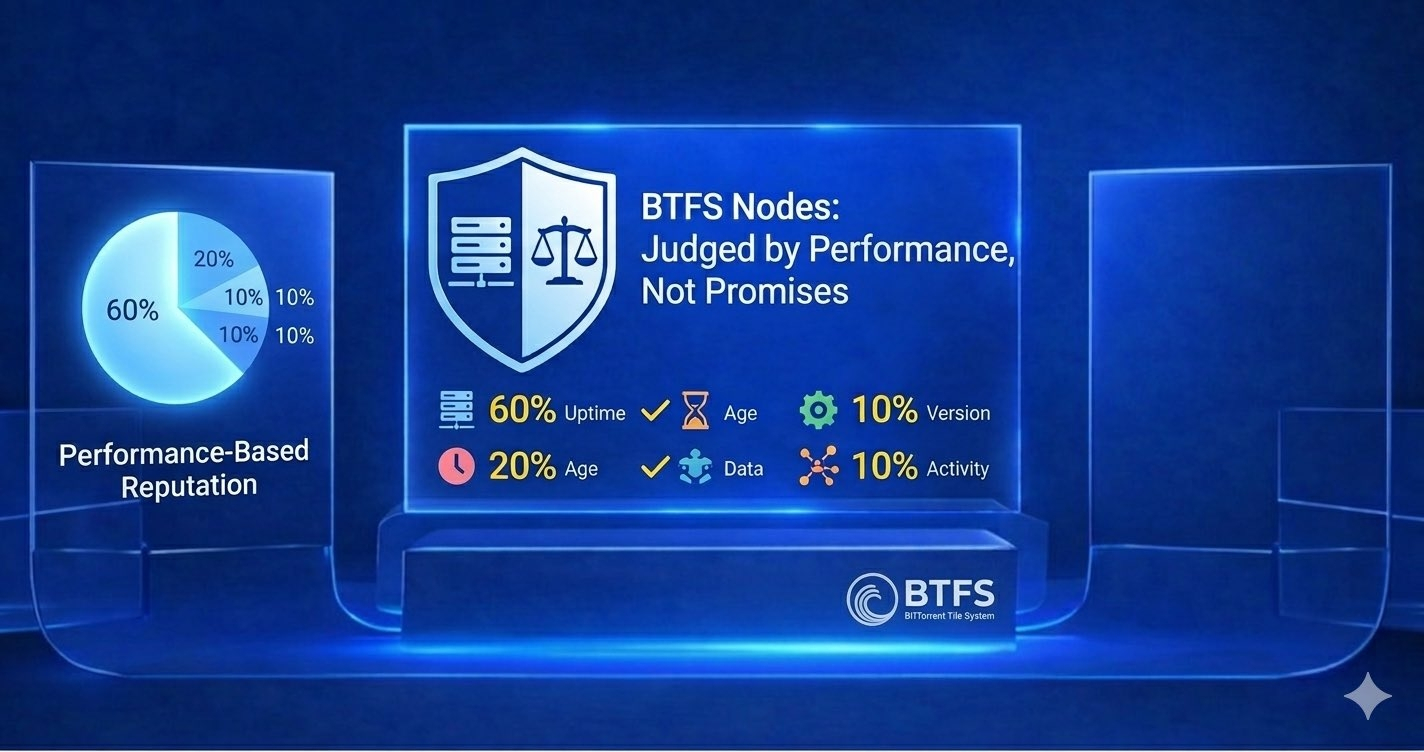
Your node in the BitTorrent File System doesn’t care about branding, hype, or what you say—it only cares about what you prove. Reputation in BTFS is not subjective; it’s calculated based on real, on-chain behavior.
How BTFS Measures Reputation
Every node is scored using clear performance metrics:
•60% Uptime → Are you consistently online and available?
•20% Age → How long have you proven reliability over time?
•10% Version → Are you keeping your node updated and compatible?
•10% Activity → Are you actively participating in network tasks?
This system ensures that trust is built through measurable actions, not assumptions.
The Core Idea: Trust = Performance
BTFS doesn’t ask:
👉 “Do you claim to be reliable?”
It asks:
👉 “Have you actually been reliable?”
If your node performs well consistently, it earns trust, visibility, and more opportunities. If it doesn’t, it naturally falls behind.
⚔️ Real-World Example: Two Nodes, Two Outcomes
🟢 Node A – The Reliable Operator
•Stays online almost always (high uptime)
•Updates regularly
•Actively participates in storage contracts
•Maintains consistency over time
👉 Result: More rewards, more contracts, stronger reputation
Node B – The Inconsistent Node
•Frequently goes offline
•Rarely updates
•Minimal activity
👉 Result: Fewer rewards, low reputation, and reduced relevance
👉 Key insight: Node B didn’t fail loudly—it simply wasn’t consistent enough to succeed.
🔗 How BitTorrent Technology Works
The foundation of BTFS comes from BitTorrent, which changed how data is shared globally.
Instead of downloading from one server:
•Files are split into small pieces
•These pieces are shared across multiple users (peers)
•You download and upload at the same time
👉 The more users participate, the faster and more reliable the network becomes.
What Makes BTFS Different
BTFS takes this idea further by turning it into a decentralized storage system:
•Files are broken into encrypted fragments
•Fragments are stored across many independent nodes
•Each file gets a unique hash (its “address”)
•The system retrieves and rebuilds files when needed
👉 No single point of failure
👉 More secure and censorship-resistant
👉 More resilient than traditional storage
🔄 Seeding: The Engine That Keeps It Alive
Seeding means continuing to share files after downloading.
Why it matters:
•Improves download speed for others
•Strengthens the network
•Rewards users who contribute
👉 BTFS builds on this idea by rewarding users who provide storage and reliability.
The Bigger Picture: A Decentralized Future
BTFS isn’t just about storage—it’s about ownership.
•Users control their data
•Storage becomes a shared economy
•Resources are distributed, not centralized
•Trust is built through performance, not authority
This is how decentralized systems scale—through participation and consistency.
🔑 Final Takeaway
In BTFS:
👉 Your node’s reputation isn’t what you claim
👉 It’s what you consistently deliver
Stay online. Stay updated. Stay active.
Because in this system, performance is everything.