
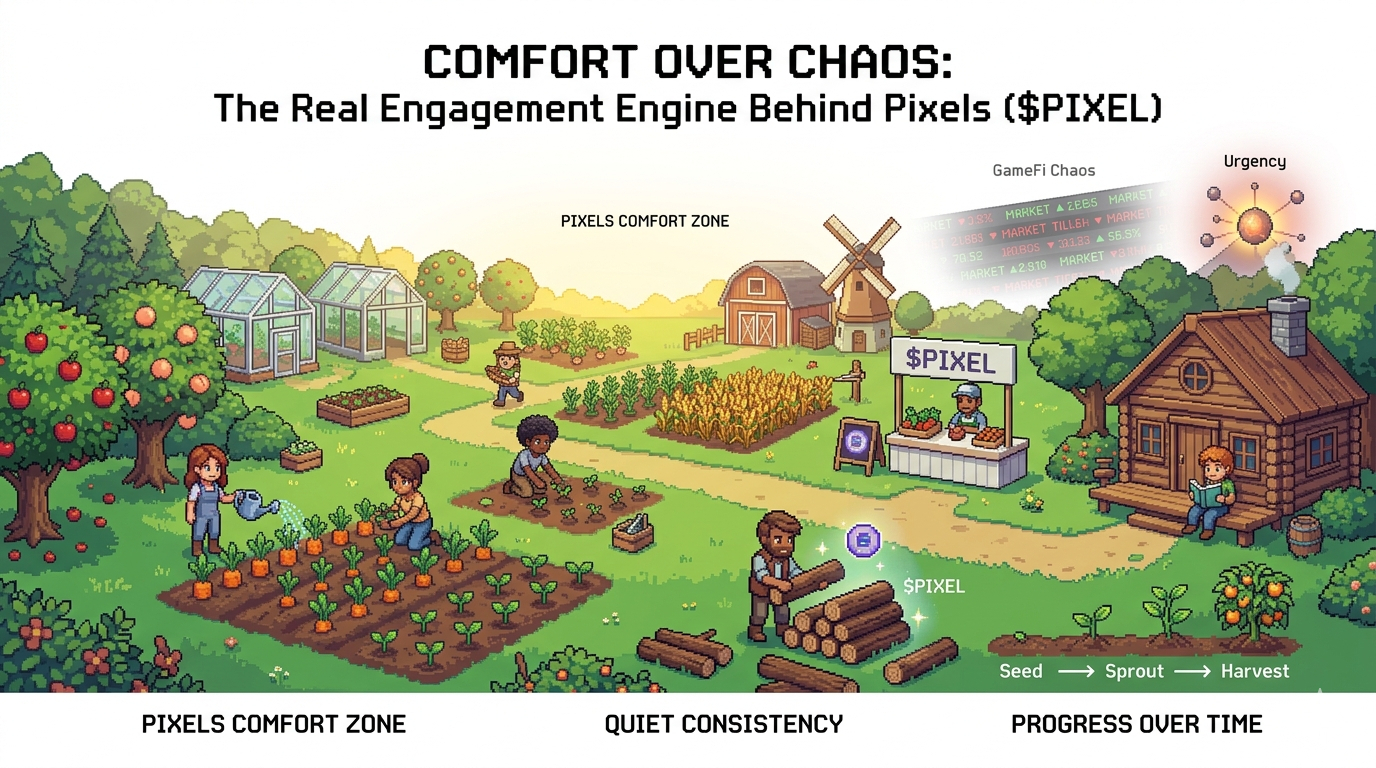
In Pixels, the first thing that stands out is not excitement, but a kind of quiet consistency that feels almost unfamiliar in today’s digital environments. Most experiences, especially in the Web3 space, try to capture attention quickly. They rely on urgency, incentives, and constant stimulation to keep users engaged. But Pixels moves in the opposite direction. It does not rush you. It does not overwhelm you. Instead, it invites you into a slower rhythm, one that feels less like a system demanding output and more like a space you can return to without pressure.
At a surface level, the mechanics are simple. You plant crops, gather resources, explore the environment, and gradually build your presence in the world. There is nothing particularly complex about these actions, and that simplicity is intentional. It lowers the barrier to entry and removes the need for constant optimization. You are not required to think about efficiency at every step. You are not pushed to maximize returns every minute. You can simply exist within the loop, and that changes the entire emotional tone of the experience.
This is where Pixels begins to separate itself from many other GameFi projects. In most cases, engagement is tied closely to rewards. Players enter because of incentives, stay while those incentives are strong, and leave when they begin to fade. The cycle is predictable. Attention is captured quickly, but it is rarely held for long. Pixels, however, seems to build its engagement differently. It relies less on intensity and more on comfort. Instead of creating urgency, it creates familiarity. Instead of pushing players forward, it allows them to settle in.
That sense of comfort is not accidental. It comes from the structure of the game itself. Farming, as a core mechanic, is inherently repetitive, but in a calming way. You perform small actions, wait, return, and see progress over time. It is a loop that does not demand constant focus, yet still provides a sense of continuity. This kind of design taps into something deeper than short-term engagement. It builds a habit of returning, not because you have to, but because it feels natural to do so.
What makes this more interesting is how that experience exists within an on-chain environment. Web3 systems are often associated with speed, speculation, and financial thinking. Every action can carry economic weight. Every decision can feel like a calculation. In many cases, this creates a layer of pressure that overrides the experience itself. The game becomes secondary to the rewards. The world becomes secondary to the market. Pixels avoids this trap by keeping its economic layer present, but not dominant.
Yes, there is a token. Yes, assets can be owned, traded, and valued externally. But these elements do not constantly demand your attention. They sit in the background, supporting the system rather than defining it. This balance is critical. When players are not forced to think about value extraction at every step, they are free to engage with the game on its own terms. The result is a softer, more natural form of interaction.
Over time, this creates a different kind of attachment. It is not driven by excitement or profit, but by presence. You begin to recognize the space, the routines, and even the subtle changes that happen as you continue to play. Progress feels less like a spike and more like a gradual shift. You do not need a major reward to feel satisfied. Sometimes, it is enough to see that your environment has improved, even in small ways.
There is also a social layer that reinforces this feeling. Players exist alongside each other, interacting in ways that are often casual and unforced. It is not a loud or highly competitive environment. Instead, it feels shared in a quieter sense. You are aware that others are present, contributing to the same world, and that awareness adds a sense of stability. A world feels more real when it is inhabited, even if those interactions are minimal.
However, beneath this calm surface, there is a more complex system at work. The simplicity of farming mechanics does not mean the overall structure is simple. Because the game operates within a broader economic framework, the meaning of each action can shift. Planting a crop might feel like a routine task, but its outcome can be influenced by factors outside the game itself. Market conditions, player activity, and token demand all play a role in shaping value.
This introduces a subtle tension. The gameplay loop remains stable, but the results it produces are not entirely predictable. The same action can carry different weight depending on the context. Sometimes it feels like pure gameplay. Other times, it feels closer to participation in an economy. This dual nature is one of the defining characteristics of on-chain games, and Pixels navigates it carefully.
It does not try to resolve this tension completely. Instead, it allows both layers to coexist. The game remains accessible and calming on the surface, while the underlying system introduces variability and depth. For some players, this adds an additional dimension of interest. For others, it remains mostly invisible. That flexibility is part of what makes the experience work.
Still, the long-term sustainability of this balance is an open question. As more players join, the dynamics of the system inevitably change. Increased activity can strengthen the world, but it can also create pressure on rewards and resources. The same loop that feels comfortable at one scale might feel different at another. This is not unique to Pixels, but it is something that every on-chain system must eventually confront.
What Pixels demonstrates, at least in its current state, is that engagement does not have to come from intensity. It can come from consistency. It can come from creating an environment that people want to return to, even without strong external incentives. In a space where attention is often treated as something to capture quickly, this approach feels almost counterintuitive.
And yet, it may be more durable.
Because in the end, the strongest signal is not how many users arrive, but how many choose to stay. Pixels does not try to dominate attention. It holds it, gently, over time. And in a digital landscape defined by speed and noise, that kind of quiet persistence may be its most valuable feature.
@Pixels #Pixels $PIXEL #pixels
