There’s a familiar moment in most on-chain games where everything still looks busy, but something underneath has already started to fade. Players are active, actions are being taken, rewards are still flowing but the intention has quietly shifted. It’s no longer about staying in the world. It’s about timing the exit. When I started looking closely at Pixels, that was the tension I kept coming back to. Not whether the game works, but whether the activity inside it actually means anything beyond the reward cycle.
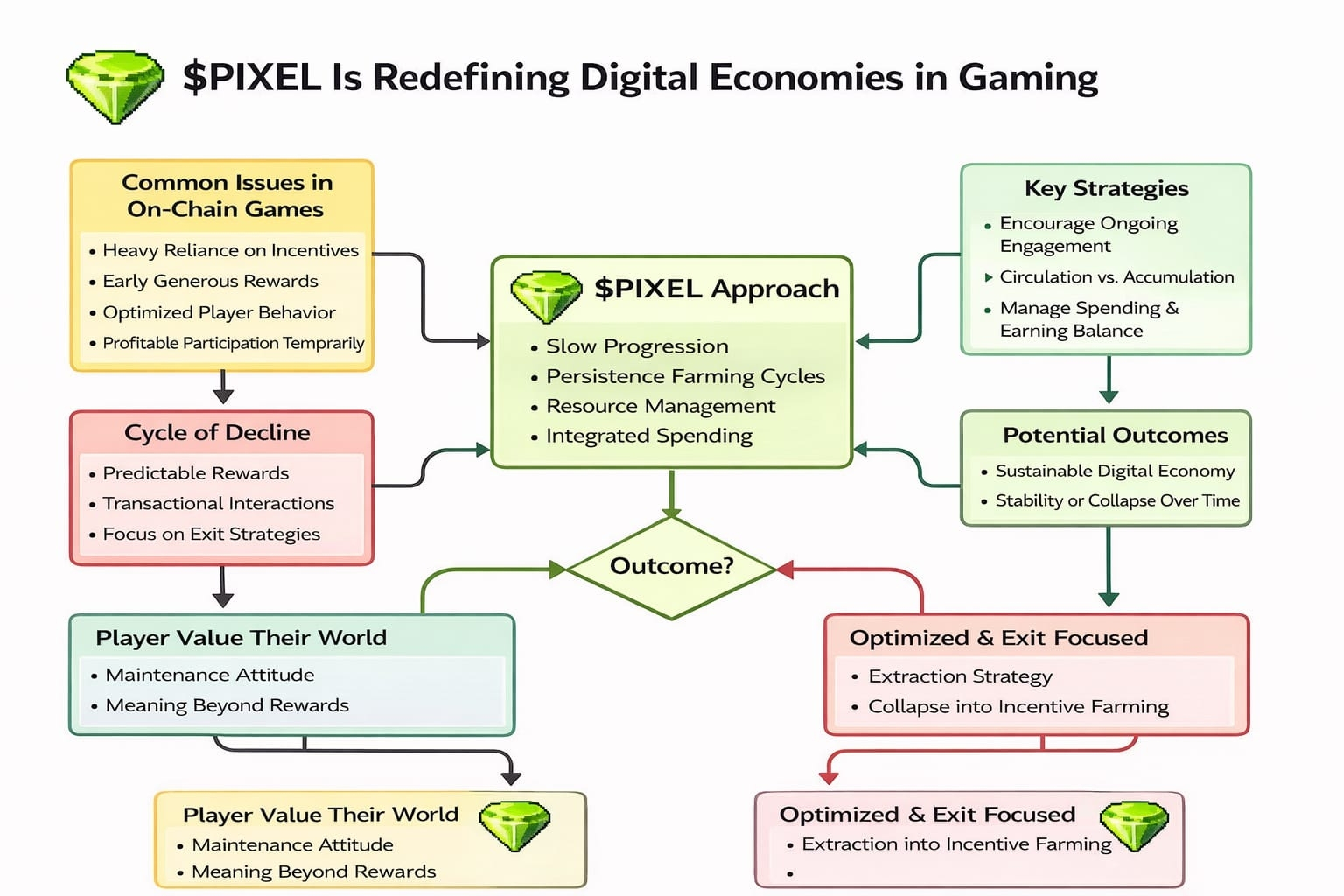
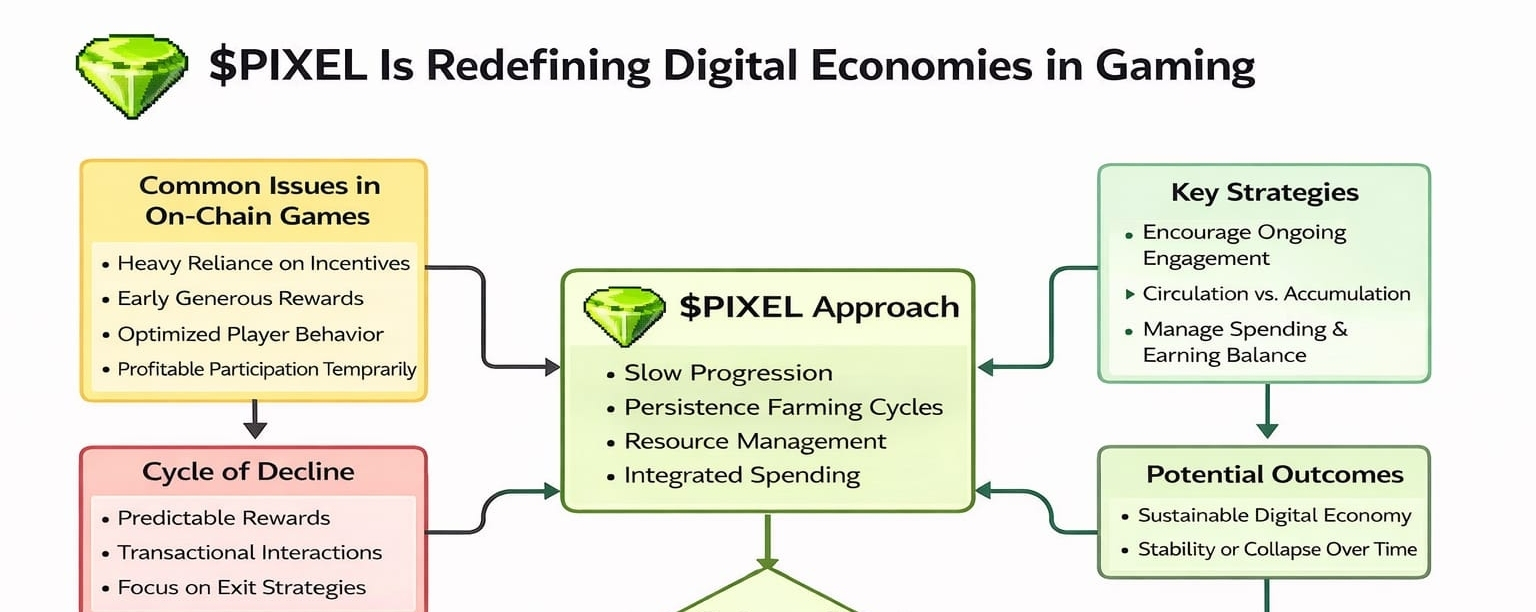
This isn’t a Pixels specific problem. It’s structural. Most token-based games lean heavily on incentives to bootstrap engagement. Early participation is rewarded, emissions are generous, and systems are designed to feel productive from the start. But that design often carries a hidden trade-off. As rewards become predictable, behavior becomes optimized. Players don’t explore they calculate. They don’t stay because the system is interesting; they stay because it’s temporarily profitable. And once that profitability weakens, so does the participation. I’ve seen this pattern repeat often enough that I don’t really take early growth at face value anymore.
What makes this difficult is that games aren’t just economies. They’re environments where time, attention, and meaning intersect. If the economic layer becomes too dominant, everything else starts to flatten. Crafting becomes routine. Progression becomes mechanical. Even social interaction starts to feel transactional. The system keeps running, but it loses its sense of place. That’s usually when you start to see the slow decline not a collapse, but a thinning.
Pixels seems aware of that risk, at least in how it structures its core loops. It doesn’t position itself as a fast-moving earning engine. Instead, it leans into persistence farming cycles, resource gathering, land management, and incremental progression. On paper, this slows things down. You’re not constantly extracting value; you’re maintaining a system over time. There’s an attempt here to make activity feel ongoing rather than opportunistic.
I find that approach interesting, but also incomplete on its own. Slowing players down doesn’t automatically make them care. It just changes the pace of interaction. The real question is whether those slower loops actually build attachment, or if they simply delay the same extractive behavior. Farming, crafting, and land ownership can create depth, but only if players start to value what they’re building beyond its token output.
That brings me to $PIXEL itself, which sits at the center of this balance. It’s not just a reward mechanism; it’s also a tool for participation. Players earn it through activity, but they’re also expected to spend it on upgrades, crafting, and maintaining their place in the world. In theory, this creates circulation rather than accumulation. In practice, it’s a delicate system to manage.
If earning outpaces spending, inflation creeps in. If spending feels forced, players disengage. If rewards are too low, activity drops. There isn’t a stable default here just a continuous adjustment between competing pressures. And what complicates it further is that player behavior doesn’t stay static. As soon as patterns emerge, they’re optimized. What starts as a balanced loop can quickly turn into an extraction strategy if incentives aren’t carefully managed.
I don’t think Pixels solves this problem outright, but I do think it’s trying to approach it more deliberately than most. The emphasis on persistence, slower progression, and integrated spending loops suggests an awareness that economies need friction to remain meaningful. Without that friction, everything accelerates toward burnout.
Still, the long-term outcome depends less on design intent and more on how players respond over time. If the majority treat it as a system to be optimized and exited, no amount of structural care will fully hold it together. But if even a portion of the player base begins to engage with it as an environment something to maintain rather than extract then there’s a chance for stability.
For me, Pixels feels less like a finished solution and more like an ongoing test. It’s asking whether a digital economy can stay active without collapsing into pure incentive farming. That’s not something you can answer quickly. It only becomes clear over time, as the system either holds its shape or slowly drifts into the same patterns we’ve already seen elsewhere.
Right now, I’d describe it as cautiously structured, but still exposed to the same fundamental pressures. The difference is that it seems to recognize those pressures, which is more than most systems do at this stage.