
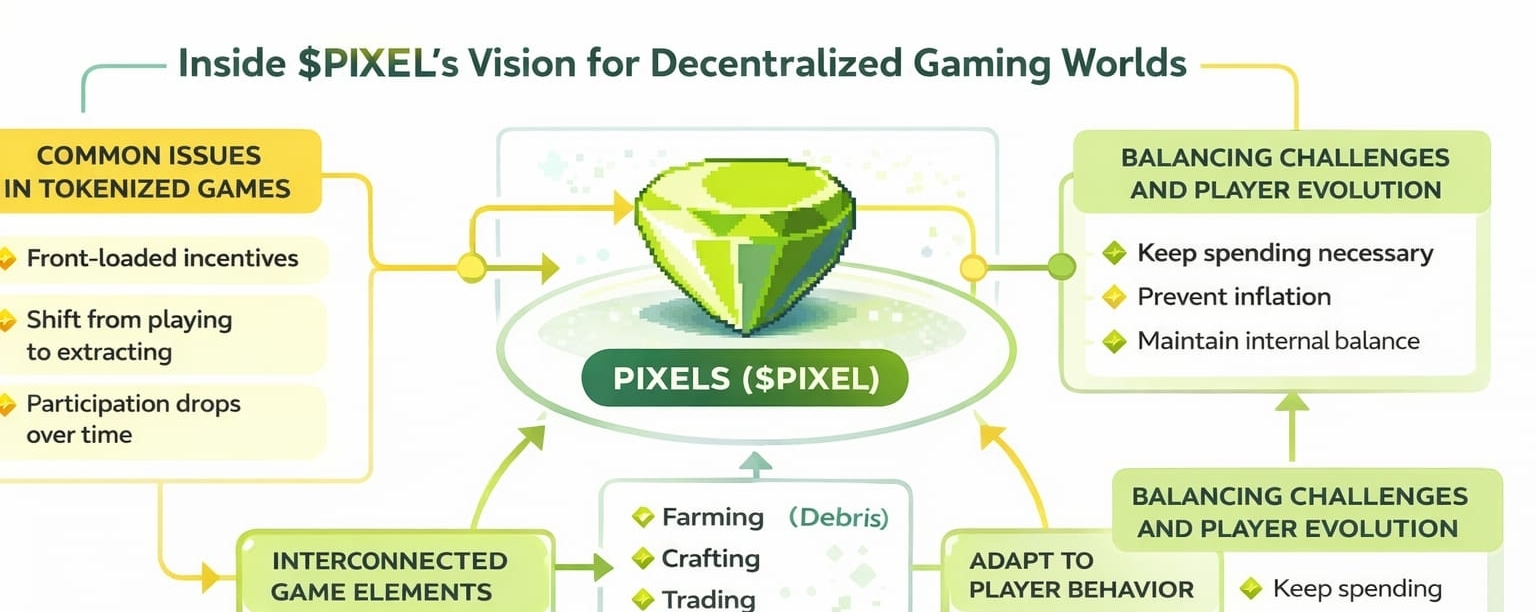
Most digital worlds look alive at first glance. There’s activity, movement, trading, constant interaction. But if you watch long enough, a pattern starts to show. The energy is often tied less to the world itself and more to the rewards flowing through it. When those rewards slow down, everything else tends to follow. That tension between gameplay and economic design is where systems like Pixels ($PIXEL) get interesting, and also where they tend to break.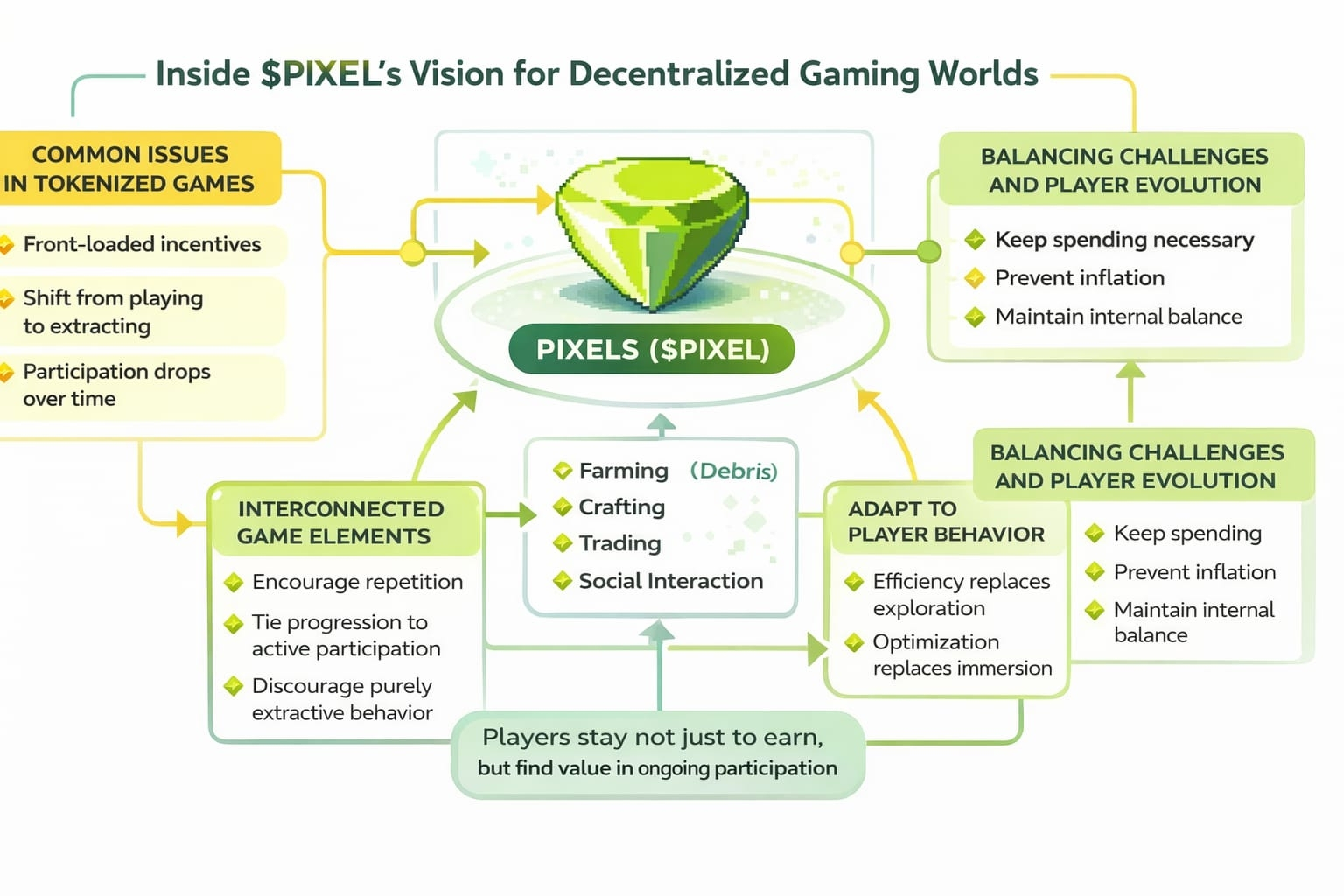
This isn’t unique to one project. Tokenized games have been circling the same structural problem for a while. Incentives are front-loaded to attract users, emissions expand to keep them engaged, and behavior gradually shifts from playing to extracting. At that point, the system is no longer sustained by interest in the game itself, but by the expectation of return. Once that expectation weakens, participation often drops faster than anyone anticipates. It’s not a failure of design in isolation, but more a reflection of how quickly economic gravity takes over in open systems.
That’s the backdrop I keep in mind when looking at Pixels. On the surface, it presents itself as a farming and social simulation environment, built around land, resource cycles, crafting, and interaction between players. None of that is new on its own. What stands out more is how those elements are arranged to encourage repetition without feeling purely mechanical. The idea seems to be that progression is tied to ongoing participation rather than one-time optimization, which is a subtle but important distinction.
Still, the presence of PIXEL at the center complicates things. The token isn’t just a reward; it’s also part of the system’s internal circulation. Players earn it through activity, spend it across different in-game functions, and indirectly shape its flow through their behavior. That creates a balancing act that is harder than it looks. If earning feels too easy, the system risks inflation and reduced perceived value. If spending doesn’t feel necessary or meaningful, accumulation becomes the dominant strategy, which usually leads to extraction.
What makes this particularly fragile is that player behavior doesn’t stay static. Early participants tend to explore, experiment, and engage with the system as intended. Over time, though, patterns emerge. Efficiency replaces curiosity. Optimization replaces immersion. Systems that don’t adapt to that shift often lose their internal balance, even if the original design seemed reasonable.
Pixels appears aware of this, at least in how it leans on interconnected loops rather than isolated rewards. Farming feeds crafting, crafting feeds trade, and social interaction adds another layer of dependency. In theory, this creates friction against purely extractive behavior. In practice, it depends on whether those loops remain meaningful once players start pushing them to their limits.
I don’t think the question is whether PIXEL can function inside a game. It clearly can. The more difficult question is whether the system around it can stay coherent as participation scales and behavior evolves. Most don’t.
If Pixels holds up, it will likely be because players find value in staying, not just earning. And that’s a much harder condition to maintain over time than it sounds.